

Executive Summary
Texas barred its environmental regulator from approving new data center permits on 21 September, shutting the last open door for a state that had become the country’s fastest-growing data center market. ERCOT’s own numbers explain the pause. Developers have filed 445.8 GW of large load interconnection requests. The grid has observed just 5.9 GW of that load actually drawing power.
The distance between those two figures is the story. A request is a study, not a substation, and 321 GW of the queue has no study submitted at all. Two audits now gate every project, one on power and one on water, and reporting says the power audit could run into December. For any team that penciled AI capacity into Texas, schedule risk is now the deciding variable.
The fastest way to add AI capacity in the United States just got slower. Texas stopped issuing new data center permits on Monday. The Texas data center permit freeze arrived in two steps, and the second step is the one that closes the door.
Gov. Greg Abbott directed the Texas Commission on Environmental Quality to approve nothing until the Electric Reliability Council of Texas and the Texas Water Development Board finish audits of the facilities queued to connect to the state grid.
“Simply put, Texans must come first,” Abbott said. “Data centers must pay their own way, protect our grid and water, and complete the ERCOT and TWDB audits.”
That is the second door. In August, Abbott had already paused new grid interconnections and ordered the power audit. Now environmental permits go dark too. The order turns what was already a de facto moratorium into a formal one, and state agencies owe the governor a compliance update by 19 October.
A queue entry is not a substation
The numbers behind the freeze are the part worth reading twice. Abbott’s office said in August that ERCOT was weighing more than 474 GW of connection requests, over five times the state’s record peak demand, with roughly 90 percent of them from data centers.
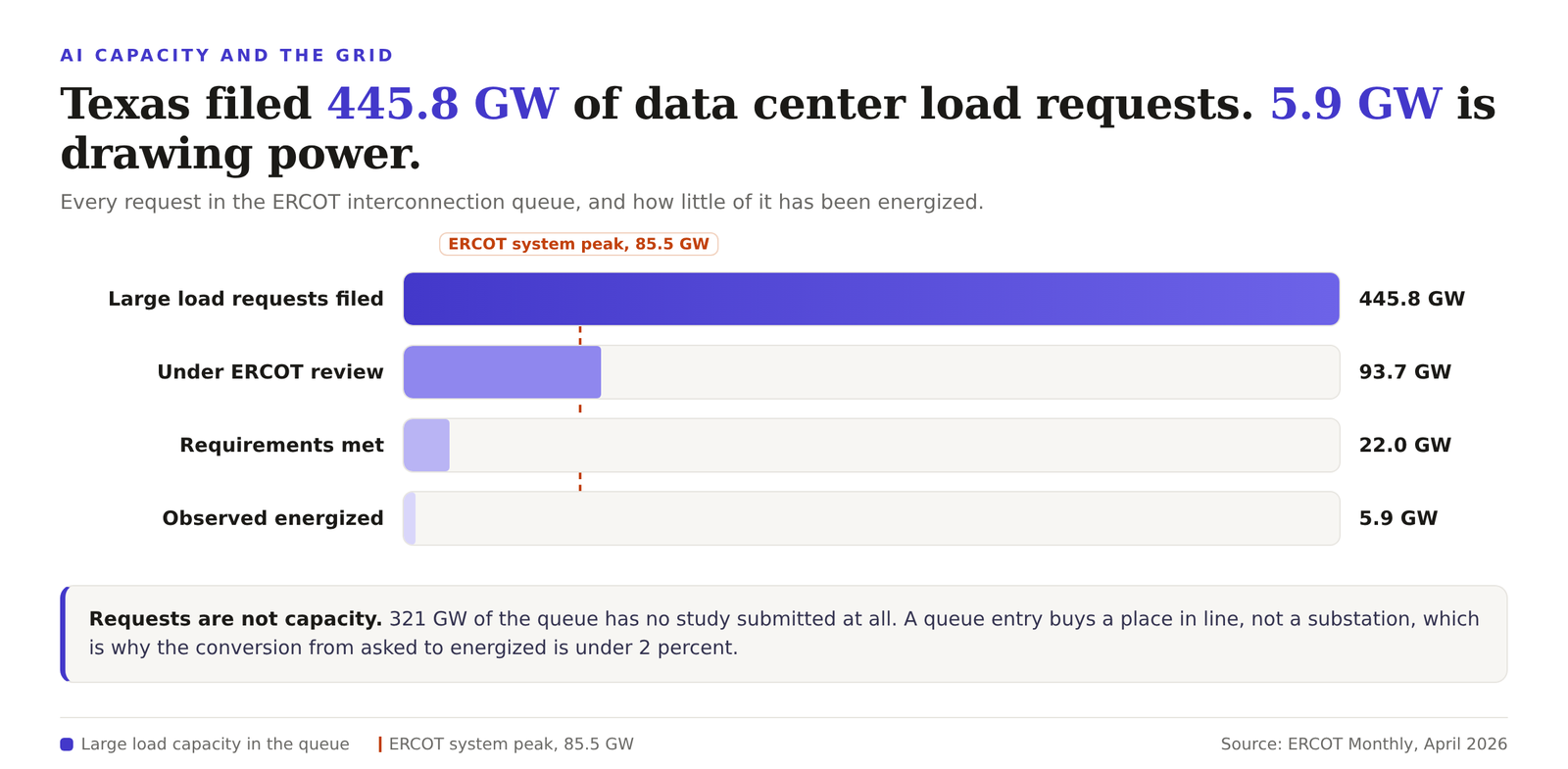
ERCOT’s own planning documents are blunter still. Its April monthly report counted 445.8 GW of large load applications through 2033. Of that, 321 GW had no study submitted at all. Another 93.7 GW sat under review. Only 22 GW had met the interconnection requirements, and ERCOT had observed 5.9 GW energized and drawing power. The same report puts the system peak at 85,508 MW and projects 367,790 MW of demand by 2032.
Read that funnel and the policy writes itself. A developer files a request, not a facility. A queue entry buys a place in line, not a substation. When 445.8 GW of requests stand against an 85.5 GW peak, the grid operator cannot say yes to everything, and the state has started choosing which projects get to try.
Two audits now gate every project
The pause is not an outright ban. Facilities already under construction and projects holding signed interconnection agreements keep moving. Everything behind them waits on two reviews. ERCOT’s power audit is the longer one and reporting points to December. The water board is the second gate, and Abbott has pushed it to name developers who withhold usage data.
That timeline is the practical problem. Texas had been the easy answer for siting inference and training capacity. Cheap power, fast permits, friendly politics. Two of those three just changed, and the third is now conditional. A three month audit is not a three month delay. It is a design freeze on where the workload lives.
This is not only a Texas story either. Governors in Virginia, Nevada and California moved on data center power and water rules in the same week. The binding constraint on AI capacity is shifting from chips to the permission to draw power, and the permission is now political.
Plan for a second jurisdiction now
If your AI roadmap assumes Texas capacity in 2027, treat the rest of this year as unbooked. Model two siting paths and price the audit risk into both. Then look at what you already own. Existing grid connections, existing buildings and permits that are already in hand just became the scarce asset, and they sit inside your own walls.
Three questions to run against your own plan. Where does your next 10 MW of AI load physically connect, and is that interconnection already approved? Which workload commitments can survive a six month permitting slip without breaching a customer SLA? If the cheapest jurisdiction freezes permits, which site is the named alternative, backed by a signed agreement rather than an intention?
Related reading. Data Center Power Procurement Moved Into the IT Budget. The Hypervisor, the Kernel, the Licence and the Grid All Moved in One Week.
Get the next one before it is old news
Independent analysis of cloud-native infrastructure, Kubernetes and data center economics. No vendor spin.
[…] The queue explains the pause. ERCOT counted 445.8 gigawatts of large load applications through 2033. Of that, 321 gigawatts had no study submitted, and only 22 gigawatts had met the requirements. ERCOT had observed 5.9 gigawatts energized, against a system peak of 85,508 megawatts. A queue entry buys a place in line, not a substation. We worked through the funnel and the schedule risk. […]
[…] reading. Our report on how Texas froze data center permits against a 445.8 gigawatt queue, and why data center power procurement is now an IT […]
[…] reading. Texas paused new data center permits pending a grid audit, the same permitting pressure arriving through a different door. Our AI data centre power […]