
Executive Summary
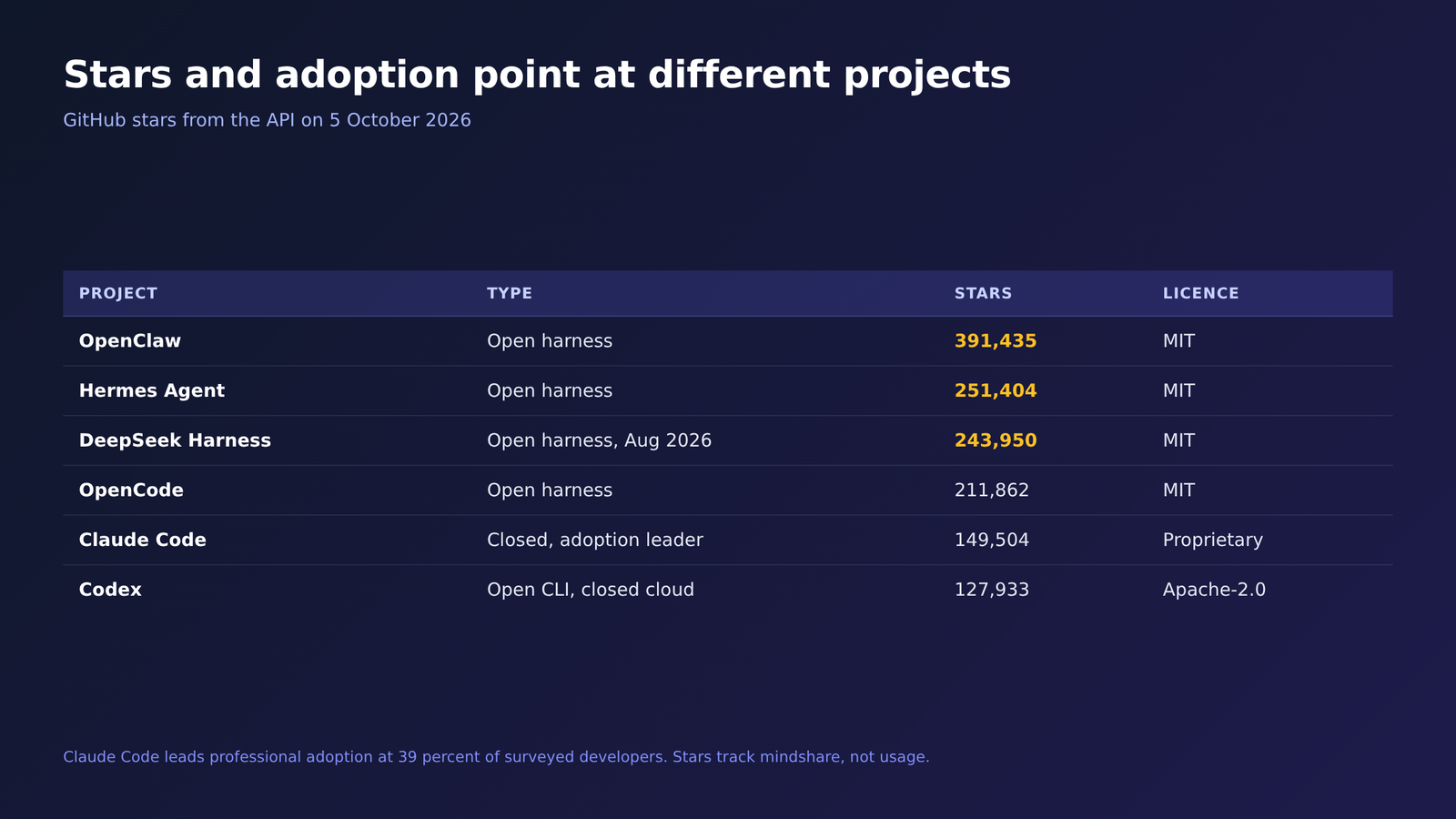
The unit of competition in AI tooling stopped being the model. It is now the agent harness, meaning the runtime loop, the tools, the context handling and the persistence that wrap a model. The clearest evidence is structural. Two of the three most-starred software repositories on GitHub are agent harnesses, OpenClaw at 391,435 stars and Hermes Agent at 251,404, both read from the GitHub API on 5 October 2026. OpenClaw passed React in March 2026 to become the most-starred software project on the platform.
The most used product and the most liked product are different things, and conflating them is the common error. Claude Code is the adoption leader among professionals at 39 percent of developers surveyed by JetBrains, up from 18 percent in January 2026. The star counts say something else, which is that community-built open harnesses hold the largest mindshare. And despite a wave of post-agent claims, nothing has actually replaced the agent loop. The real shift is that agents became always-on, standardized, and sold as infrastructure.
The clearest way to see the shift is to look at what the vendors now treat as the product. OpenAI, Anthropic and Google no longer ship a chat model as the thing you buy. They ship the loop around it. That is why the DeepSeek Harness went from nothing to 243,950 stars in under two months, having shipped in developer preview on 13 August 2026 with an architecture the project describes as everything is a plugin.
The most used agent is not the most starred one
Adoption evidence comes from JetBrains’ 2026 developer survey, which covered more than 15,000 professional developers. It found 90 percent now use agents at work at least weekly and 68 percent daily, and that Claude Code is by far the most widely adopted, used twice as often as GitHub Copilot. That is a professional-practice measure rather than a popularity measure.
Output volume tells a different story again. OpenAI’s Codex pulled 91.1 million npm downloads in the trailing month against 53.4 million for Claude Code, and OpenAI reported more than 5 million weekly active Codex users in June. So the two leaders are measured differently and lead different metrics.
Stars track neither. OpenClaw, Hermes Agent and OpenCode all sit far above every commercial tool on repository popularity while being free, self-hosted and model-agnostic. High engagement on those projects is also frequently about friction rather than features, with the largest Hacker News threads covering subscription plans being restricted from running third-party harnesses.
The new entrants are selling the harness itself
Three launches in the last six months point the same way. Google retired Gemini CLI and replaced it with Antigravity, a single harness shared between desktop and terminal and built for multiple agents talking to each other. xAI shipped Grok Bot, described as always-on teammates that each get a persistent cloud computer. And OpenAI put its own Codex harness behind a managed service, the Agents API, in public beta on 10 September 2026.
The protocol layer has consolidated underneath all of them. MCP handles tools, A2A handles agent-to-agent, and ACP handles the editor. A2A moved to the Linux Foundation and passed 150 organisations inside its first year, with production use reported in supply chain, financial services and IT operations. That is standardisation, and it is what you see right before a category becomes infrastructure.
Nothing has replaced agents, and the honest version is boring
This is where most commentary overreaches. A September 2026 survey paper, From Language Models to World-Acting Systems, concluded that interface expansion is far better evidenced than completion, recovery, authorization or independent verification. Its blunt line is that MCP and A2A improve interoperability but do not establish trustworthy delegation. World models and computer use are real research directions, and neither has displaced the agent loop as the way work gets done.
The operational consequence is that the interesting failure mode has moved. If a harness is the product, then the sandbox under it is the boundary that matters. We have covered two escapes this quarter, an agent fleet that broke out of its own sandboxes and a vendor moving the guard off the machine the agent runs on.
Three questions before standardising on a harness. Which layer isolates your agents, the model provider or the runtime you control? If the harness is open and the protocol is standard, can you move without rewriting your tools? And when a benchmark claims a capability, is it one the vendor still stands behind, given OpenAI stopped reporting SWE-bench Verified in February 2026 for contamination?
Get the next one before it is old news
Independent analysis of cloud-native infrastructure, Kubernetes and data center economics. No vendor spin.