

Executive Summary
The Department of Energy’s Office of Electricity named 31 projects across 26 states on 24 September to add more than 23 gigawatts of grid capacity without building a new transmission corridor. The work will receive $5.25 billion in total, $1.9 billion in federal funding and $3.35 billion in recipient cost share, and the department says it reaches about 100 million people.
Two mechanisms carry it. Reconductoring replaces the conductor strung between existing towers with a higher capacity one, and grid-enhancing technologies such as sensors and dynamic line rating let an operator move more power through conditions that a static rating leaves unused. Both skip the multi-decade approval cycle a new corridor needs. The relief is real, and it is still a fraction of the load queue the projects sit beside.
The cheapest new gigawatt in the United States sits on a line that already exists. The Department of Energy’s Office of Electricity named 31 projects across 26 states on 24 September to add more than 23 gigawatts of capacity without building a new transmission corridor. The projects will receive $5.25 billion in total, $1.9 billion in federal funding and $3.35 billion in cost share from the recipients.
The mechanism is the story. Grid capacity is not only a question of how much generation exists. It is a question of how much the wires between generation and load can carry, and how much of that capacity an operator is allowed to use.
The wire stays. The conductor changes.
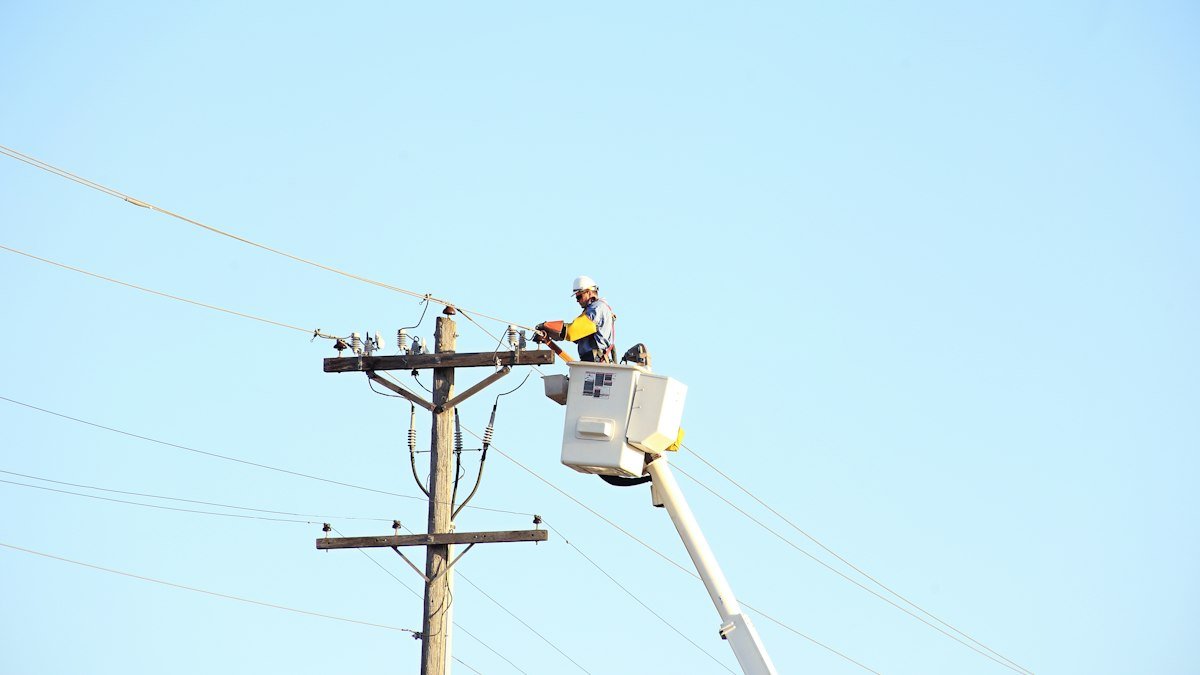
Reconductoring is the first mechanism. It swaps the conductor strung between existing towers for a higher capacity one. The towers, the right-of-way and the permits stay where they are. Recipients will reconductor or rebuild more than 1,500 miles of transmission line.
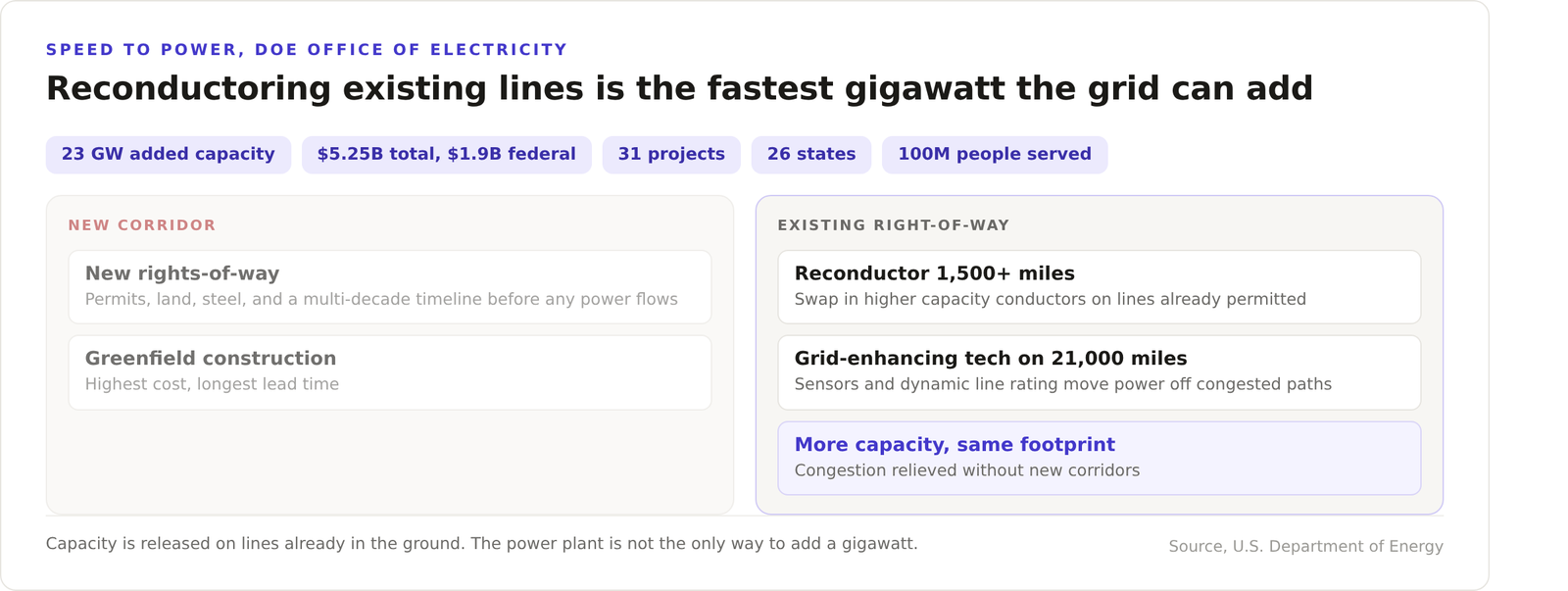
The second is a family of grid-enhancing technologies. Sensors and dynamic line rating measure real conditions, such as wind and temperature, and let an operator push more current through a line than a fixed rating allows, or steer power off a congested path. The department expects them across nearly 21,000 miles of line.
Both routes skip the bottleneck that has stalled grid expansion. A new corridor needs land, steel and a multi-decade approval cycle before a single electron moves. Reconductoring uses a right-of-way that already cleared that process. The department groups the effort under its Speed to Power initiative, and describes the approach as a way to bypass those timelines.
Capacity in months, not decades
The scale is the argument. More than 23 gigawatts of added capacity is roughly what a cluster of AI campuses asks for, and the department says the projects serve about 100 million people. The funding runs through the Grid Resilience and Innovation Partnerships program.
Set that against the queue it sits beside. The Electric Reliability Council of Texas was weighing 445.8 gigawatts of large load requests against a system peak of 85.5 gigawatts. A 23 gigawatt national lift does not clear one state’s backlog. What it does is relieve congestion on the lines that already feed the campuses under construction, which is often the difference between a project energizing on schedule and a project waiting on a study.
Relief is not supply
Here is the part to hold onto. Getting more out of existing wires is not the same as building more generation. It buys headroom, and headroom is what an operator needs to accept a new load without waiting on a new plant. It does not create a megawatt of firm supply.
There is a quieter reason capacity sits unused in existing rights-of-way. Utilities earn a return on new construction, and a reconductored line earns less. That incentive gap is why grid-enhancing technologies have been slow to spread even where the engineering is settled. Federal cost share is one way to close it.
Three questions for your own siting work. If your next campus lands in a constrained region, how much of its power could come from reconductored lines rather than a new interconnect? Does your utility have a dynamic line rating program you can join? And if generation is years out, what does your schedule look like at 23 gigawatts of relief instead of zero?
Related reading. Our report on how Texas froze data center permits against a 445.8 gigawatt queue, and why data center power procurement is now an IT problem.
Get the next one before it is old news
Independent analysis of cloud-native infrastructure, Kubernetes and data center economics. No vendor spin.
[…] coverage of the 23 gigawatts Washington is buying out of existing wires makes the same point from the other direction, and the battery-before-chip shift shows what happens […]
[…] is the place to start. Our look at why AI factories buy batteries before chips and the grid upgrades behind new capacity covers the supply […]