

Executive Summary
On 29 September 2026 the President signed Executive Order 14434, titled Inaugurating the Era of Super Intelligence. It directs the federal executive branch to use Super Intelligence and SI in place of Artificial Intelligence and AI in correspondence, websites, reports and policy documents, and says the branch will not acknowledge the older terms in any applicable setting. The Federal Register published it on 2 October as 91 FR 63129.
The clause almost nobody has quoted is Section 3. The order defines Super Intelligence as, in its own words, the technologies and systems encompassed by the term artificial intelligence as defined in section 9401(3) of title 15 of the United States Code. That is the 2020 National AI Initiative definition, unchanged. Superintelligence is an established term of art meaning a system that exceeds human capability. This order does not require that, does not test for it, and sets no threshold of any kind. A real federal definition is only proposed, due within 60 days.
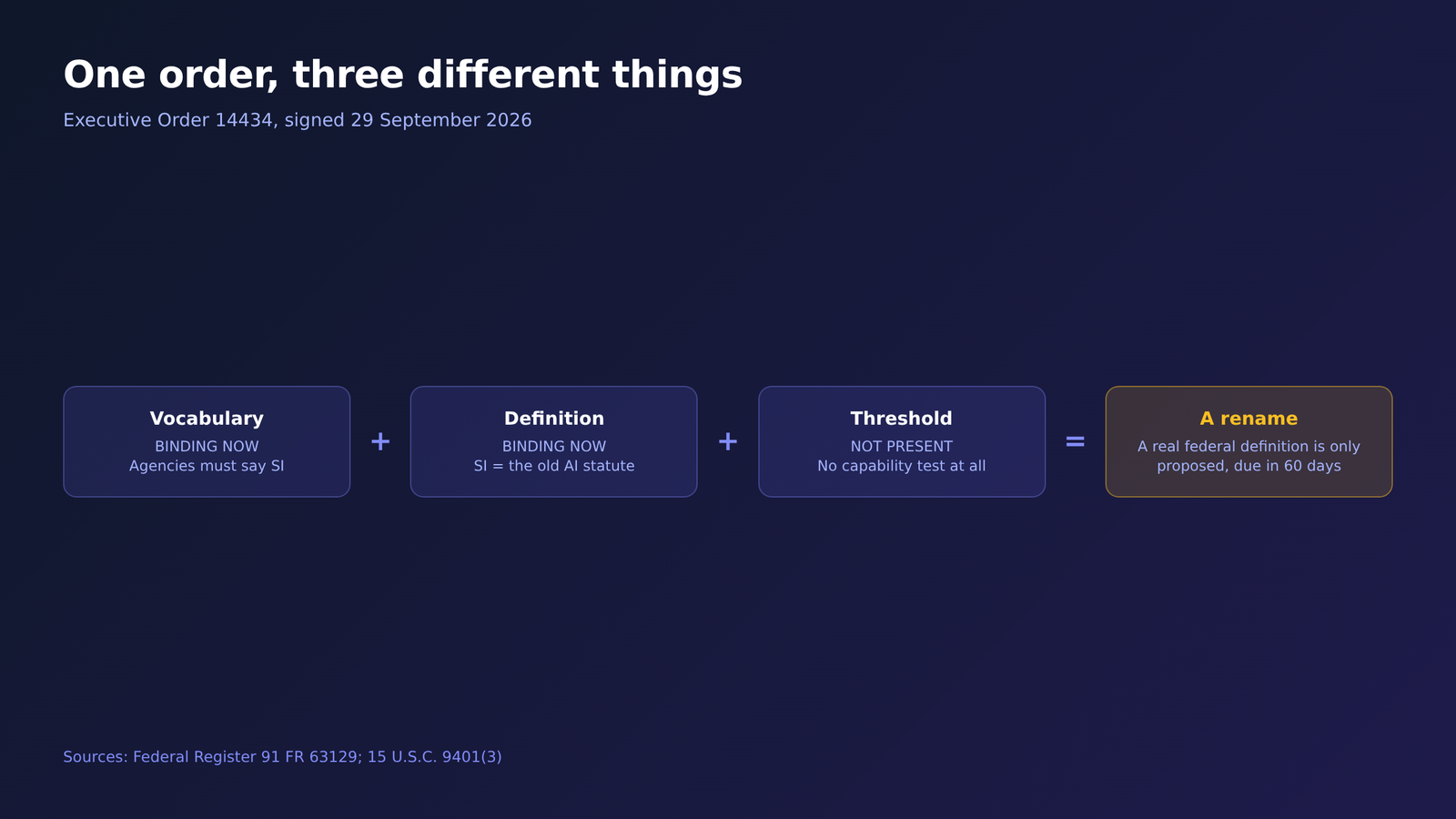
The gap between the headline and the text is the whole story. A government can rename a category without changing what falls inside it, and that is what happened here. The order as published does three separate things, and they are easy to collapse into one.
The order renames the term and then reuses the old definition
First, it mandates vocabulary. Section 2 directs agencies to use Super Intelligence and SI in official correspondence, public communications, websites, reports and policy documents. Section 1 goes further and states the executive branch will not acknowledge the usage of Artificial Intelligence and AI in any applicable setting.
Second, it fixes an identity. Section 3(a) says the terms Super Intelligence and SI mean the technologies and systems encompassed by artificial intelligence as defined in 15 U.S.C. 9401(3). That statute describes a machine-based system that makes predictions, recommendations or decisions. Nothing in it mentions human-level capability, autonomy, or a frontier threshold. So for the purposes of this order, the new term and the old term point at exactly the same set of systems.
Third, it asks for a real definition later. Section 3(b) gives the Assistant to the President for Science and Technology 60 days to submit proposed legislative language establishing a federal definition, including an assessment of whether it should modify, expand upon, or supersede the existing one.
Nothing here regulates a single private company
The order binds the executive branch’s own vocabulary. Section 4(c) creates no private right of action, and Section 2(b) says nothing requires altering previously issued regulations, contracts, grants or historical records. Counsel reading it carefully, including Wiley, reached the same place. There is no export control change, no testing mandate, no liability shift and no new procurement rule in this instrument.
Safety sits in a separate and voluntary document signed the same day, the White House Accord on Super Intelligence, in which Google, Anthropic, Meta, OpenAI, xAI and Nvidia commit to internal controls and independent audits. It carries no enforcement mechanism, and the word Super Intelligence appears only in its title.
The measurable reactions have been branding, not compliance. Slovenia’s .si registry reported a surge in registrations, and Elon Musk said he would rename his AI arm. Critics concentrated on the one point that matters, that renaming a technology does nothing to the risk it carries.
The real change arrives on 28 November, or it does not
The 60-day clock makes the proposed federal definition due in late November. If it becomes law, every statute that references artificial intelligence would need conforming amendments, and that is where actual obligations would move. Until then the two terms are aliases, and the practical risk is administrative. Compliance teams that grep contracts and solicitations for AI will miss documents that say SI.
Three questions worth asking this quarter. Does your regulatory watchlist track the term or the statute? If a federal solicitation says SI, will your intake process recognize it? And if the definitions diverge in November, which of your agreements were written against the older one?
For where AI workloads physically run and who can audit that, see our workload sovereignty reference and the gap in how countries disclose AI compute.
Get the next one before it is old news
Independent analysis of cloud-native infrastructure, Kubernetes and data center economics. No vendor spin.