

Executive Summary
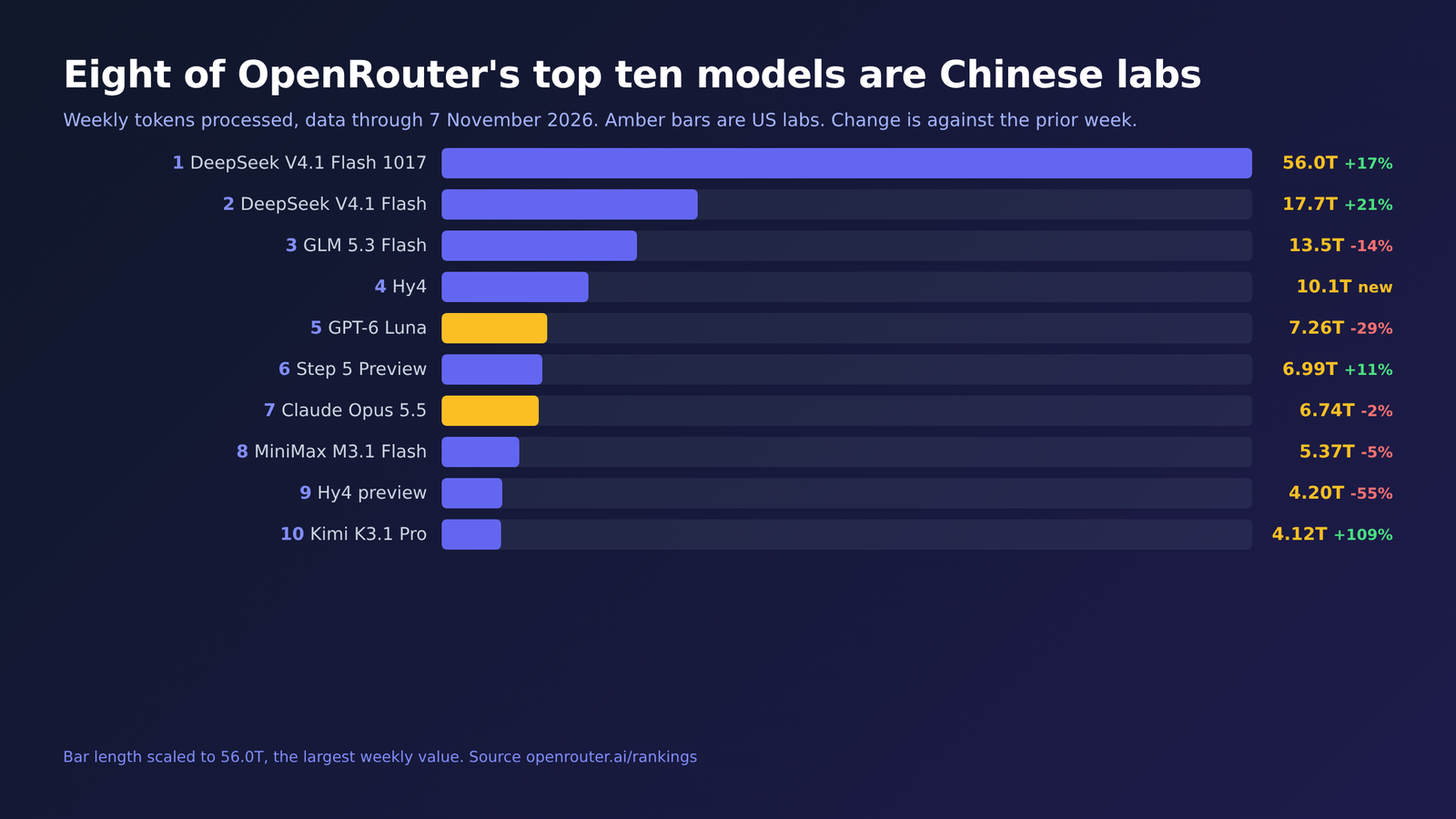
In the week OpenRouter measured through 7 November, eight of its ten most used models came from Chinese labs. The more useful number sits inside Tencent. Hy4 entered the board at fourth with 10.1 trillion tokens, while the open weight Hy4 preview, the only Hy4 checkpoint on Hugging Face, fell 55 percent to 4.2 trillion. One lab, one family, two directions in seven days.
Moonshot ran the opposite test and passed. Kimi K3.1 Pro went up on Hugging Face this week and its served tokens rose 109 percent to 4.12 trillion, into tenth. Publishing weights cost Moonshot nothing in demand. Withholding them cost Tencent nothing either, and that is the part buyers should sit with, because the exit a self hosted checkpoint offers is now one release behind the flagship it was meant to replace. The weights are a distribution choice now, not a commitment.
Eight of the ten are Chinese, and the split inside Tencent matters more
DeepSeek V4.1 Flash 1017 processed 56 trillion tokens in the week, up 17 percent, and the older DeepSeek V4.1 Flash added 17.7 trillion, up 21 percent. Z.ai’s GLM 5.3 Flash held third at 13.5 trillion, down 14 percent. Tencent’s Hy4 arrived at fourth with 10.1 trillion as a new entry. The top four slots belong to three Chinese labs.
The rest of the table reads GPT-6 Luna at 7.26 trillion, down 29 percent, Step 5 Preview at 6.99 trillion, up 11 percent, Claude Opus 5.5 at 6.74 trillion, down 2 percent, MiniMax M3.1 Flash at 5.37 trillion, down 5 percent, Hy4 preview at 4.2 trillion, down 55 percent, and Kimi K3.1 Pro at 4.12 trillion, up 109 percent.
Eight of those ten come from Chinese labs. The two that do not, GPT-6 Luna and Claude Opus 5.5, both lost ground in the same week the top two grew by 17 and 21 percent. One week is not a trend, and OpenRouter traffic is not all AI traffic. But the board is the only public measure of what developers pay for at inference time, and it has stopped being a Western table with a few Chinese guests.
The checkpoint you can download is now the previous model
Tencent put Hy4 out on 4 November and its own notes said the weights would follow in the coming days. Four days later the tencent organization on Hugging Face returns twelve newest repositories and no Hy4 checkpoint. The newest is a speculative decoding drafter for Alibaba’s Qwen3.8-27B, posted on 7 November. The only Hy4 checkpoint anyone can hold is still the August preview, and that one handles text only.
Demand did not vanish. Hy4 preview still served 4.2 trillion tokens last week. It served 55 percent fewer than the week before while the closed flagship went from unlisted to fourth. Tencent’s traffic did not leave Tencent. It left the file. We traced the same gap two days ago when Hy4 sat second on the daily board with nothing to download, and the direction has not changed, only the size.
That matters to anyone sizing GPU capacity. A checkpoint you can host is a hedge against a price change, an endpoint withdrawal, or an export rule that lands on a Tuesday. When the hedge runs one release behind the model your team wants, it stops being a fallback and becomes a side project. The hosted version also carries a discount Tencent said ends on 31 December, so the cheap number has a shelf life whether or not the weights ever appear.
Moonshot shipped the weights and doubled its served tokens anyway
Kimi K3.1 Pro is a 2.8 trillion parameter mixture of experts with 104 billion active per token. Moonshot’s card lists 896 experts, 16 selected plus two shared per token, 69 KDA attention layers and 24 Gated DSA layers, a 1,048,576 token context, and MXFP4 weights with MXFP8 activations. The change from Kimi K3 is that the full attention layers became Gated DeepSeek Sparse Attention, which is how the long context stays affordable.
The checkpoint drew 25,569 downloads and 1,709 likes on Hugging Face in its first days. Served tokens rose 109 percent to 4.12 trillion, tenth on the board. On Moonshot’s own comparisons Terminal-Bench 4.0 scores 65.7 against 66.4 for Claude Opus 5.5, 42.3 for DeepSeek V4.1 Flash 1017 and 41.8 for GLM 5.3. Those are vendor numbers and vendor numbers run optimistic, but they are the ones a buyer sees first.
Read the license before the benchmarks. The weights sit under Moonshot’s own Kimi K3.1 Pro License, not an OSI approved one, and reselling inference above a revenue threshold needs a separate agreement. Open weight has always meant a file you can hold. It never meant a permission slip, and the gap between those two ideas is where most self hosting plans go wrong.
Three questions are worth carrying into the next procurement cycle. Does your fallback checkpoint run the same architecture as the model in production, or last quarter’s. What does the bill look like if the cheap endpoint doubles and the file cannot absorb the load. And who owns that answer on the day the weights do not ship.
Get the next one before it is old news
Independent analysis of cloud-native infrastructure, Kubernetes and data center economics. No vendor spin.