


Executive Summary
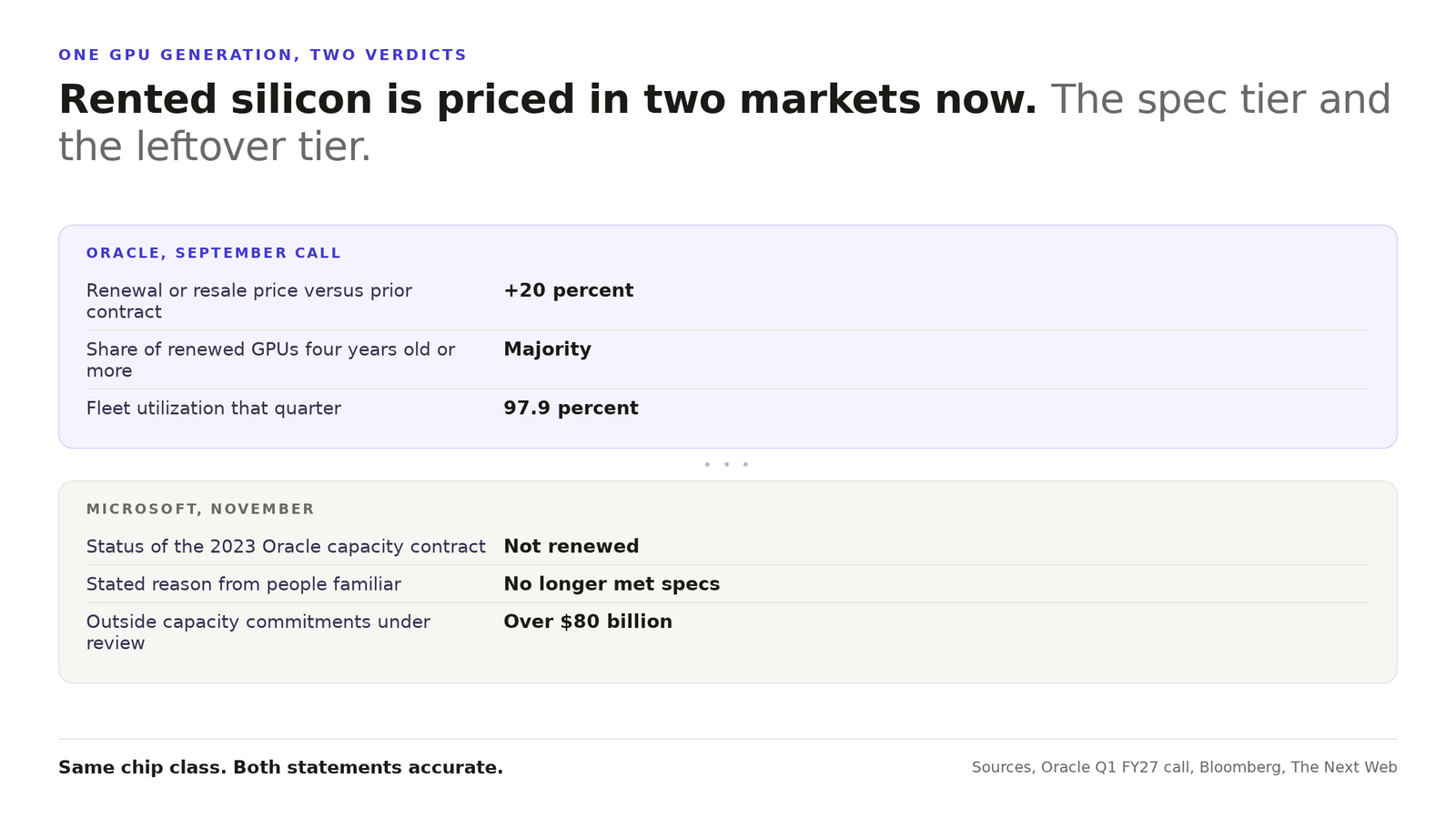
Oracle told investors in September that AI capacity coming up for renewal was renewed or resold at a 20 percent premium, that most of those GPUs were four years old or older, and that its fleet ran at 97.9 percent utilization. In November, Microsoft stopped renewing capacity it had rented from Oracle because the hardware no longer met its specifications. Both statements can be true at once. The rental market has split into one tier priced by how new the silicon is and another priced by how cheap the workload is.
The split moves risk, and it moves it downward. Microsoft has more than $80 billion committed to renting capacity from other providers and is now reviewing those contracts. The neoclouds underneath financed fleets against multi year leases and an assumed earning life. If a tenant can walk when silicon ages, then residual value is an operating decision made by the customer rather than an assumption held by the lender. The verdict is that the residual value argument belongs to the tenant, and anyone buying rented GPU capacity should read the renewal clause before the price sheet.
Microsoft started renting AI capacity from a competitor in 2023, when supply was short enough that buying from Oracle made sense. It has spent recent months switching that capacity off. People familiar with the matter told Bloomberg the contract was not renewed because the Oracle hardware ran older Nvidia chips that no longer met Microsoft’s specifications, as The Next Web reported.
Oracle describes the same silicon differently. On the September call, co-CEO Clay Magouyrk said capacity that came up for renewal was renewed or resold at a 20 percent premium, that most of those GPUs were four years old or older, and that utilization was 97.9 percent. Oracle also delivered 850 megawatts of AI capacity in that quarter. It is not a landlord short of tenants.
Rented GPU capacity works like any leased asset. The landlord buys the silicon, the tenant signs a term, and the rent is set against an assumed earning life. The tenant renewal is what makes the back half of that term profitable. When the tenant walks, the landlord owns hardware with a smaller market and a shorter runway.
A chip can be unfit and still be in demand
The two claims reconcile on workload. Frontier training and latency critical serving need interconnect bandwidth, memory capacity and the newest precision support. Batch inference, fine tuning and embeddings compete on cost per unit of work, where a four year old accelerator with cheap rent wins outright.
So Oracle and Microsoft are describing different buyers rather than different facts. One is buying capability and the other is buying throughput. That is a market with two price curves, and only one of them is set by scarcity.
The review matters more than the contract
One contract is the small part of this. Microsoft has committed more than $80 billion to renting capacity from providers including CoreWeave, Nscale and Nebius, and Bloomberg reports its leadership is frustrated with the cost and the delays. This week the company passed on an option to more than double its Texas deal with Nscale, weeks after walking away from an Nscale site in the UK.
The delays already cost it a quarter. Microsoft finished its September quarter with capital spending of $45.2 billion against a $50.7 billion plan, and put the gap down to third party capacity that arrived late. We covered that result in October, and the difference now is the direction of the adjustment. A delivery slip is a scheduling problem. A non renewal is a valuation problem.
Residual value has become a contract term
The financing rests on the assumption the tenant is now disputing. Lenders underwrite GPU fleets against a four to six year earning life, which is why that number sets the cost of capital for every neocloud. A tenant declining to renew is the first observable evidence in a debate that has run on projections.
Oracle’s answer, a 20 percent premium on four year old capacity, is the counter evidence. Neither claim is audited. The test arrives in revenue per GPU over the next two quarters, and in whether the capacity Oracle says it re rented is billed at the price it quoted. Oracle reports again in December.
Three questions are worth asking about any capacity you rent. What generation is the fleet on, when does the term renew, and who eats the loss if your workload moves up a tier before the contract ends.
Related reading. Why Microsoft capex miss was a delivery date and not a demand signal.
Get the next one before it is old news
Independent analysis of cloud-native infrastructure, Kubernetes and data center economics. No vendor spin.