

Executive summary
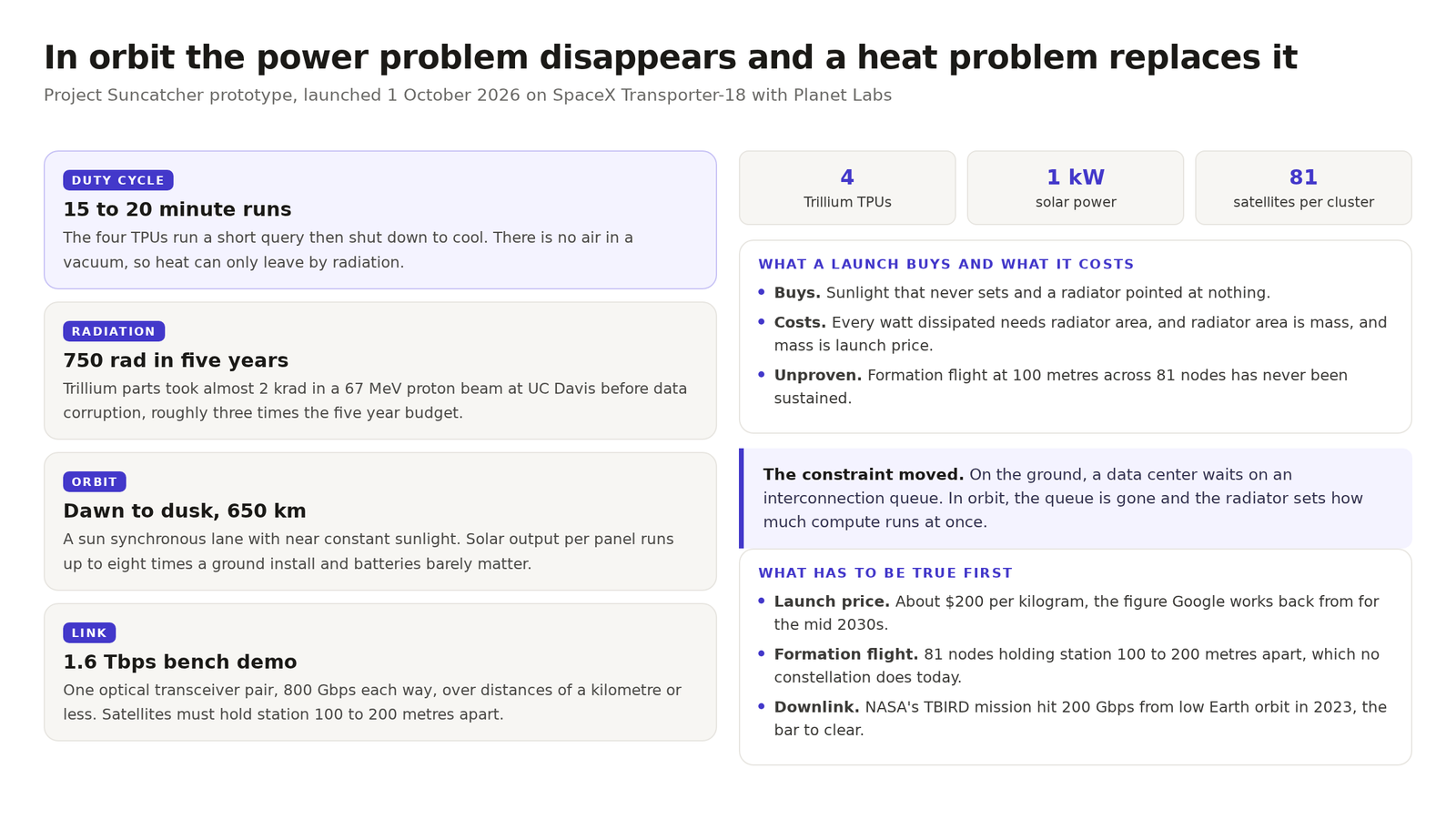
Google’s Project Suncatcher sent four Trillium TPUs into low Earth orbit on 1 October, and the useful result is not that the chips survived. It is that the duty cycle is set by heat. The prototype runs a short query then powers down to cool, because a vacuum offers no air to carry heat away. A solar panel in the right orbit can be up to eight times as productive as one on the ground, so the power half of the argument holds. The thermal half does not.
That inverts the usual pitch. Space does not delete the constraint on AI capacity, it swaps a utility interconnection queue for a physics queue. Radiation tolerance has a number behind it. Formation flight at the density Google proposes has never been sustained at that scale, and the ground downlink trails the inter-satellite link. Anyone modelling an orbital data center as terrestrial compute with cheaper electricity is skipping the part of the system nobody has built.
Google put four of its own AI chips into orbit on 1 October and the first limit arrived within minutes. The prototype satellite for Project Suncatcher launched aboard SpaceX Transporter-18 from Vandenberg Space Force Base, built with Planet Labs. Inside are four Trillium tensor processing units, close to a single cloud TPU v6e-4 slice, running on roughly one kilowatt of solar.
The mission matters because it is the first time a commercial AI accelerator has gone up to run machine learning rather than to prove it survives a launch.
The chip passed its radiation test and the cooling system has not
Radiation was the known risk and it now has a number. Google ran the Trillium parts through a 67 MeV proton beam at the Crocker Nuclear Laboratory at UC Davis while the chips executed workloads. They took almost 2 krad before data corruption appeared, against the 750 rad a five year mission would accumulate. Memory was the most exposed subsystem.
Heat is the open one. A vacuum has no air to move it, so the only path off the chip is radiation from a surface. The prototype runs in windows reported at about 15 minutes, then shuts down to cool. Google describes the approach as heat pipes plus radiators, tested in a thermal vacuum chamber on the ground, and says the design is still being refined.
That reframes the pitch. Space is sold as an answer to power, and the power case is solid. A panel in the right orbit can be up to eight times more productive than the same panel on the ground, and a dawn to dusk sun synchronous lane gives near constant sunlight. The panel is half a system. The other half is the surface that rejects the heat, and that surface is mass, and mass is money at launch prices.
The interconnection queue is replaced by a radiator queue
The architecture Google describes is 81 satellites in a planar cluster about a kilometre wide at a mean altitude of 650 km, with next nearest neighbours drifting between 100 and 200 metres apart. A bench demonstrator using one transceiver pair reached 800 Gbps each way, 1.6 Tbps in total. The tight formation is arithmetic, since received optical power falls with the square of distance.
Call the pattern interconnection arbitrage. On the ground a project waits for a utility to energise a substation. In orbit the wait is on radiator area, formation control and downlink. No utility, different gatekeeper. Grouping the two is the useful move, because the second gatekeeper has never been tested at this density and the first has been tested to exhaustion.
The ground link is the least glamorous part and the furthest behind. Google’s paper cites NASA’s TBIRD mission at 200 Gbps from low Earth orbit in 2023 as the current leader, and the company is starting with radio rather than optical for the ground segment. The cost modelling works backward from launch prices around 200 dollars per kilogram, which is a mid 2030s assumption and not a current one.
What to watch, and what not to believe yet
The next milestone is a two satellite flight planned for 2027 that has to hold an optical inter-satellite link in orbit. Until that flies, 1.6 Tbps is a bench result and not a system result. The other number to watch is radiator mass per watt, because that, not solar output, decides how much compute runs continuously.
What not to believe is any cost comparison that treats launch as free or cooling as solved. The most interesting sentence in the program is not about sunlight. It is the one that says the chips have to power down.
Three questions for anyone sizing this against a terrestrial build. How much of your workload tolerates a duty cycle rather than a continuous service level. What does your cooling plant cost per kilowatt rejected, and does that beat a grid connection. And if launch price is the swing variable, what does the model say at today’s price rather than the projected one.
Related reading. We covered the other end of the same squeeze, Oracle’s force majeure on a New Jersey AI project, where the power was not there on schedule.
Sources. Google’s explainer, the research write up, the preprint, NPR and Data Center Dynamics.
Get the next one before it is old news
Independent analysis of cloud-native infrastructure, Kubernetes and data center economics. No vendor spin.