

Executive Summary
Announced AI capacity is a forecast, not a delivery date, and Project Jupiter is the newest proof. Oracle told the developer of its 2.45 gigawatt New Mexico campus that the power may arrive late, using a contract clause normally reserved for storms and strikes. The trigger was not silicon. It was an air permit that has not been issued and a gas pipeline that has slipped to next year.
The grid cannot cover the gap. PJM, the operator for 67 million people, cleared its 2028/2029 capacity auction 6,831 megawatts below its own reliability requirement, the second straight shortfall. Operators answer by building generation behind the meter, which moves the bottleneck from equipment to permits and rights of way. The finding for anyone buying capacity is blunt. When the tenant signs for the power, every hearing date lands on the tenant. Expect power-risk clauses to be priced into large AI leases from here.
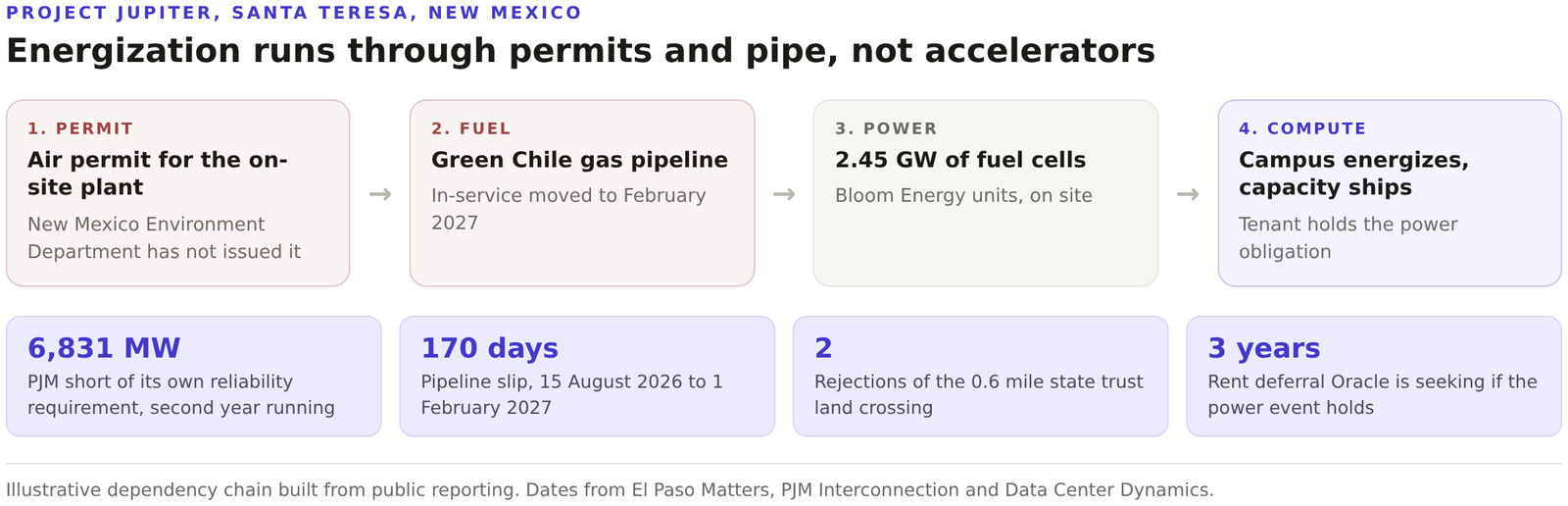
On 24 September Oracle sent a force majeure notice to STACK Infrastructure, the developer of its Project Jupiter campus near Santa Teresa, New Mexico. The campus is not short of chips, tenants or capital. It is short of the paperwork that lets it switch on.
The notice, reported by Data Center Dynamics and acknowledged by the developer, is not a move to exit. Oracle says the project “remains on our planned schedule”. It is a claim that the power may not be ready, and that payments should follow the power rather than the calendar.
The tenant is holding the power risk, not the landlord
Most build-to-suit leases hand the tenant a powered building. Project Jupiter runs the other way. Securing power sits with Oracle under the contract, according to people familiar with the terms. That is why the notice came from the tenant rather than the developer, and it is why a regulatory delay turned into a tenant problem.
El Paso Matters reported that Oracle could defer some rent for up to three years if both sides agree a power-related force majeure event has occurred. Oracle cannot terminate the lease. Under the same account, Oracle pays the debt costs. Read together, the structure means the company that signs for capacity also signs for the interconnection, the fuel supply and every permit behind them.
Two approvals stand between the campus and the switch
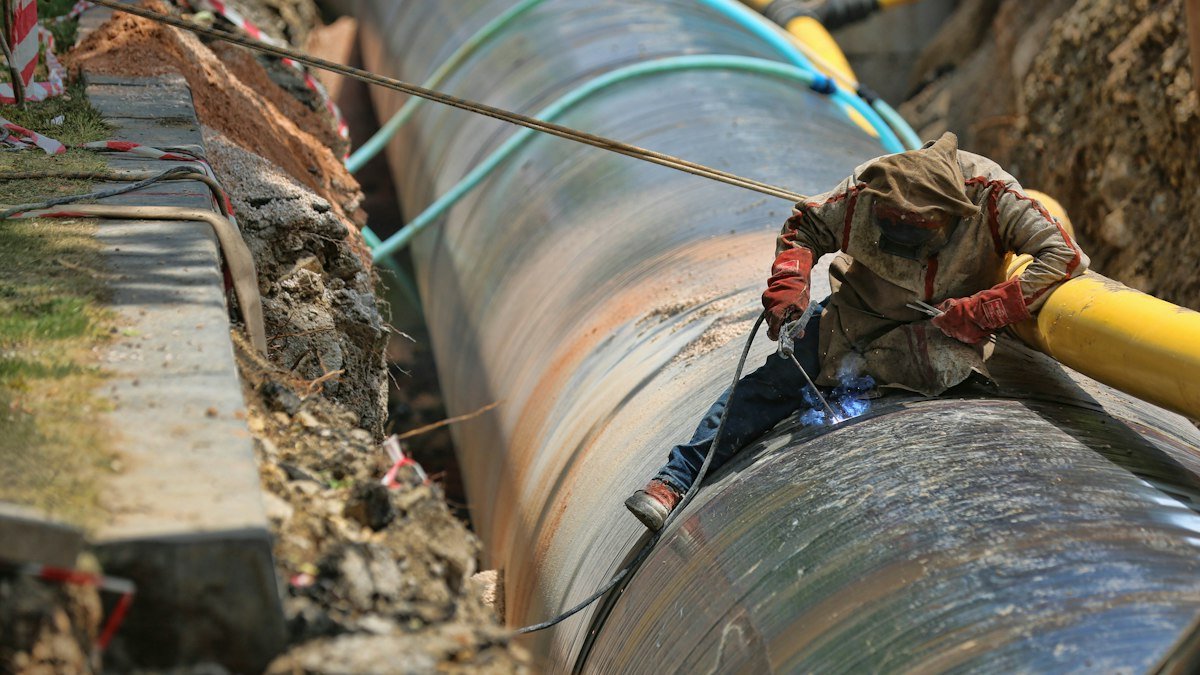
The campus plans to make its own electricity. Up to 2.45 gigawatts of Bloom Energy fuel cells would sit on site. The cells run on natural gas, so the plant needs a fuel line and an air permit.
Neither is settled. The New Mexico Environment Department has not issued the air permit for the plant. The Green Chile pipeline, an Energy Transfer lateral of about 18 miles, moved its in-service date from 15 August 2026 to 1 February 2027. That is a slip of 170 days, after the New Mexico State Land Office twice rejected its crossing of a 0.6 mile strip of state trust land.
The grid is not the fallback, so permits set the clock
Buying from the grid instead sounds simpler. The numbers say otherwise. PJM Interconnection, which runs the market for 67 million people across 13 states, cleared its 2028/2029 capacity auction at the $325 per megawatt-day price cap and still finished 6,831 megawatts short of its reliability requirement. It was the second shortfall in a row. Only 525 megawatts of the total came from new generation and uprates.
Behind-the-meter generation is a rational answer to the AI data center power squeeze. It also hands the schedule to agencies that issue air permits and to landowners who grant easements. That is the pattern to name. The further a campus moves from the grid, the more its energization date depends on parties with no revenue share in the project.
Three questions for anyone buying capacity this quarter. Who carries the power obligation in your contract, and do they control the permits behind it? If energization slips, is the remedy money or an exit? And if the on-site fuel plan needs a permit a court can pause, what is the fallback?
Sources and further reading. Data Center Dynamics reported the notice and the developer’s response. El Paso Matters has tracked the air permit and the pipeline schedule. PJM Interconnection published the 2028/2029 auction results. Bloom Energy supplies the fuel cells, and STACK Infrastructure is the developer.
Related reading. Anthropic is negotiating a gigawatt lease of its own, and the same power question sits underneath it. Our weekly roundup traced the four limits AI infrastructure hit in one week.
Get the next one before it is old news
Independent analysis of cloud-native infrastructure, Kubernetes and data center economics. No vendor spin.
[…] reading. We covered the other end of the same squeeze, Oracle’s force majeure on a New Jersey AI project, where the power was not there on […]
[…] reading. Oracle’s force majeure fight over Project Jupiter shows how thin some AI power plans can run, and batteries are arriving before chips at AI data […]