
Executive summary
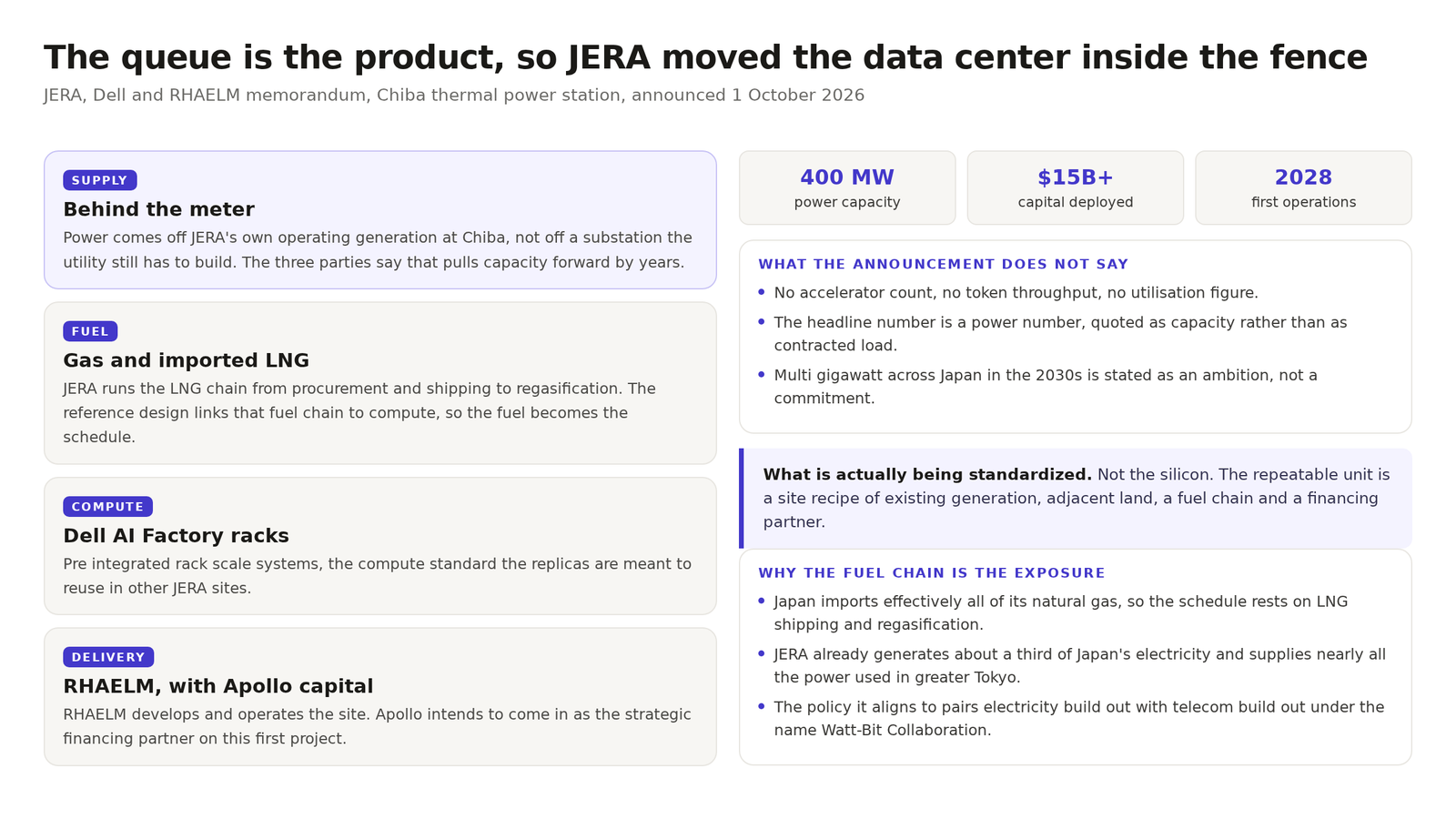
JERA, Dell Technologies and RHAELM signed a memorandum on 1 October to build a standard design for national scale AI infrastructure in Japan, starting at JERA’s Chiba thermal power station. The number that matters is not the capital. It is that the data center sits behind the meter on JERA’s own operating generation, so it does not wait for a utility to build a substation. Reported capital is above 15 billion dollars and the power envelope is up to 400 megawatts, with operations targeted from around 2028.
That step converts one constraint into another. A grid interconnection queue is replaced by a fuel chain, and Japan imports effectively all of its natural gas. The memorandum standardizes the site recipe rather than the silicon, which is the part worth copying. Nobody has published an accelerator count, a token throughput or a utilisation figure, so the headline remains a power claim rather than a compute claim.
Japan’s largest power producer put an AI data center inside its own fence. JERA, Dell Technologies and RHAELM signed a memorandum of understanding on 1 October covering a repeatable model for national scale AI infrastructure, with the first project at JERA’s Chiba thermal power station near Tokyo. Apollo Global Management intends to act as strategic investment and financing partner for RHAELM on that first site.
The headline figures are large. Power capacity of up to 400 MW, total capital deployment expected to exceed 15 billion dollars, or about 2.3 trillion yen, across land, power infrastructure, construction and compute. Operations are targeted from around 2028. On the partners’ own description it would be the largest single site AI infrastructure deployment in Japan.
A gas plant is the shortcut past the interconnection queue
The design choice that unlocks the schedule is a second electrical connection that never touches the transmission queue. The project takes power behind the meter from JERA’s existing Chiba generation, which the partners say pulls delivery forward by years against a conventional grid connected build. Reuters reported the arrangement as a 15 to 25 year power supply from JERA, with the site reaching full capacity in 2029.
This is interconnection arbitrage again, and Japan is a natural place for it. JERA already generates roughly a third of Japan’s electricity and supplies nearly all the power consumed in greater Tokyo, so it has generation sitting next to land it controls. What it does not have is spare grid headroom on demand, and neither does anywhere else building at this scale. Buying a position in the queue and buying around the queue are the two viable moves, and only the second has no counterparty.
Dell supplies the compute layer as standardized rack scale systems, billed under the Dell AI Factory name, and RHAELM develops and operates the site. RHAELM’s chief executive described the company’s purpose as turning stranded power capacity into sovereign AI infrastructure, which is an accurate description of what the deal does.
The fuel chain becomes the single point of failure
A queue is a wait. A fuel chain is an operating dependency, and this one runs the length of a supply chain Japan does not own end to end. JERA’s own framing is that the country’s ability to scale AI infrastructure depends on reliable gas fired generation and a resilient LNG value chain, and that the model links LNG supply directly to computing.
That is a fair answer for a company that already runs the chain, and it is also a transfer of risk. A grid connected campus is exposed to a utility’s construction schedule. A behind the meter campus is exposed to fuel price, shipping logistics and the reliability of one generating asset at one site. The partners are open about the ambition, multi gigawatt capacity across Japan in the 2030s at other JERA sites. Each replica carries the same exposure.
What the announcement leaves out
There is no accelerator count, no model throughput, no utilisation figure and no contracted load. The comparison that circulates with these projects, dollars per megawatt, is a capacity number rather than a revenue number, and the two diverge sharply when a site is energised in phases over two years. The 400 MW figure is power capacity at the site rather than the draw on day one.
The policy alignment is real and worth tracking for anyone following sovereign compute. Japan’s government has been pushing coordinated electricity and telecommunications build out, and the partners tie the model to that drive explicitly. Sovereign AI capacity that runs on imported fuel is a specific kind of sovereignty, and it does not remove a dependency. It moves it from chips to cargo.
Three questions to put to any project shaped like this one. What is the contracted load as distinct from the installed capacity. What happens to the compute schedule when the host plant is offline for maintenance. And if the site recipe is exportable, does the second country have the same fuel chain, because that is the part that does not travel by container.
Related reading. We covered the same squeeze from the other side, Oracle’s force majeure on a New Jersey AI campus, where the power was not there on the promised date.
Sources. The JERA announcement, Reuters via Channel News Asia, Nikkei Asia and Data Centre Magazine.
Get the next one before it is old news
Independent analysis of cloud-native infrastructure, Kubernetes and data center economics. No vendor spin.