

Executive Summary
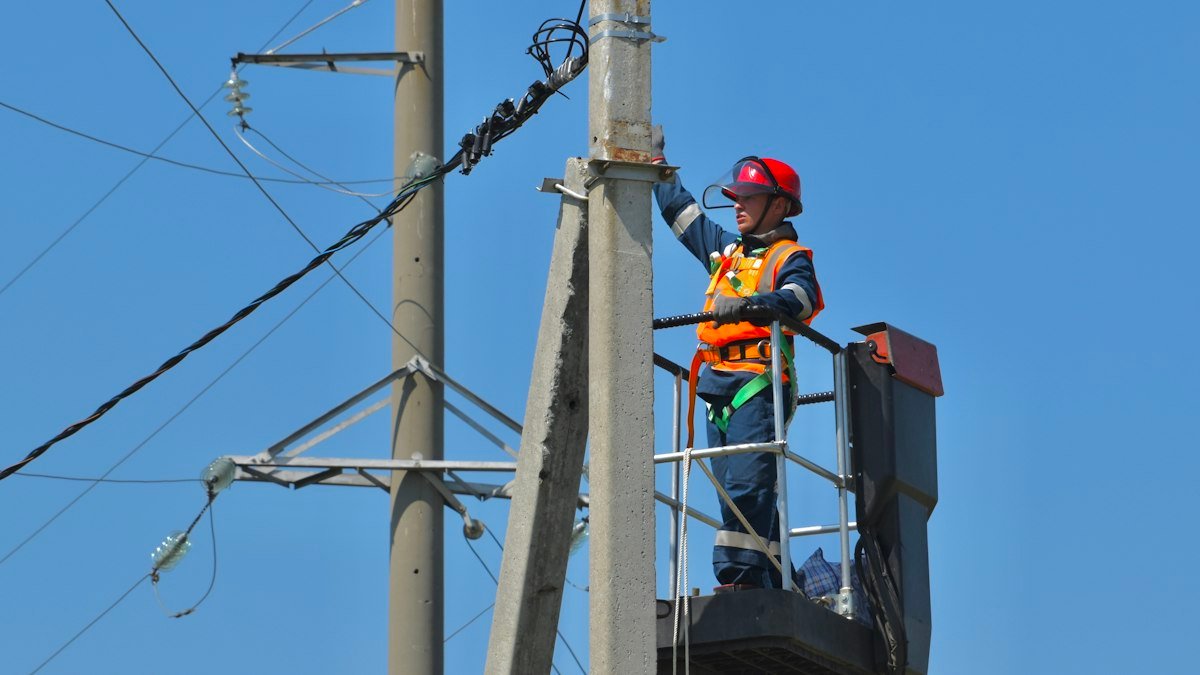
A 20 year nuclear power purchase agreement signed on 30 September 2026 at Calvert Cliffs in Lusby, Maryland buys the buyer less than the words suggest. The 690 megawatts never leave the shared grid. No wire carries them to a single customer, so the purchase is a fixed price hedge and a claim on capacity that every other load in the region can also draw on.
The new megawatts come from a licensing extension and a turbine uprate rather than a new reactor, and the plant owner is paying for them itself instead of asking utility customers to pick up the bill. For anyone buying capacity in PJM, the same contract that made the work bankable also sets a floor under long dated prices and a template for keeping reactors open.
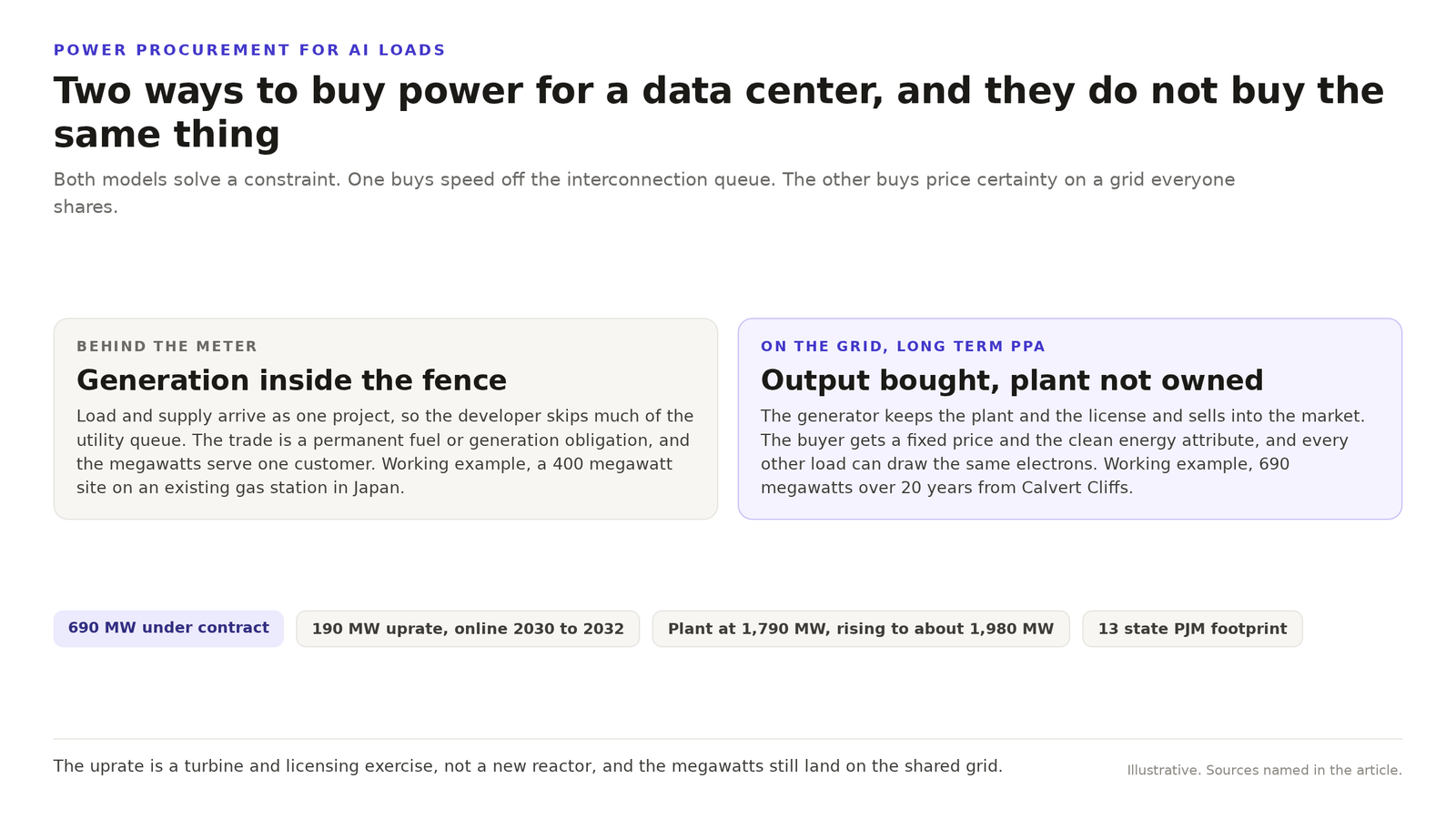
The mechanism is where the story sits. A power purchase agreement is a contract over output, not a transfer of ownership. The generator keeps the plant and the license, sells the electricity into the regional market, and the counterparty gets price certainty and the clean energy attribute. A build behind the meter works the other way. The data center sits inside the fence line, the generation is dedicated to it, and the developer skips much of the interconnection queue because load and supply arrive as one project. One model buys certainty on price and carbon accounting. The other buys speed.
On 30 September 2026 Constellation Energy and Amazon signed the first model at the Calvert Cliffs Clean Energy Center in Lusby, Maryland, the state’s only nuclear plant. The agreement covers 690 megawatts, including a 190 megawatt uprate, and supports more than USD 3 billion of investment across the 1,790 megawatt plant, which will reach about 1,980 megawatts. The new capacity comes online between 2030 and 2032. A separate retail supply agreement covers Amazon operations across the 13 state PJM market.
The grid keeps the megawatts, so the contract is really about price
David Dardis, senior executive vice president at Constellation, told Maryland Matters that none of this is private. ‘We’re not selling this behind the meter. This is all being served on grid.’ He also said the 690 megawatt contract is large for the industry, and that without an agreement like it you have to project future power prices. ‘One thing we know about future power prices is: We’re always wrong.’
That concession is the case for the deal. A 20 year buyer removes the guesswork and the seller gets revenue certainty. Amazon says it has no plans to build a data center at Calvert Cliffs, which is worth holding onto. The electrons are not dedicated to Amazon. They land on the same wires everyone else uses.
The new megawatts are a relicensing and a turbine, not a reactor
The 190 megawatt uprate is roughly equal to all utility scale wind and solar operating in Maryland, according to the Baltimore Sun. That is the physical change on site, an engineering and licensing exercise rather than a construction program. The long term commitment gives Constellation the certainty to relicense the plant for another 20 years. The current licenses for the two reactors expire in 2034 and 2036. Constellation is also evaluating small modular reactors with AWS, though those discussions are early.
Calvert Cliffs produces about 80 percent of Maryland’s clean energy, employs more than 800 people and contributes about USD 21 million a year in local taxes, and it can power the equivalent of more than 1.3 million homes. Constellation will fund the USD 3 billion itself rather than through utility customers, and the Wall Street Journal reported that Amazon is funding the uprate, its first such funding. The money reaches the site. The output does not reach Amazon alone.
The contract sets a price floor for every load in PJM
Amazon already has an agreement with Talen Energy tied to Susquehanna in Pennsylvania and backs small modular reactor development in Washington state. The pattern is a run of long dated nuclear commitments from hyperscalers, and the Energy Information Administration tracks how those costs move against fuel and power benchmarks. A buyer of this size signing for 20 years changes what a developer can finance, and financing decides whether a plant survives.
Amazon tried the other model at this same site. In August 2026 Amazon Data Services withdrew a conceptual plan for a data center on the plant site after county voters opposed data centers in the June primary, reported by the Baltimore Sun and Maryland Matters. What replaced it is a contract and an uprate, both of which sit on the shared grid.
Ask how a 20 year contract at your own site would change the revenue case for the generation you depend on. Ask whether your load is better served by owning the supply or by fixing the price of someone else’s. Ask what happens to your capacity costs if the largest buyer in the market starts setting the floor.
Related reading. Oracle’s force majeure fight over Project Jupiter shows how thin some AI power plans can run, and batteries are arriving before chips at AI data centers.
Get the next one before it is old news
Independent analysis of cloud-native infrastructure, Kubernetes and data center economics. No vendor spin.