


Executive Summary
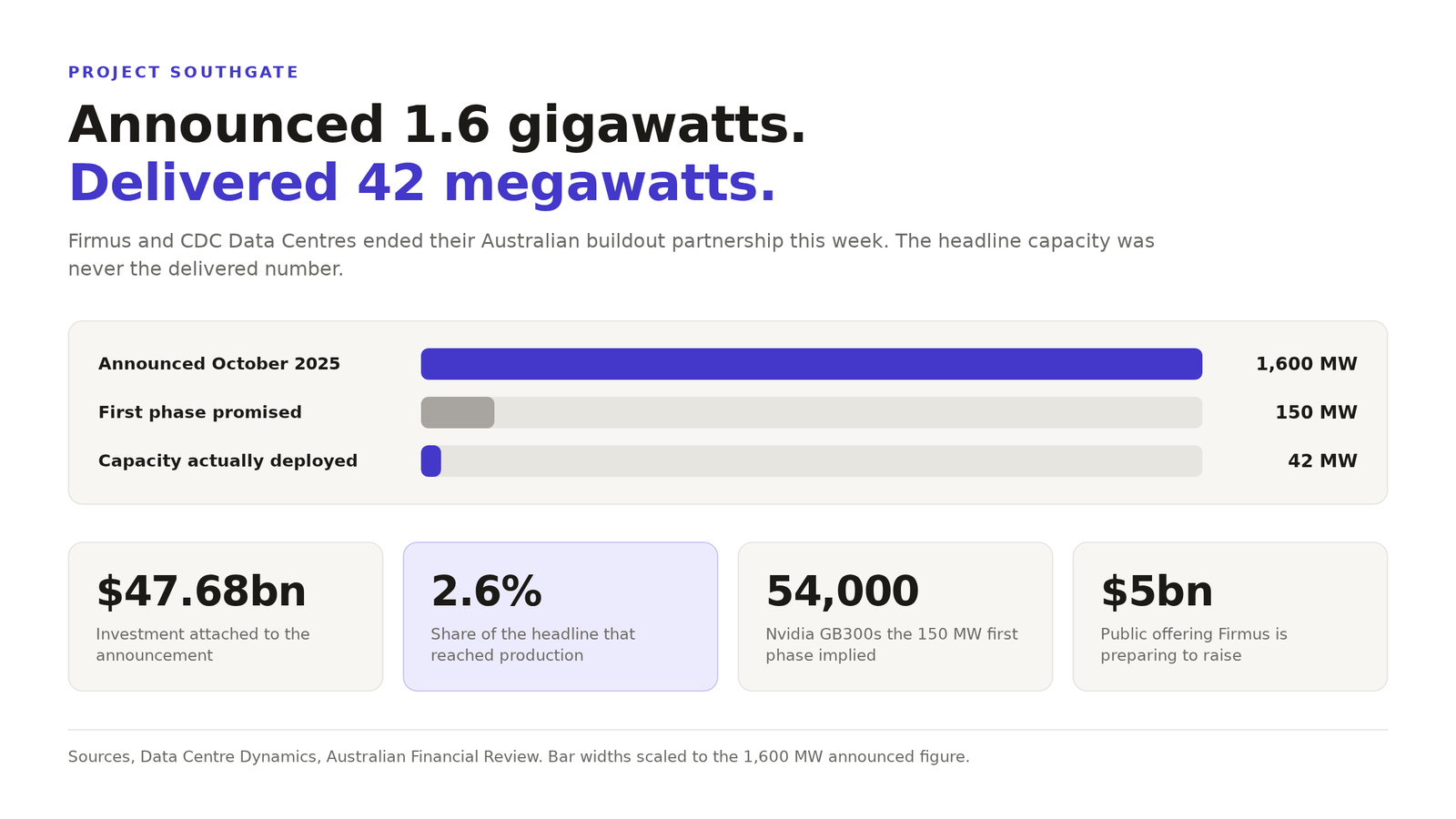
Firmus and CDC Data Centres have ended the partnership behind Project Southgate, an Australian buildout that carried a 1.6 gigawatt headline and up to $47.68 billion of promised investment when it was unveiled in October 2025. The first phases in Tasmania and Melbourne were meant to reach 150 megawatts, roughly 54,000 Nvidia GB300 systems, by the middle of 2026. What reached production is 42 megawatts at a single CDC site in Melbourne.
That is 2.6 percent of the number the project was sold on. The gap is not a scandal, it is the ordinary shape of AI capacity announcements, and it is why announced megawatts and energized megawatts should never share a row in the same spreadsheet. For buyers the lesson is narrow. Ask which site, which substation and which date a megawatt is tied to, because the headline number can outlive the partnership that was supposed to deliver it.
The scarcest number in AI infrastructure is not capacity. It is capacity someone can point at, in a building that exists, drawing power a utility has already switched on.
Firmus and CDC Data Centres stopped working together on Project Southgate this month. CDC first signalled the split in September, when chief executive Greg Boorer said the two companies were moving apart because Firmus had expanded across Asia, which raised questions about its funding and its ability to build. This week he was blunter. The two were not planning to deliver 1.6 gigawatts together, he told Rampart, because Firmus made other choices about developing its own sites.
The headline number outlived the partnership that was meant to build it
Firmus describes the ending differently. Co-chief executive Oliver Curtis said both sides mutually agreed earlier this year not to proceed with the proposed Southgate development partnership, and that the decision does not affect its development plans, contracted customer capacity or international partnerships.
Both accounts can be true at once. Firmus has signed capacity agreements with Meta in Indonesia and OpenAI in Malaysia, and is preparing a public offering to raise about $5 billion. CDC wants its own campuses filled on its own schedule. What neither company disputes is the delivered figure, 42 megawatts at one building, against a plan that reached 1.6 gigawatts on paper. Run the arithmetic and the ratio is 2.6 percent. Run it on the first phase alone, 150 megawatts of promised Tasmanian and Melbourne capacity, and it is 28 percent.
Neither number is an engineering failure. They are what happens when a partnership is the delivery mechanism and the partnership ends. Demand was never the constraint.
Every announced megawatt needs a site, a substation and a date
None of the three appeared in public. The Southgate proposal named no site to a utility, no substation and no energization date, which is how a 1.6 gigawatt figure survived a year of reporting without anyone establishing what had been switched on.
The pattern is not Australian. Legrand models 180 gigawatts of installed data center load by 2030 against 420 gigawatts of announced projects, and the difference is the grid rather than the capital. We covered the repricing that followed when powered landlords started resetting renewal spreads. We covered the moment the power did not arrive when Oracle filed force majeure. Same failure mode both times. The megawatt was real in the forecast and absent in the switchgear.
The delivery partner broke, not the demand
Firmus is not a distressed company. It has hyperscaler customers, a listing to raise and years of growth behind it. What it does not have at the Melbourne site CDC built is a second phase. That is the detail worth carrying into procurement, because the customer demand that justified the build is still there and the capacity is not.
Three questions for your own capacity plan. Which of your committed megawatts has a named substation behind it with a signed interconnection agreement. For the ones that carry only a headline, who is contractually obliged to deliver the shell, the power and the network. And if that partner walked away this quarter, how many megawatts would still be drawing load next quarter.
The pattern to watch is the ratio rather than the total. Firmus reached 42 megawatts against a 1.6 gigawatt plan and is still raising. Watch what the next neocloud disclosure says about energized capacity, and whether that number is published before the partnership is.
Related reading. Sovereign AI capacity now costs $60 million a megawatt, and Anthropic leased 2.16 gigawatts in Australia on inference-only terms.
Get the next one before it is old news
Independent analysis of cloud-native infrastructure, Kubernetes and data center economics. No vendor spin.
[…] reading. Firmus announced 1.6 gigawatts and handed over 42 megawatts, and the short Bite on the same delivery […]