


Executive Summary
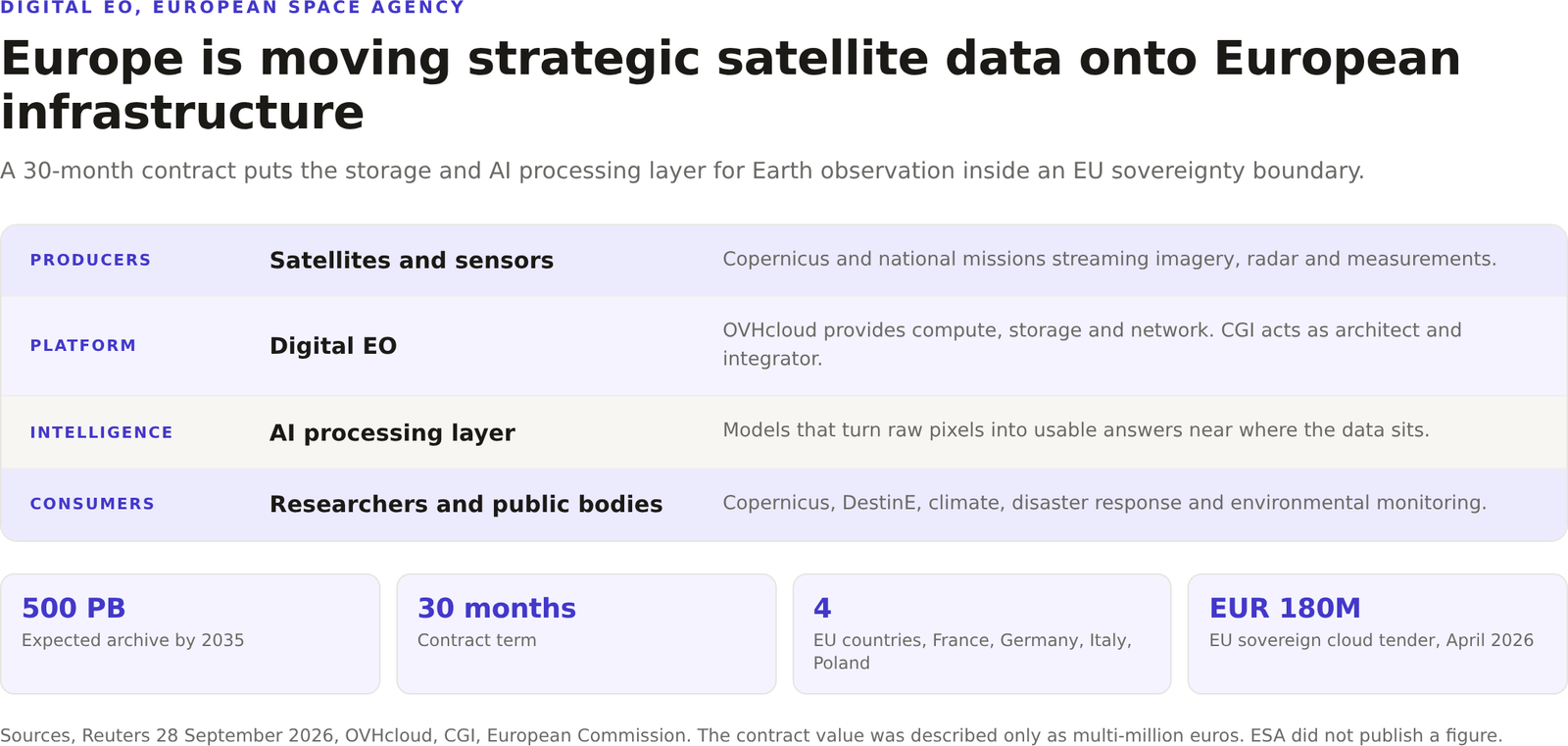
The European Space Agency has handed a 30-month contract to OVHcloud and CGI to build the storage and AI processing layer for Europe’s Earth observation data. The system, called Digital EO, will run across France, Germany and Italy, with support operations in Poland. The companies describe the value only as being in the multi-million euro range, and ESA did not publish a figure.
The contract is small next to the money moving through AI infrastructure. The direction is the signal. Europe is steering its most strategic dataset, an archive ESA expects to pass 500 petabytes by 2035, onto infrastructure it controls, under a framework that scores legal control, supply-chain transparency and the extent of non-EU influence. The prize was never the storage. It is the AI processing layer that turns satellite pixels into decisions, and who owns it.
The clearest test of European sovereign cloud policy this year is a space contract. The European Space Agency awarded OVHcloud and CGI a 30-month deal on 28 September to build the computing platform for Europe’s Earth observation data. Reuters reported the award, with Leo Marchandon on the byline. The platform is called Digital EO, and it combines storage, compute and AI tooling for researchers, companies and public authorities.
Earth observation is a firehose. Modern constellations stream imagery, radar and measurements used to monitor agriculture, sea ice, wildfires, floods and urban growth. AI is what turns that stream into answers, and it wants compute sitting next to the archive rather than a network hop away from it.
The storage is European, and that was the point
OVHcloud, the largest European-headquartered cloud provider, supplies compute, storage and network. CGI acts as system architect and integrator. The platform will be deployed in France, Germany and Italy, with support run from Poland. It connects to existing national and European facilities rather than replacing them with one central database.
The award sits inside a wider procurement shift. In April the European Commission handed contracts worth up to EUR 180 million for sovereign cloud services to European provider groups, including OVHcloud, StackIT, Scaleway and Proximus-led partnerships. Suppliers were scored against a Cloud Sovereignty Framework covering legal and operational control, supply-chain transparency, technological openness and security.
The archive is why this is not a rounding error
ESA expects its Earth observation archive to exceed 500 petabytes by 2035. Data at that scale is not something you casually move across a border, and it is not something you process by shipping it to whichever region is cheapest that week. The platform will feed Copernicus, the EU Earth observation programme, and Destination Earth, the digital twin of the planet used for climate modelling and disaster response.
That combination is what makes the contract matter beyond space policy. A sovereign cloud argument used to be about where a virtual machine ran. Now the same argument covers where the inference runs, because the AI layer is what the data is worth. If the model that reads the imagery sits outside the jurisdiction, local storage buys less than it appears to.
The same logic is spreading to security
Digital EO is not the only European move in this space. Earlier in September, ESA awarded parallel study contracts to teams led by Finland’s ICEYE and Italy’s Leonardo to design a separate Earth observation architecture aimed at government security requirements. That work is distinct from Digital EO, but the two point the same way. Satellite data, cloud infrastructure and security policy are converging into one procurement problem.
Europe holds real strength in Earth observation through ESA, Copernicus and national systems. The infrastructure that stores and processes the output has become the contested layer. This week’s contract puts the core of that architecture under European operators across four EU countries.
What to watch. Whether the Commission extends the sovereignty test from storage to the model layer. The moment it does, every inference endpoint that touches public sector data falls under the same framework, and non-European providers have to prove operational control they do not currently hold.
Three questions for your own estate. If an EU regulator asked where your inference physically runs, could you answer in one step? Which of your datasets would be hard to move if a supplier’s jurisdiction changed overnight? And does your AI processing layer sit inside the same legal boundary as the data it reads?
Related reading. The 2026 State of Enterprise Infrastructure covers the sovereignty and capacity shifts behind this. AI data centre power commitments tracks the physical buildout the processing layer depends on.
Get the next one before it is old news
Independent analysis of cloud-native infrastructure, Kubernetes and data center economics. No vendor spin.
[…] Read the full analysis. Europe Is Moving 500 Petabytes of Satellite Data Onto European Cloud […]