

Executive Summary
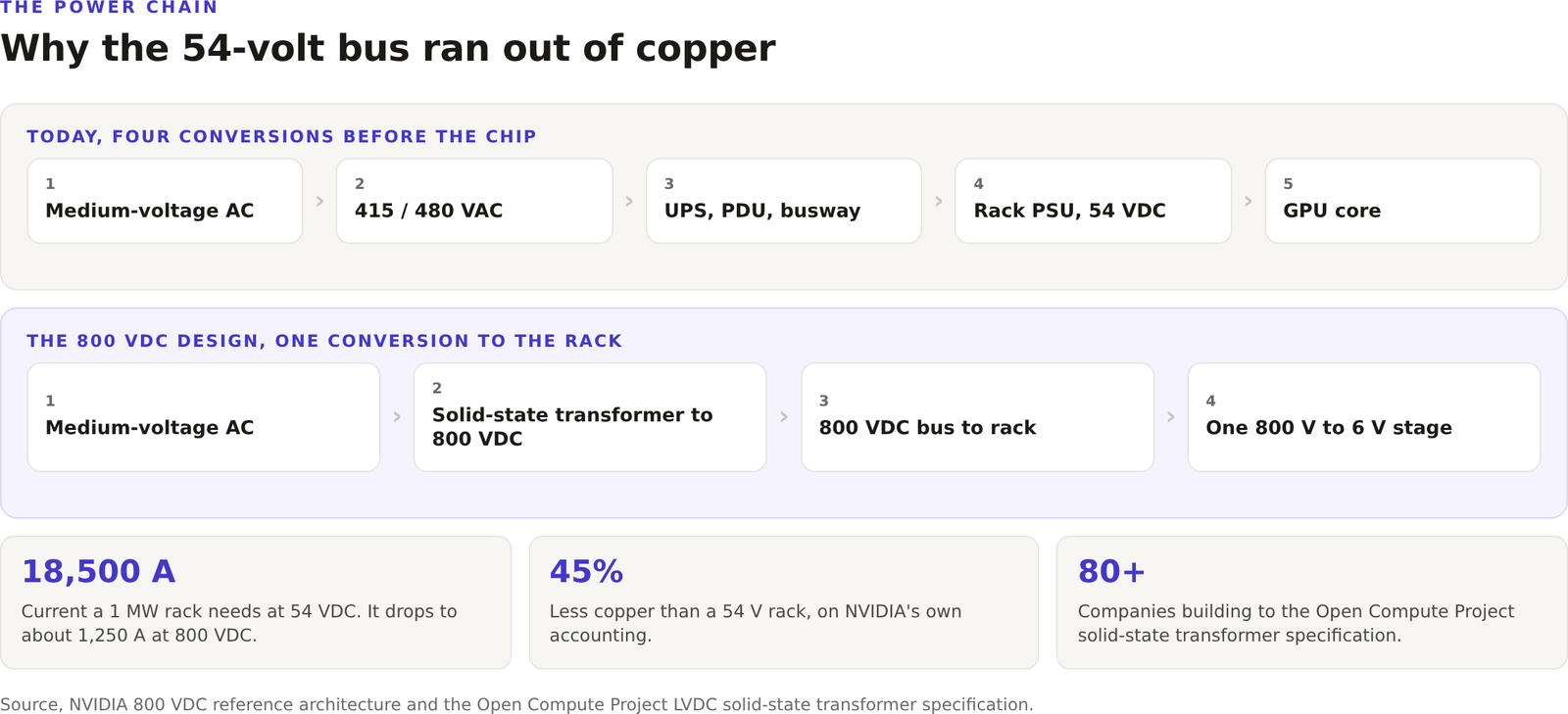
AI racks have outgrown the power distribution that served data centres for two decades. A 1 megawatt rack on a 54 volt DC busbar would draw about 18,500 amps, which is more copper than the rack can hold, so the industry is moving the bus to 800 VDC. The first products ship this year and the full design lands over the following three years.
The finding is that the binding constraint on the next wave of AI capacity is not the accelerator or the grid connection. It is the chain of conversions between them, four stages today, and the solid-state transformer that collapses it to one. Infineon and Eaton put silicon carbide inside a medium-voltage solid-state transformer platform on 29 September, which moves the last missing part from roadmap to hardware.
The rack got too hungry for its own wiring. A 1 megawatt AI rack running a 54 volt DC busbar needs around 18,500 amps, and the copper to carry that can weigh up to 200 kilograms inside one rack. That is why AI capacity is moving to a new distribution voltage.
Volts are the lever. Raise the distribution voltage and the current falls for the same power, and conductor losses fall with the square of the current. At 800 VDC the same 1 megawatt rack draws roughly 1,250 amps. NVIDIA puts the gain at up to 5 percent end to end, up to 70 percent lower maintenance cost, and up to 30 percent lower total cost of ownership against the 54 volt baseline.
The 54 volt era ended at the rack level
Today’s chain steps the voltage down four times before it reaches the chip. Medium-voltage AC arrives, a transformer drops it to 415 or 480 VAC, a UPS and power distribution units pass it along, and a rack power supply rectifies it to 54 VDC. Each stage loses a little and takes up space.
Schneider Electric puts the ceiling on the incumbent design plainly. The two main approaches become difficult at 200 kilowatts per rack and impossible at 400 kilowatts. NVIDIA’s own generation targets run from 145 kilowatts per rack, to 330 kilowatts for the Vera Rubin NVL72, to 570 kilowatts, with a future design aimed at 1 megawatt.
Silicon carbide moved the missing part to hardware
The gating component is the solid-state transformer, which converts medium-voltage AC straight to 800 VDC and replaces both the iron-and-copper line transformer and the separate rectifier. Infineon and Eaton paired on it. Infineon silicon carbide devices will be deployed inside Eaton’s MVSST 2.0 medium-voltage platform.
The standard is forming around it. The Open Compute Project published a low-voltage DC solid-state transformer specification, version 0.3, in July, and more than 80 companies are building to it. Vertiv has an aligned 800 VDC reference architecture, ABB has a solid-state circuit breaker, and Texas Instruments has shown an 800 volt to 6 volt converter at 97.6 percent peak efficiency.
Decide the topology before the racks arrive
NVIDIA has laid out three stages. An MGX-compatible power rack converts AC to 800 VDC beside the compute racks, entering production in the second half of 2026. A row power centre carries 800 VDC overhead at up to 2 megawatts per row in 2027. Facility-scale DC power blocks of 4.8 megawatts come last, targeting 2029.
There are two rival topologies, and they are not interchangeable. NVIDIA runs a single 800 volt rail. The Open Compute Project’s Diablo design, co-authored by Google, Meta and Microsoft, splits the same class into two 400 volt rails around a centre reference. The two have different fault behaviour, different breaker requirements and different grounding schemes, so the choice is a design decision, not a preference.
Safety is settled in the specification and it is not optional. The design calls for high-resistance grounding, continuous insulation monitoring, active arc-fault detection and mechanical interlocks that stop a connector being pulled under load. Power capacity is arriving faster than the electrical trade can build rooms for it, so the specification is the place to start. Our look at why AI factories buy batteries before chips and the grid upgrades behind new capacity covers the supply side.
Three questions for your own estate. What is your highest rack density today, and at what point does it hit the 200 kilowatt ceiling? Does your electrical design leave room for a rack-adjacent 800 VDC power rack? And which topology will you standardise on, before you buy the first switchgear?
Get the next one before it is old news
Independent analysis of cloud-native infrastructure, Kubernetes and data center economics. No vendor spin.