


Executive Summary
CoreWeave reported its best quarter to date. Revenue of $3.66 billion beat the $3.55 billion consensus, adjusted operating margin reached 10 percent a quarter ahead of plan, and the contracted backlog grew from $104 billion to $132.5 billion in ninety days. Guidance moved up on revenue, operating income, and the run rate the company expects to exit the year on.
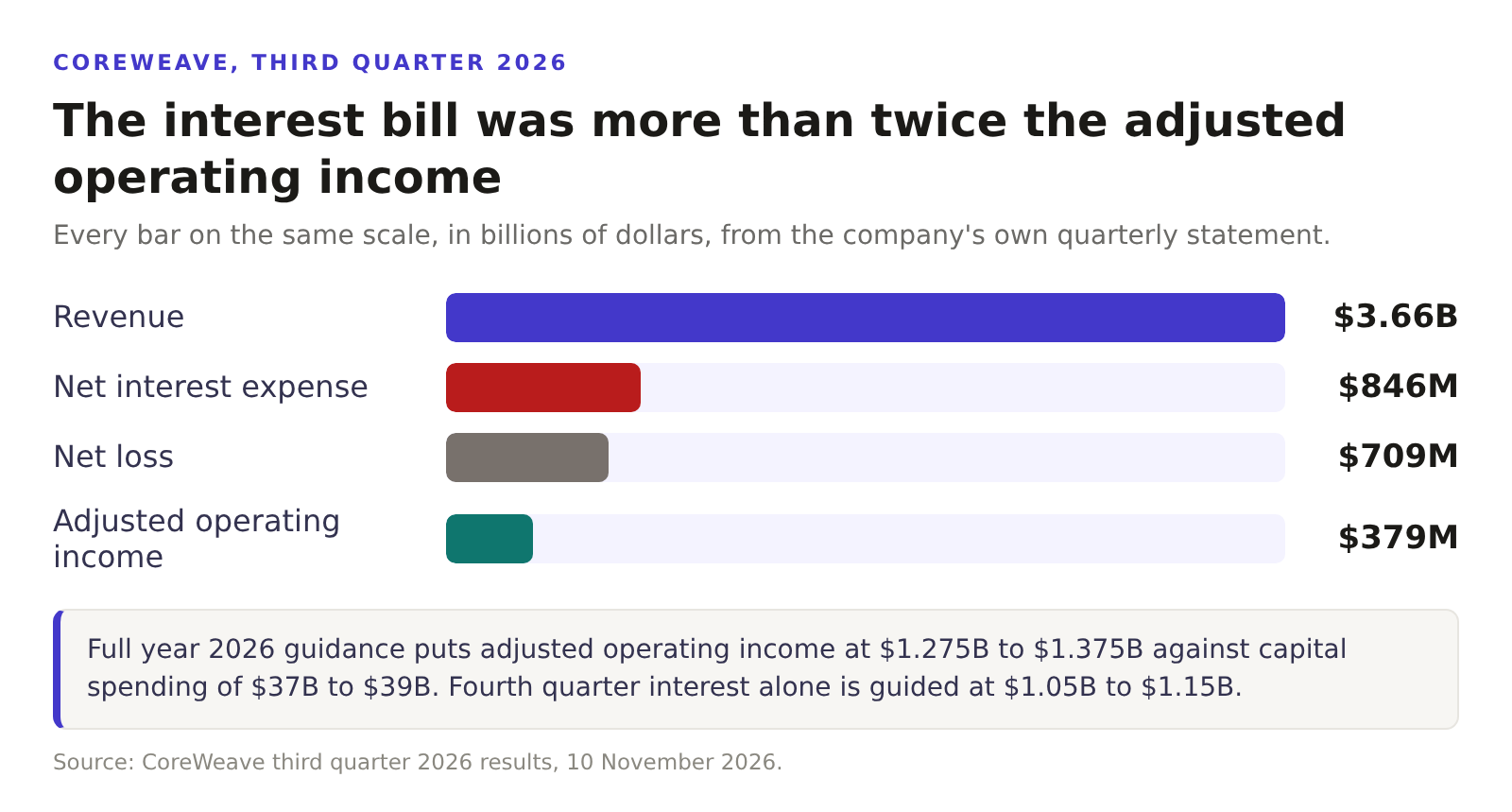
The constraint is no longer demand or execution. It is the price of the money that builds the capacity. Net interest expense of $846 million was more than double adjusted operating income of $379 million, and a single quarter of fourth quarter interest will consume about four fifths of a full year of operating profit. CoreWeave says the fix is customer cash, with roughly $9 billion in prepayments and deposits arriving in the next three months. That works while supply is short. It also turns the backlog into a claim on power that has not been built yet.
CoreWeave reported $3.66 billion in revenue for the third quarter on 10 November. It paid $846 million in net interest over the same three months. The distance between those two lines is the story of the GPU cloud right now.
The company beat the $3.55 billion consensus, raised guidance, and grew its contracted backlog by $28.5 billion in ninety days. It also lost $709 million. Both things are true, and only one of them is about demand.
The operating business turned a corner and the balance sheet did not
Revenue rose 168 percent from $1.37 billion a year earlier. Operating income was $207 million. Adjusted EBITDA came in at $2.26 billion on a 62 percent margin, and adjusted operating income reached $379 million, which management described as a quarter ahead of plan. Read sequentially, the margin story is real. Adjusted operating margin was 1 percent in the first quarter, 5 percent in the second, and 10 percent in the third.
Then the interest line arrives. Net interest was $846 million, up from $310 million a year earlier and more than double the adjusted operating income earned in the same three months. Guidance puts fourth quarter interest at $1.05 billion to $1.15 billion and full year adjusted operating income at $1.275 billion to $1.375 billion. One quarter of financing costs eats roughly four fifths of a year of operating profit, and the margin was 16 percent a year ago against 10 percent now, even with absolute operating income rising from $217 million.
Customers are becoming the source of the build capital
Michael Intrator, the chief executive, described the funding stack plainly in the results release. Growth is supported by financing backed by customer contracts, by operating cash flow, and by about $9 billion in customer prepayments and deposits expected in the next three months alone.
A contract with a creditworthy buyer becomes collateral. A lender prices a draw against it. The buyer often pays part of it in advance, and when the contract ends the hardware is owned outright. That sits closer to project finance than to cloud computing, and the tell is where the cash arrives first.
Debt sits at about $47 billion, according to the results as reported by CNBC. Capital spending for the year is guided at $37 billion to $39 billion against revenue of $13.0 billion to $13.3 billion. Intrator said the company will not fund itself with unsecured debt at current yields, where some of its bonds recently yielded above 16 percent. Delayed draw term loans tied to individual contracts are the instrument of choice.
The power is the collateral, so the renewal is where you pay
CoreWeave ended the quarter with more than 1.7 gigawatts of active power after adding more than 200 megawatts, double where it started the year. Contracted power passed 4.6 gigawatts, including more than 1.3 gigawatts outside the United States. The company still expects to pass 1.85 gigawatts of active capacity by year end.
Those gigawatts are what the $132.5 billion backlog rests on, and the footnote is the part to read. CoreWeave defines backlog as remaining performance obligations plus other amounts it estimates will be recognized under committed contracts, in each case subject to the delivery and availability of service. A backlog is a schedule, not a payment.
New supply is also harder to site. Voters rejected dozens of local measures on data center development in the midterm elections, CNBC reported, which pushes permitting risk into every operator plan through 2027. The CoreWeave Q3 2026 figures make one thing clear. Demand is not the variable to watch. Deliverable megawatts are.
If you rent GPU capacity rather than own it, the reading is uncomfortable. Your supplier growth depends on lenders being repaid out of your contract. Ask what your rate does at renewal, whether the power behind your cluster is contracted or penciled in, and what you do if a provider refinancing slips a quarter. The last three years rewarded whoever signed fastest. The next three will reward whoever read the terms.
The verdict is not that the model fails. It is that the model is now priced by lenders, and lenders reprice.
Related reading. Our look at rented capacity and residual value, the $40 billion GPU loan that set the template, and a lease that missed its closing on financing conditions.
Get the next one before it is old news
Independent analysis of cloud-native infrastructure, Kubernetes and data center economics. No vendor spin.
[…] Nebius carried $112.5 million of interest expense against $465.8 million of adjusted EBITDA. CoreWeave paid $846 million in interest on comparable ambition. Both models work while capacity arrives. They fail differently when it […]