
Executive Summary
Anthropic has committed $11.6 billion over seven years to Akamai Cloud, and the contract is entirely for CPU capacity. The deal is the largest in Akamai’s history and it is not a GPU deal at all. Akamai will spend about $5.5 billion in capital expenditure to serve it, including $1.7 billion in 2026 to pre-purchase components such as memory, and it expects no revenue from the contract this year. Anthropic also picked up warrants for about 5 percent of Akamai, vesting as it spends more.
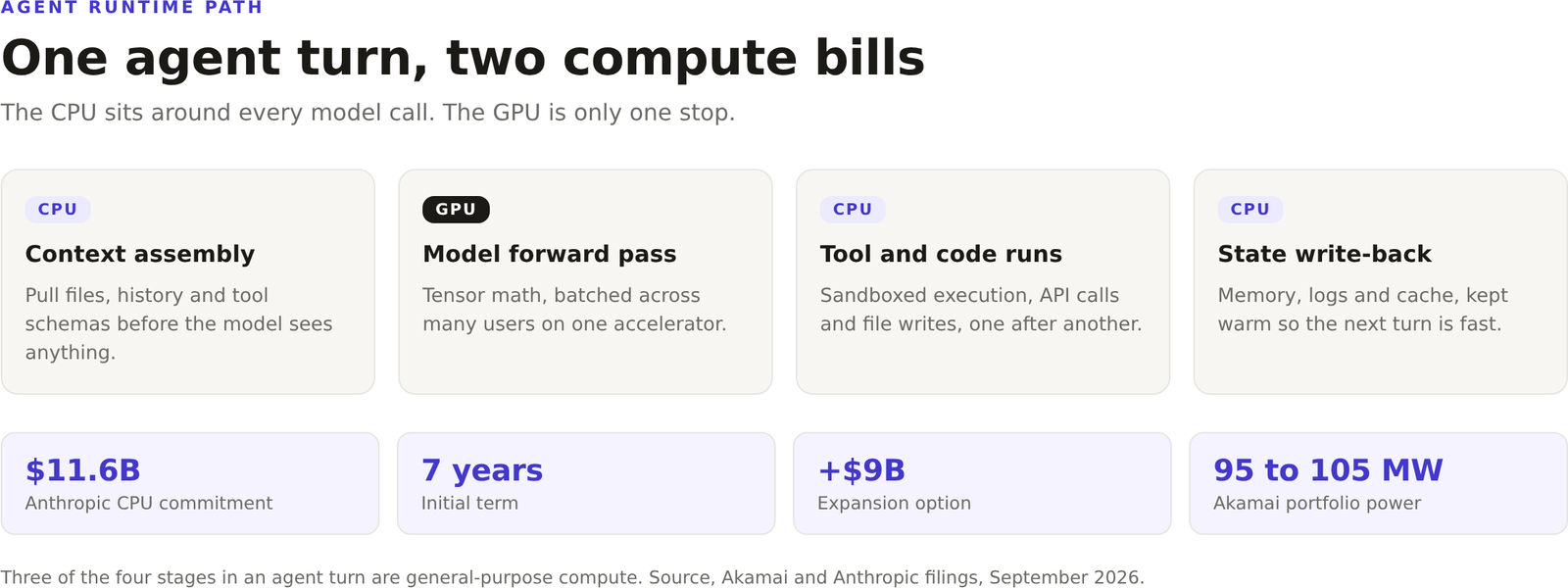
The finding is structural. The AI infrastructure market prices GPUs, and the GPU is one stage in an agent turn. Context assembly, tool execution, sandboxing and state write-back all run on CPUs, and they run continuously while the agent is working. The verdict is that general-purpose compute near the workload is now a first-class capacity constraint, and this is the first large contract that says so in public. Watch whether the equity-for-spend structure repeats in the next deal.
An agent does not simply call a model. It loops. It reads the task, gathers context through connections like the Model Context Protocol, asks the model what to do next, runs the tool that answers, writes the result back, and repeats. The model call is one step in that chain. Everything around it is ordinary, serial, latency-sensitive compute, and it lands on CPUs. That is why CPU workloads for AI agents are a capacity story, not a footnote.
That is the shape of the deal Akamai and Anthropic signed on 24 September. Anthropic committed $11.6 billion over seven years for Akamai Cloud capacity, and the release states the purpose plainly. Anthropic’s accelerating CPU workload demands. Not accelerators. Processors. The contract carries an option to add $9 billion, taking the total potential commitment to about $20 billion.
This deal is all CPU, and that is the tell
Every AI infrastructure headline this year has counted GPUs. Akamai’s chief financial officer, Ed McGowan, told analysts the Anthropic agreement is entirely CPU-based, while the company’s other recent cloud contracts mix CPU and GPU work. The largest single commitment in Akamai’s history buys none of the silicon the market talks about.
The economics are specific. Akamai put capital expenditure tied to the commitment at about $5.5 billion, with $1.7 billion of it in 2026 to secure and pre-purchase critical supply chain components, including memory. Revenue starts in the second half of 2027. The company expects $150 million to $300 million that year and an annualised run rate near $1.7 billion by the end of 2028, under a take-or-pay structure. Across its recent cloud contracts, Akamai estimates 95 to 105 megawatts of power and about $22 million of annual revenue per megawatt.
Keep the memory line. Pre-buying components to guarantee delivery is what a supplier does when procurement, not demand, is the bottleneck. High-bandwidth memory and server DRAM gate CPU fleets as much as accelerator fleets, and a $1.7 billion forward purchase bets the shortage outlasts the contract.
Anthropic is buying equity in its own supplier
Buried in the same filing is a warrant. Akamai issued Anthropic the right to buy Series B preferred stock convertible into about 7.7 million common shares, close to 5 percent of the company, at $111.33 per share equivalent. Roughly 2 percent vests against the $11.6 billion already committed, and the remaining 3 percent vests at about one point per additional $3 billion Anthropic spends.
That is vendor financing wearing a customer contract. Anthropic’s upside is tied to the growth of the company it is paying. The pattern is spreading across the AI supply chain. Nscale, an infrastructure provider behind a large Anthropic agreement, told investors in its September IPO filing that it had not yet secured binding financing for the equipment behind the contract, as Data Center Frontier reported.
The questions to ask before you copy the pattern
Anthropic can commit $11.6 billion because its agents run at a scale few buyers reach. The pattern underneath is what travels. Ask three questions of your own.
First, where does the compute around your model calls run? If your agent harness, retrieval layer and sandbox execution sit far from your users, you pay latency on every loop, and the loop runs many times per task. Second, is your capacity contract priced on the right unit? A GPU reservation prices accelerators. If three of four stages in the loop are CPU, you are buying the wrong thing and renting the rest. Third, who carries the risk when demand does not arrive? A take-or-pay contract with a supplier equity kicker hands upside to the buyer and downside to the supplier’s shareholders. If you are the supplier, price that warrant like the option it is.
The agent era bills like a general-purpose workload with an accelerator in the middle. Operators who price only the accelerator will be surprised by the invoice. Our running record of AI data centre power commitments tracks the gigawatt deals, and CPU contracts will show up there next.
Related reading. OpenAI made the agent harness a managed service, the same bet on where the work runs. Our four-layer view of enterprise AI infrastructure explains why scheduling is where the value leaks.
Get the next one before it is old news
Independent analysis of cloud-native infrastructure, Kubernetes and data center economics. No vendor spin.
[…] reading. We covered Anthropic’s 11.6 billion dollar commitment to CPUs and why token prices fell while the cache took on the […]