
Executive Summary
AI data center power, not land or chips, now decides where capacity gets built. Sesterce, a French AI infrastructure company, said on 8 October it will spend more than 10 billion euros to turn a former paper mill in Jamsa, Finland into an AI campus, starting at 200 megawatts and stretching past one gigawatt. The point is not the paper mill. It is the grid connection already attached to it. Interconnection queues, not construction schedules, set the pace now, so builders are buying sites that already have power.
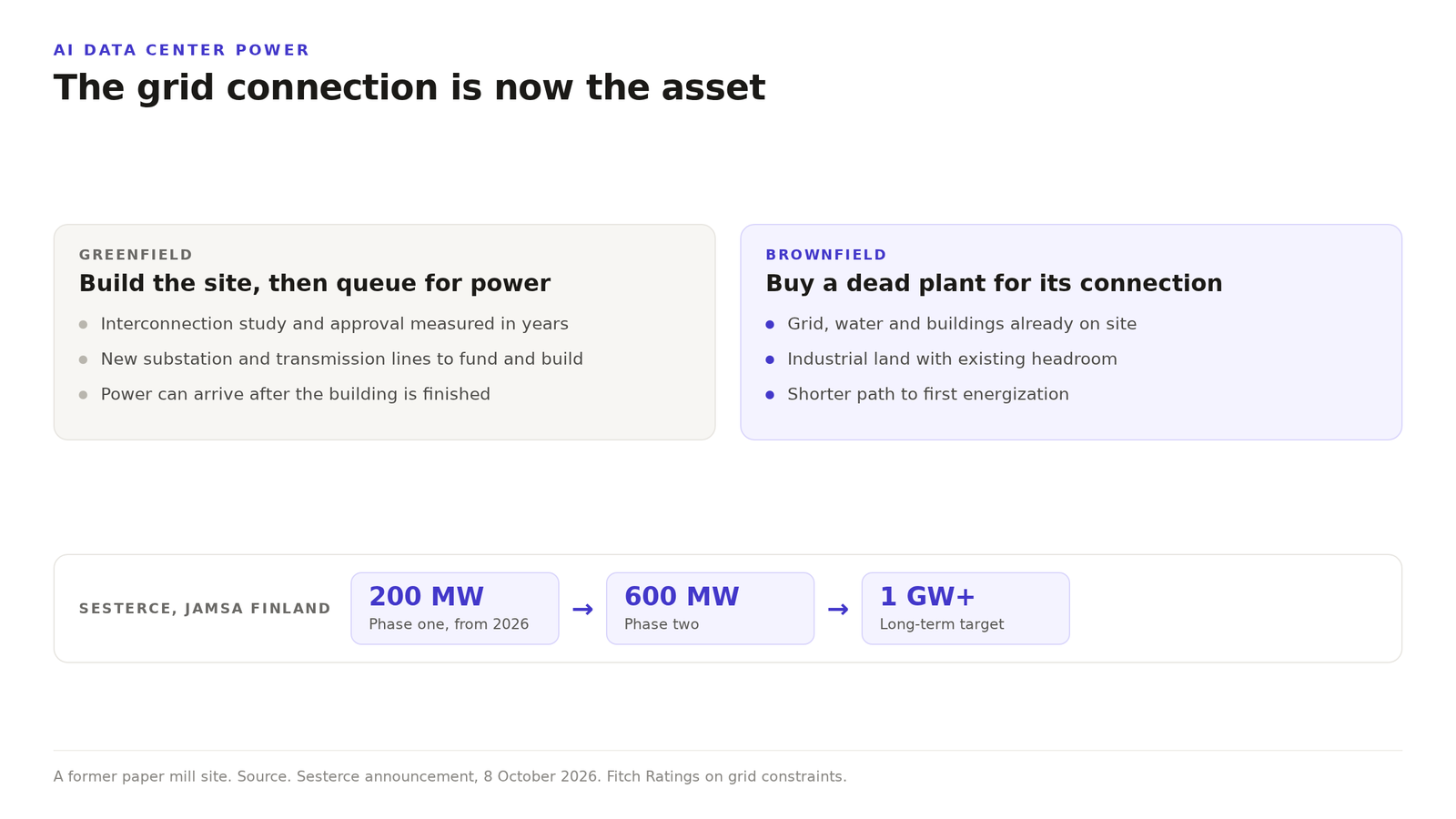
The finding is that the grid connection has become the scarce asset, and it trades like one. A greenfield site waits years for a study slot and a substation. A brownfield site arrives with a connection, water and buildings. Fitch Ratings makes the same point about Taiwan, where approved power allocation decides which projects proceed. Read a capacity announcement by asking one question. Does the site already hold the power, or is it still in the queue?
Sesterce picked a stretch of central Finland that used to make paper. It plans to make compute there instead.
The French company said on 8 October it will invest more than 10 billion euros in an AI campus at the former Kaipola paper mill in Jamsa. Phase one carries 200 megawatts and begins this year. Phase two takes the site to 600 megawatts. The long-term target is more than a gigawatt, built across existing industrial sites in Finland rather than green fields.
The point of the site is the wire that already reaches it
An idle mill is not valuable for its buildings. It is valuable for the power grid, water systems and logistics connections already wired to it. Sesterce’s chief executive said the goal is to reuse that existing infrastructure and keep the area’s industrial identity intact. That is the whole mechanism in one sentence.
A brand-new AI campus mostly waits on the grid. Interconnection studies and approvals run for years, and the wait often continues after approval while substations and lines get built. A site that already draws power skips most of that line. That is why a shuttered plant on a transmission line can beat open land with a better view.
Power allocation is now the gate on AI capacity
Fitch Ratings said in October that power availability, not chips, will drive Taiwan’s AI data center growth. The island makes most of the world’s AI servers, yet northern Taiwan has frozen new power applications above five megawatts since 2024 because of grid limits. As of November 2025, 79 applications for AI data center power totalling about 4,758 megawatts had been filed, and only 40 covering about 3,033 megawatts were approved. The hardware was never the constraint.
Sesterce is also pricing the political side. For every megawatt the campus consumes, it commits to enable a new renewable megawatt on the Finnish grid within ten years. Cooling uses a closed loop with harvested and recycled water, no drinking water. It will put 10 million euros into a community fund. Those terms are the cost of local consent for gigawatt-scale load, and they are now part of the bill.
Three questions for any capacity claim
Three questions separate a real site from a press release. Does it hold an approved interconnection, or only a queue position? What is the marginal cost of the next megawatt, and who pays for the line? And does the local grid have headroom, or does the campus compete with the town for power? The answers decide whether a gigawatt announcement becomes a building.
Related reading. The 32 gigawatt gap the AI supply chain is not pricing, and why a hyperscaler signed a 20-year power price hedge.
Sources. Sesterce and its own site, the Hut 8 power-first model and its AEP Texas interconnection, plus Fitch Ratings.
Get the next one before it is old news
Independent analysis of cloud-native infrastructure, Kubernetes and data center economics. No vendor spin.