


Executive Summary
The United States faces a 32 gigawatt shortfall in data center power through 2028, a 34 percent net gap that remains after fuel cells and behind-the-meter generation are counted. Morgan Stanley produced the estimate, and it says the gap will not slow the two companies sitting at the top of the AI build.
The bank argues Nvidia and Broadcom can steer scarce product toward projects that already have power, so their 2027 revenue forecasts survive the crunch. The pain moves one layer down, to memory, optics, power management and analog parts, where a six month delay pushes deliveries out and strands inventory. The finding reframes the AI data center power shortage as a scheduling problem, and scheduling is now the thing operators and their suppliers both have to manage.
Power is the constraint now, and it is starting to pick winners. A new analyst note puts a number on the gap and shows which parts of the AI supply chain carry the risk when the electricity does not arrive on time.
The gap is 32 gigawatts, even after the workarounds
Morgan Stanley estimated, in a note reported by Reuters, that US data center developers face a 34 percent net power shortfall through 2028, equal to 32 GW. That figure already gives credit for behind-the-meter generation and fuel cells, the on-site power that developers have been racing to add.
The cause is a build that keeps outrunning the grid. Developers have announced gigawatt campuses faster than utilities can connect them. Nvidia chief executive Jensen Huang has described the sequence in the same terms, saying builders now secure the land, power and shell before they fill a building with hardware, a process he says can run two to three years.
When electricity sets the timeline instead of chips, the question stops being how many accelerators can ship. It becomes where those accelerators can actually run.
Nvidia and Broadcom are shielded because they can move
Morgan Stanley does not see the bottleneck putting the 2027 forecasts for Nvidia or Broadcom at risk. The bank credits three things, visibility into where product is being deployed, geographic reach, and coordination across data centers, chip suppliers and the power industry.
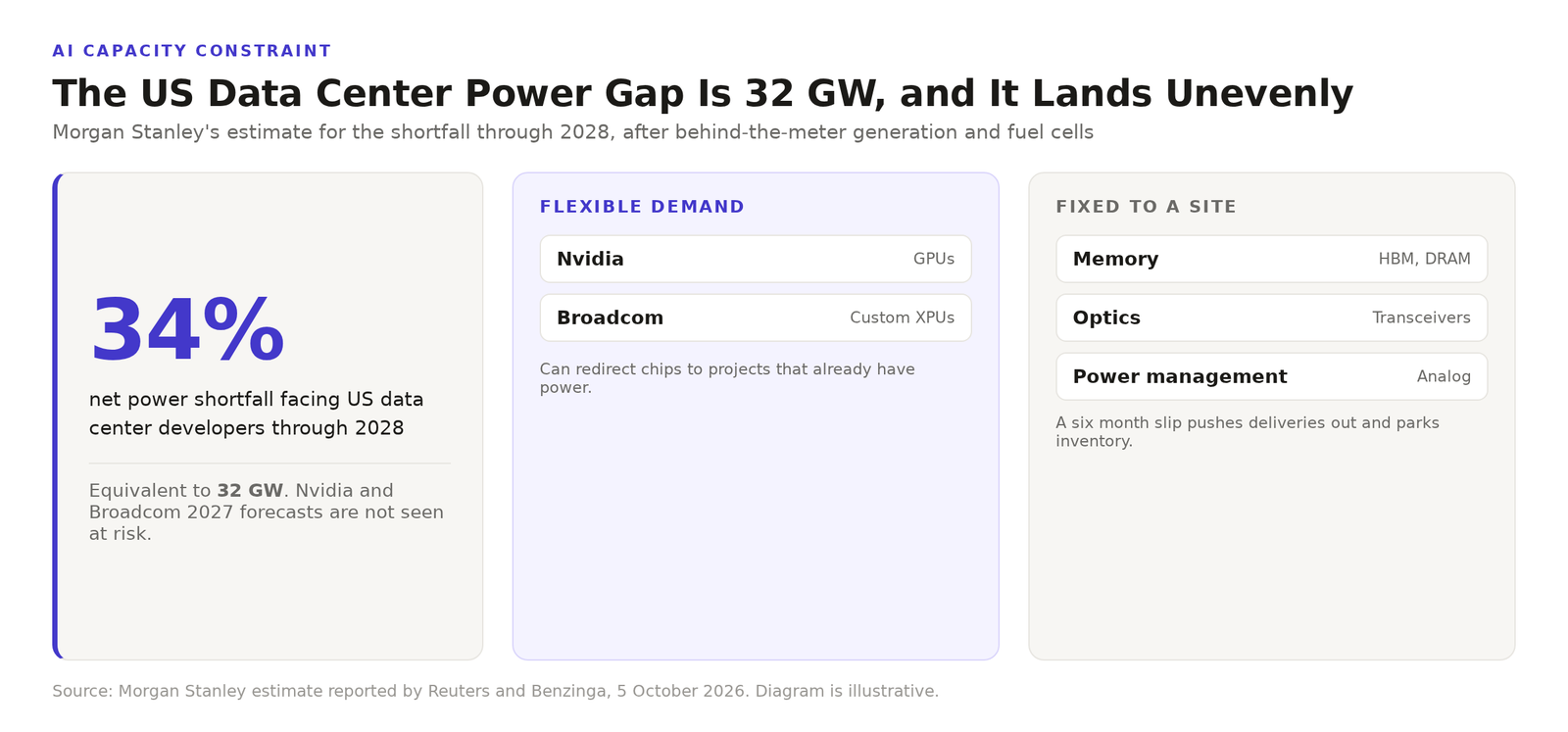
That flexibility is the shield. If one campus slips, Nvidia can redirect scarce GPUs to a project that has already secured power. Broadcom designs custom accelerators around specific customers and their data center plans, so it also sees where the racks are headed.
The bank has made a related argument before. If electricity is the binding constraint, customers have more reason to buy the part that produces the most compute per watt. Scarcity pushes buyers toward the densest hardware rather than the cheapest.
The inventory risk lands on the parts that cannot move
A delay does not delete demand. It reschedules it. If a facility slips six months, a customer can push out or cancel deliveries of memory, optical, power-management and analog components while it waits for the substation. Morgan Stanley named those four categories as the most exposed to inventory disruption, Benzinga reported.
That is where the AI data center power shortage turns into an earnings problem. Micron says more than 75 percent of its 2027 output is already committed, and the memory shortage is real. But committed and deployed are different dates. The same memory a delayed campus still needs can sit in a warehouse while the interconnection is finished.
Nvidia is underwriting some of that power itself. It is providing credit support for 4.25 GW at SB Energy in Ohio and invested 1.5 billion dollars in the developer, which is one way to move a project up the queue.
The takeaway for anyone planning capacity is blunt. Your hardware schedule is only as firm as a power schedule you may not control.
Three questions worth putting to your own plan. Where does your next capacity actually get its power, and is that interconnection signed. If one site slips, can your hardware move to another that has power. And do your supplier delivery dates assume a power schedule that does not exist yet.
Related reading. The real AI buildout number is 180 gigawatts, not 420. Memory, not the GPU, now sets the price of an AI rack. And the data center backlash has not moved the capacity forecast.
Get the next one before it is old news
Independent analysis of cloud-native infrastructure, Kubernetes and data center economics. No vendor spin.
[…] reading. The 32 gigawatt power gap the AI supply chain is not pricing, and why a memory limit can read wrong on the […]