


Executive Summary
AI compute is now financed by the companies that supply it. The Wall Street Journal reported on 7 October that Broadcom, Oracle and SpaceX are each arranging large debt packages to pay for AI chips. Broadcom is working on a package above $50 billion for OpenAI custom silicon, while Bloomberg put the early talks nearer $30 billion. The pattern is not new. Broadcom, Apollo and Blackstone launched the AI XPV Platform in June to enable more than 20 gigawatts of custom-accelerator capacity, starting with a $35 billion transaction for Anthropic.
The finding is that vendor financing has become the default capital structure for AI hardware. Institutional investors buy the accelerators, lease them to developers, and the chip supplier backstops part of the debt. That moves the risk question from product demand to credit quality. Analysts expect the reported deals to convert, and they differ on what the structures imply for risk. Watch whether the packages become binding commitments.
Broadcom sells the chips. Increasingly, it arranges the money to buy them.
AI chip financing has moved onto the supplier’s balance sheet. The Wall Street Journal reported on 7 October that Oracle, Broadcom and SpaceX are each seeking blockbuster debt to pay for AI chips. Broadcom is working on a package above $50 billion for its custom accelerators with OpenAI. A separate Bloomberg report the same day put the early discussions nearer $30 billion. Neither figure is committed, and none of the companies has disclosed a final structure.
The mechanism is worth pausing on, because it changes who carries the risk. A financing vehicle raises money from institutional investors and buys the accelerators. That vehicle leases the hardware to an AI developer. The chip supplier backstops part of the debt. The developer gets compute without a full upfront payment. The lender gets hardware as collateral and a long contract to sit behind.
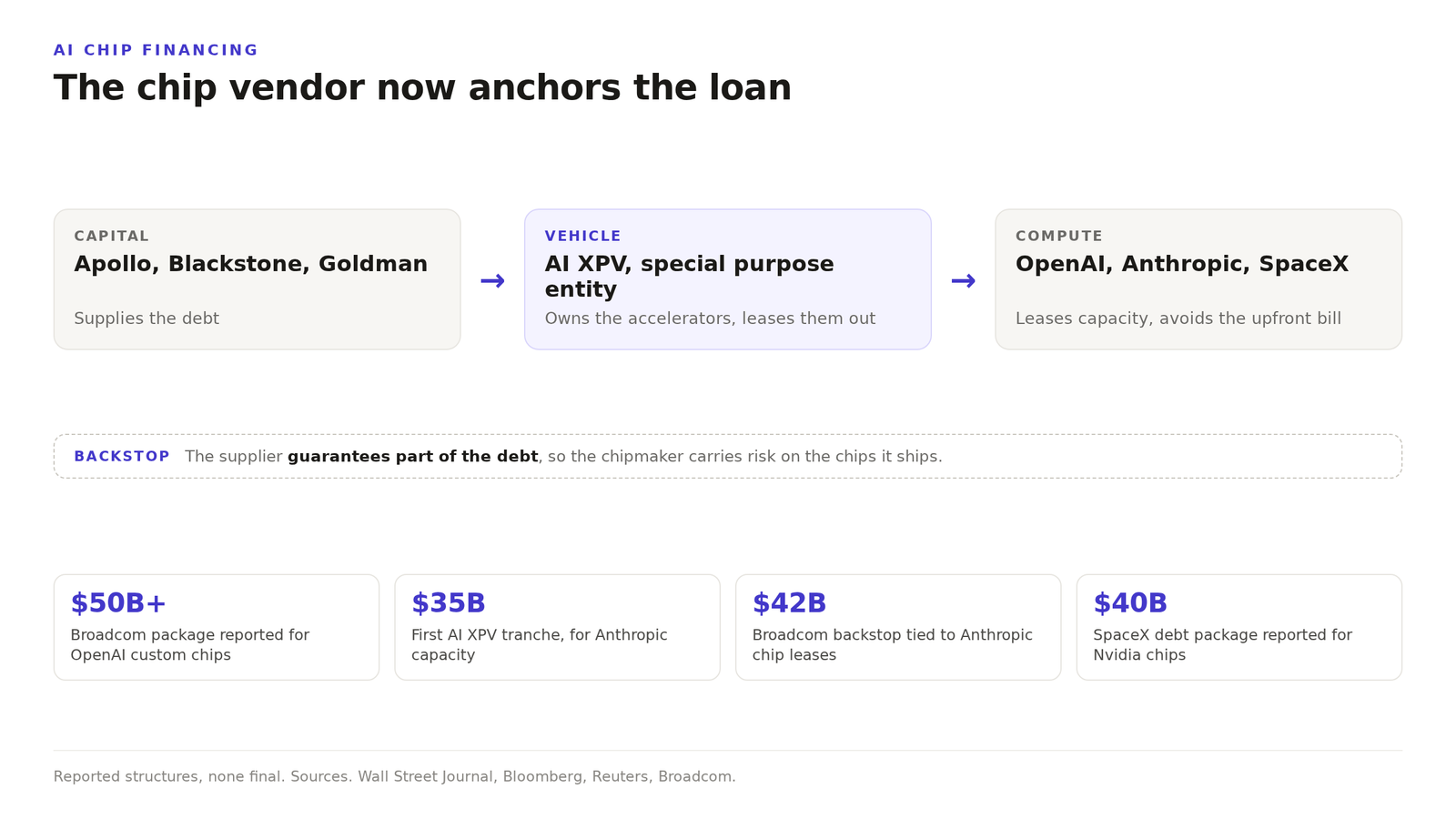
The chipmaker now carries the risk it sells
Broadcom built the plumbing for this in June, when it launched the AI XPV Platform with Apollo and Blackstone. The platform is designed to enable more than 20 gigawatts of compute using Broadcom custom accelerators. Its first transaction was $35 billion for more than a gigawatt of Anthropic capacity.
The model is already widening. Reuters reported on 1 October that Broadcom agreed to provide up to $42 billion of financing tied to Anthropic’s chip capacity leases. That is roughly one third of a $125.2 billion five-year leasing commitment. The same filing said some of the debt instruments could convert into Anthropic shares, which draws the supplier even closer to the customer’s outcome.
Vendor financing turns revenue into a credit question
The scale is what makes this different. Broadcom reported $16.7 billion of AI semiconductor revenue in its fiscal third quarter, up 221 percent from a year earlier, and guided to $21.7 billion for the next quarter. A reported $50 billion financing package is more than three times the latest quarterly figure. A financing commitment is not revenue, and it can span several years. Even so, the two numbers now sit in the same conversation.
That is the argument to hold onto. When one company supplies the chips and guarantees the loan, the buyer’s demand and the supplier’s credit risk start to look like a single thing. Oracle is in talks with Apollo and Goldman Sachs for a similar structure on a planned one gigawatt data center. SpaceX is reportedly seeking about $40 billion for Nvidia chips. Every deal pushes the same question forward. Is the demand coming from end users, or from a financing cycle the suppliers keep turning?
What to ask before you trust the number
Three questions sort a solid capacity claim from a fragile one. Who owns the hardware, and who is left holding it if usage falls? Who backstops the debt when a generation of accelerators loses resale value? And what happens to the contract if the end customer cannot cover its obligations? A number that answers all three is worth more than a headline figure.
Related reading. How GPU financing became an investment-grade asset class, and why firms want a futures market for GPU rental.
Sources. Broadcom, the AI XPV launch, Reuters, Bloomberg and The Wall Street Journal.
Get the next one before it is old news
Independent analysis of cloud-native infrastructure, Kubernetes and data center economics. No vendor spin.
[…] reading. We covered how Broadcom is becoming the bank for the chips it sells, the financing side of the same capacity […]