


Executive Summary
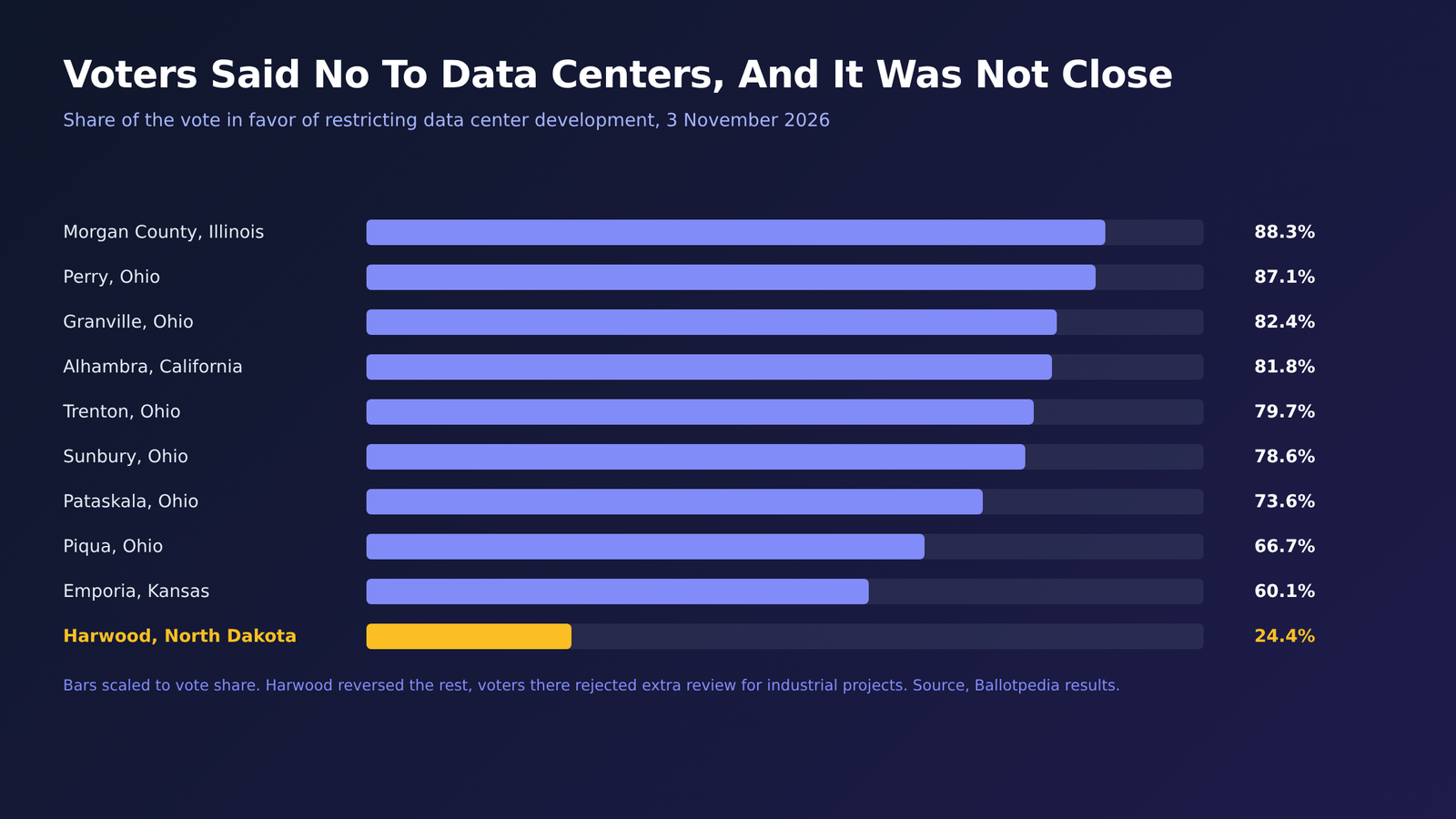
Forty-one data center questions went to voters in ten states, and the industry lost every one but Harwood, North Dakota, where a three to one majority declined to add review for industrial projects. The margins carry more information than the count does. Morgan County, Illinois cleared 88 percent. Perry, Ohio took 87. Four Ohio towns passed 77 or better. Local ballot questions almost never land there.
The pattern running through them is a megawatt number. Ohio wrote 25 megawatts into measure after measure. Kansas wrote 10. Both sit below the draw of any AI campus now being financed, which turns a zoning exercise into a construction ban on the only facility the industry builds. Ohio is also the state where OpenAI holds eight gigawatts, and where the Senate seat and the governor office both went to candidates who campaigned against the load.
Ohio put 21 data center questions on Tuesday’s ballot, more than any other state, and the same election flipped its Senate seat and its governor’s office. The two results share a cause.
Most of those towns were asked one question. Prohibit data centers above 25 megawatts, yes or no. That number is the whole story, because it is smaller than anything the industry is currently building.
A 25 megawatt ceiling bans the only data center anyone is financing
Four Ohio measures name the threshold explicitly. Conneaut, Defiance, Sunbury and Trenton all prohibit facilities with an aggregate demand or peak load greater than 25 megawatts.
Kansas went lower. Emporia and El Dorado define a high impact data center as peak load above 10 megawatts, or a water draw above 100,000 gallons a day, per MultiState’s survey of the measures. El Dorado wrote a ten year ban that only another public vote can lift.
Put that against the pipeline. PORTS-Pike, the Ohio campus OpenAI is developing with SoftBank and SB Energy, is meant to hold 8 gigawatts according to CNBC’s reporting. That is 8,000 megawatts. It is 320 times the ceiling four Ohio towns set on the same ballot.
Piqua is what enforcement looks like. The charter amendment prohibiting a data center passed 67 to 33. In a separate special election, more than 70 percent of voters recalled three commissioners who had backed the project, as WOSU reported.
Ohio carried 21 of the 50 questions because Ohio is where the load is landing
Ballotpedia counted 50 data center ballot measures across 13 states this year. Twenty-one sat in Ohio, spread over 18 jurisdictions. Illinois held seven, four of them in Madison County. The remaining 22 were scattered across 11 states, and Stateline found the same answer almost everywhere it was counted, whether the question was a flat ban, a pause or an energy cap.
That concentration tracks the load. Ohio has become one of the fastest growing data center markets in the country. MultiState put the number of active local moratoriums there at 125 in September, before any of Tuesday’s votes. A running tally of the outcomes sits at Data Centers on the Ballot.
The statewide races moved on the same current. Sherrod Brown defeated Jon Husted after making data centers central to the campaign. Amy Acton won the governor’s office on a conditional moratorium tied to projects covering their full utility costs.
Texas reached the same verdict from further right. Gina Hinojosa beat Greg Abbott after campaigning for a statewide moratorium, and Abbott had already frozen new permits and ordered an audit in August.
The capacity forecast has not moved, which is where the cost shows up
We said in October that the backlash had not moved the national capacity number, and Goldman forecast 64 gigawatts of US data center capacity for 2026. That still holds in aggregate. It fails at the site level. A prohibition in Granville does not delete eight gigawatts from a forecast. It relocates them and adds a permit step that a lender now prices.
Texas is the clearest cost. ERCOT’s queue held 445.8 gigawatts of requests against an 85.5 gigawatt peak when Abbott froze permits, so the requests did not vanish. They queued behind a decision that no longer belongs to the utility.
The second cost lands on the towns that vote yes. Umatilla, Oregon declared a fiscal emergency over $5 billion in investment and fees it had already budgeted once the state’s moratorium froze its permit queue. A pause protects a budget from a load it cannot serve. It also removes the revenue that was going to pay for the roads.
Three questions are worth putting to a pipeline this week. Which of your sites sits in a jurisdiction that has already voted, rather than one that might. What does your delivery date assume about a permit that is now discretionary. And if the answer is nothing, how much schedule can you absorb before the eight gigawatt gap becomes someone else’s capacity.
Get the next one before it is old news
Independent analysis of cloud-native infrastructure, Kubernetes and data center economics. No vendor spin.