
Executive Summary
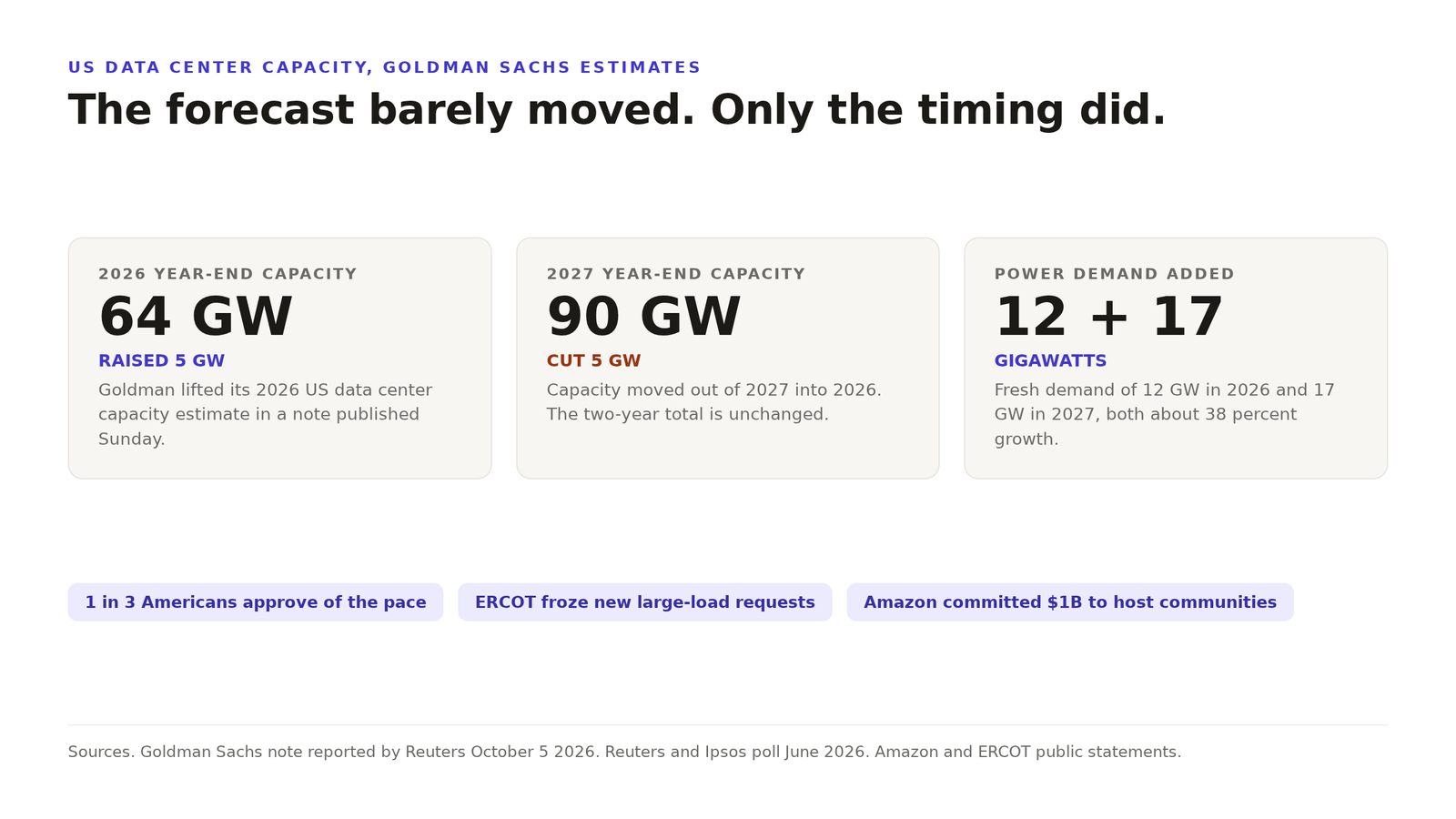
Political opposition to data centers is loud, organized, and so far invisible in the capacity numbers. Goldman Sachs raised its 2026 year-end US data center capacity forecast by 5 gigawatts to 64 GW in a note published on Sunday, and trimmed the 2027 figure by the same 5 GW to 90 GW. The two-year total did not move. What shifted was timing.
The second finding is about who absorbs the friction. About one in three Americans approve of the pace of construction, Amazon has committed $1 billion to the communities that host its campuses, and grid operators are auditing their interconnection queues instead of turning gigawatt-scale requests away. Capital is treating local opposition as a cost and a delay, not a ceiling. The number to watch is 2027, because that is where the siting fights will land.
The note landed on Sunday and it was reported the next morning. Goldman Sachs did not lower its US data center capacity forecast. It raised the near-term number and cut the later one by exactly the same amount.
For 2026 the brokerage now expects 64 GW of year-end capacity, up 5 GW from its prior estimate. For 2027 it expects 90 GW, down 5 GW. Alongside that, Goldman put US data center power demand growth at about 38 percent in both years, or 12 GW in 2026 and 17 GW in 2027.
Read the two moves together and the story is not slower growth. It is growth that arrives sooner, with a thinner tail on the far end. The direction never changed.
Sixty four gigawatts of new load has no precedent
The scale is the part that gets lost in the political argument. A single year adding 12 GW of fresh demand is a load class that did not exist a decade ago, and 2027 adds 17 GW on top of it.
The supply side is moving to match. The Department of Energy is funding transmission upgrades aimed squarely at this demand, most of it reconductoring existing lines so they carry more power without new right of way. That adds headroom on the wires. It does not add generation, and it does not skip the connection study.
Opposition is now a line item, not a stop sign
Community resistance is real and measurable. A Reuters and Ipsos poll put approval of the pace of data center construction at roughly one in three Americans. County boards have paused projects, and Texas stopped issuing some environmental permits until grid and water audits are finished.
The industry answered with money and process. Amazon said it will put $1 billion into the communities that host its data centers, a fund that spreads goodwill across dozens of sites for less than a single campus costs. Grid operators like ERCOT froze new large-load requests and began auditing a queue that had grown far faster than the grid it describes.
Neither move is a retreat. A community payment is cheaper than a lawsuit and faster than a relocation. An audit is how a queue stops being a free option for developers who file at four substations and build at one.
What is left is a siting problem, not a demand problem. The buyers committing to gigawatt-scale campuses are the same ones signing multi-year leases and buying accelerators. They will build where the interconnection is already approved, which is why behind-the-meter generation has moved from curiosity to default at new sites.
The 2027 number is the one that moved
Goldman trimmed 2027 by exactly the five gigawatts it added to 2026, and that symmetry is the useful signal. Capacity is being pulled forward at sites that already have power and pushed out at sites that do not. The pipeline is intact. The geography is changing.
Three questions to apply to your own environment. Does your capacity plan assume power arrives when the buildings do, or when the queue clears? Have you modeled a two-year slip at your newest site? And if you have not, which workloads could move closer to where the power already sits?
Related reading. The power problem inside the rack shows up in our look at how a one megawatt rack broke the 54 volt bus, and the squeeze on where AI capacity can physically land is tracked in our piece on the disclosure gap in sovereign GPU clusters.
Get the next one before it is old news
Independent analysis of cloud-native infrastructure, Kubernetes and data center economics. No vendor spin.