


Executive Summary
Beijing’s draft export list would put model weights under license, and the test with the widest reach is not size. A checkpoint counts as globally leading if it ranks in the global top ten on public evaluations or on global call volume at the time of export. Tencent’s Hy4 is put at about 770 billion parameters by Chinese press, well under the two trillion line. It also served 16 trillion tokens on OpenRouter in the week to 9 November, third on the board. Popularity alone can carry a model into the restricted tier.
Moonshot went the other way and published a 3T-class checkpoint anyway. The draft leaves already-public technology outside its scope and promises automatic licensing for new open releases, so the open-weight tap is not closing. It has a valve now. For anyone sizing a platform on a Chinese checkpoint, the release date is a compliance date, and comments on the draft close on 15 November.
Tencent put Hy4 live on 4 November and promised the weights and a system card in the coming days. On 10 November the Tencent account on Hugging Face carries the August preview and nothing else.
The easy explanation is a safety review, because Tencent says it is running one. There is a second clock, and it runs in Beijing.
One clause turns call volume into a license test
China AI export controls reached model weights on 16 October, when the Ministry of Commerce and the Ministry of Science and Technology published Announcement No. 48 of 2026 as a draft. It would add 23 AI technologies to the restricted export catalogue. For large models that covers weights, checkpoints, source code and architecture.
Any one of three tests moves a model into the restricted tier. Training compute of 10 to the 26th floating point operations. Two trillion parameters. Or a top ten position on public assessments of performance, capability, call volume, safety or training efficiency, judged at the time of export.
That third test is the one that changes behavior, because it has no floor. The draft never names the rankings it trusts. A model well under two trillion parameters qualifies if a large platform ranks it in the top ten for use.
Hy4 sits well under. Tencent has published no parameter count for the final build, and Chinese state and business press put the Hy4 series at 770 billion. On OpenRouter it entered the weekly board third with 16 trillion tokens processed, behind DeepSeek V4.1 Flash 1017 at 55.4 trillion and the earlier DeepSeek V4.1 Flash at 17.5 trillion.
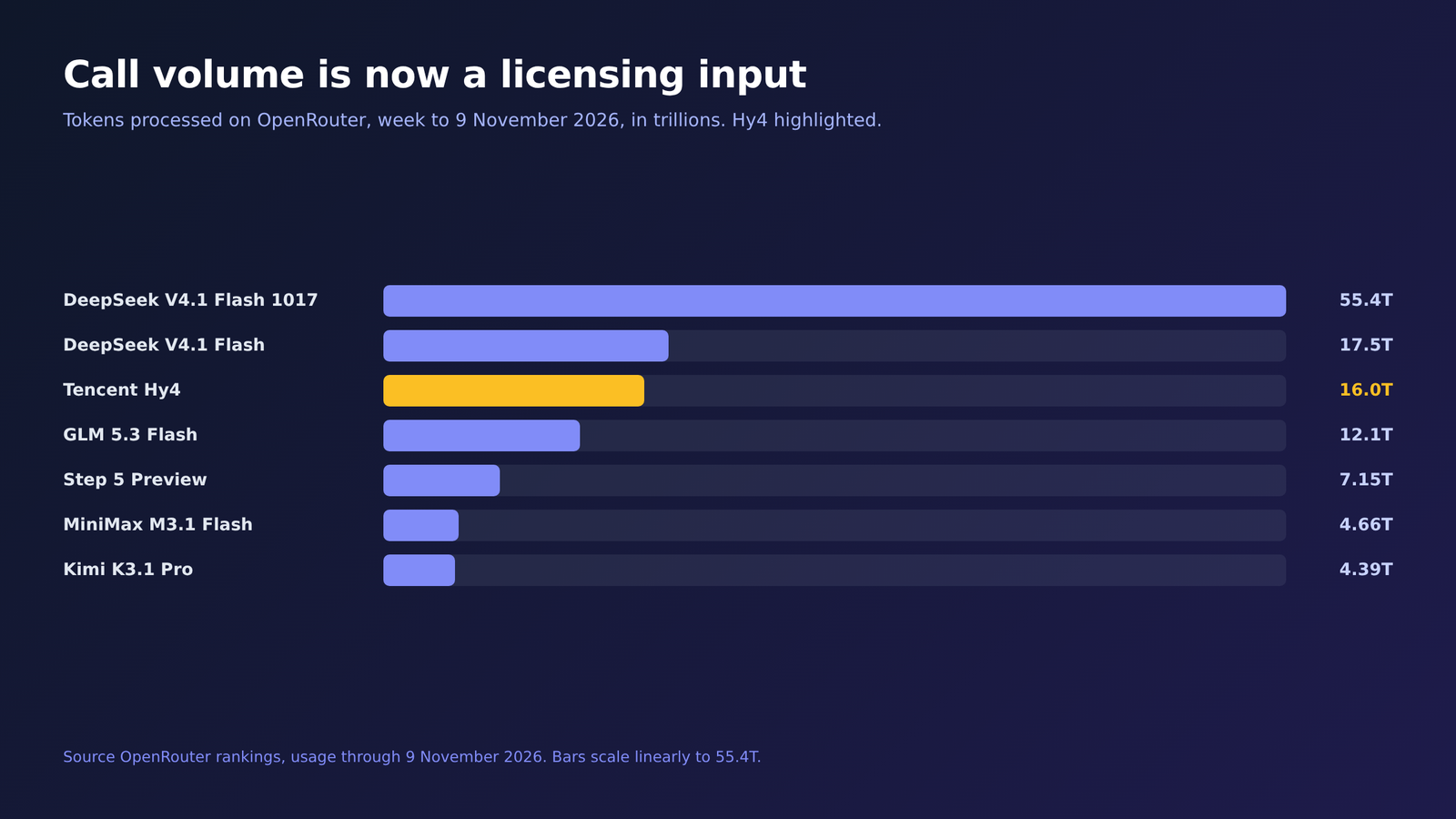
By call volume that is a top ten model in the world, and the draft does not say which rankings count. The commerce ministry says most AI technology can still be exported freely, and that companies should judge what needs a filing.
A 770 billion parameter checkpoint serving more tokens than anything except DeepSeek is the exact shape the third test was written for, and there is no file to download.
Moonshot shipped 2.8 trillion parameters into the same window
Moonshot promised Kimi K3.1 Pro’s weights by 4 November and delivered. The checkpoint sits on Hugging Face with 30,721 downloads and 1,864 likes. Moonshot calls the model 3T-class, which is a trillion parameters past the draft’s size test.
The release was allowed by two clauses. Technology that has already entered the public domain through open-sourcing and similar means is not brought within the scope of management, the announcement says. New open releases of restricted technology get automatic licensing, which the ministry describes as cleared about as soon as it is filed.
So the direction is paperwork, not a ban. That does not make it free. A registration rule has been live since 16 October covering listed technology a company exports or licenses abroad, so the first action on a big release is now a filing rather than a download link.
Price the filing step before you price the GPU
Nothing here threatens the checkpoint you already have. Public weights stay outside the scope, and the duty falls on the company exporting, not on the person downloading.
What changes is the next one. A model that crosses any of the three tests needs a filing before the weights leave, and the third can be crossed by a launch that lands well. That is a new risk for a team that picked a vendor because the weights were downloadable.
Three questions are worth asking a supplier. Does the checkpoint you depend on sit above two trillion parameters, above 10 to the 26th floating point operations of training compute, or inside the top ten by usage. Is it already public, because that is the difference between grandfathered and filed. And does the vendor treat a weights date as a roadmap milestone or as a regulatory one.
Comments close on 15 November. Tencent can still call the missing weights a safety review. It is now also a licensing question, and the model that 16 trillion tokens of traffic landed on is not the model you can install.
Related reading. Tencent Moved Its Own Users Off the Model You Can Download followed the same gap, and The Second Most Used Model on OpenRouter Cannot Be Downloaded is the earlier count.
Get the next one before it is old news
Independent analysis of cloud-native infrastructure, Kubernetes and data center economics. No vendor spin.