


Executive Summary
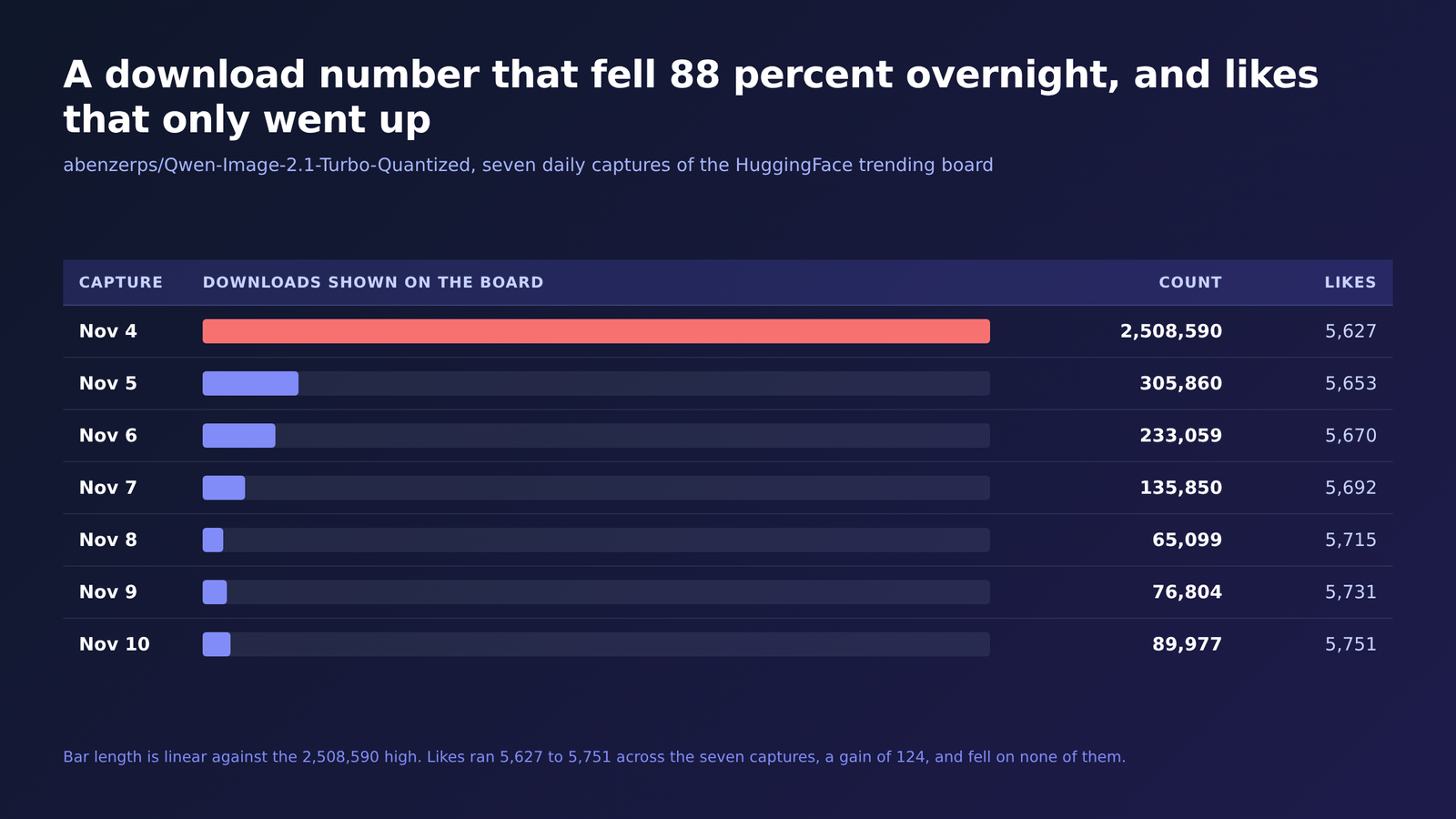
Twelve daily captures of the HuggingFace trending board cover 69 different models, and across them the download column moved down 20 separate times. Seven repositories produced those falls. The steepest came from abenzerps/Qwen-Image-2.1-Turbo-Quantized, which read 2,508,590 on 4 November and 305,860 the following morning, then kept sliding to 65,099 by 8 November. Nothing was withdrawn and the weights never changed. Only the counter moved.
The likes column fell zero times. That asymmetry is the useful part. The figure beside a model is a trailing month of request traffic, and the page itself labels it that way, so it cannot serve as an install base or as a fair comparison between two models of different ages. Teams sizing GPU capacity off it are reading a window with no fixed base. The like count is stricter but much smaller, a floor under human interest rather than a count of anyone running weights.
On 4 November the Qwen-Image-2.1-Turbo-Quantized repository showed 2,508,590 downloads. On 5 November it showed 305,860. The files were still there and the weights still loaded. The number above the file list had dropped 87.8 percent in a single capture.
That is not a scraping fault. It is how a trailing count behaves once a burst of interest ages out of it, and it happens often enough on this board to change the way the column should be read.
The column is a trailing window, so it can fall
HuggingFace labels the figure on a model page “Downloads last month.” Check a repository against today’s capture and the two agree, which is why the numbers drop when a spike leaves the window. Seven of the 69 models we have tracked fell at least once in twelve captures, and between them they produced 20 drops.
Qwen’s own flagship shows the same behavior on a gentler curve. Qwen3.8-27B read 8,037,597 on 6 November and 7,508,158 this morning, a loss of 529,439 across four captures. Its rank improved over the same stretch, from ten to nine. A repository does not shed half a million downloads and gain standing unless the two columns are counting different things.
The counting rules make the HuggingFace download count looser still. HuggingFace’s own documentation says every HTTP request to a repository’s query file counts, GET and HEAD alike, and that GGUF repositories count every GGUF file, so one whole-repo clone lands as several downloads. The 4,215,003 beside SC117’s Flash-Next rebuild is a request count from a repository holding a dozen quantized files. It is not a fleet census.
The board and the count disagree about the same repository
The abenzerps repository sits at rank 28 on today’s board. It got there on 89,977 downloads, five days after that figure read 2.5 million. The board does not notice. Its score weighs recent activity inside a short window, so a repository that lost 96 percent of its displayed downloads can hold a slot next to one that gained, and the ranking says nothing about which of them anybody is actually running.
Watch the second column while the first one collapses. Likes on that repository went 5,627, then 5,653, 5,670, 5,692, 5,715, 5,731 and 5,751 across the seven captures. One direction, no reversals, 124 added while the download figure lost 96 percent of its value. Whatever the big number was measuring, it was not the thing the like button measures.
Read the like rate, then ask three questions
Across all twelve captures and 69 models, likes never fell once. That is what a cumulative counter does, and it makes likes the only column on the board with a stable base. It also makes them small, which is honest, because a like needs a signed in person who chose to click.
Compare rates rather than totals. Of the models present at both ends of the week, Pika-H3-Flex added 164 likes against 592 new downloads, roughly one like per 3.6 pulls. ccore’s Qwen3.5-4B-3D-Coder added 389 likes against 225,967 downloads, one per 581. Same seven days, same board, a spread of 161 times.
Three questions worth asking before a download number moves a budget. Is the figure you are quoting a month of requests or an installed base, and can you date the window. Does the like rate move when the count does, because a repository with flat likes through a spike is being mirrored rather than adopted. And has anyone outside the uploading account shipped a working build, since a single repository with a dozen GGUF files is a distribution point, not a deployment.
Our earlier reading of board tenure covered how fast a slot expires. This one covers the column underneath the slot. Both point the same way. The board measures the last few days of attention and the number beside each name measures the last month of requests. Neither one is a headcount.
Get the next one before it is old news
Independent analysis of cloud-native infrastructure, Kubernetes and data center economics. No vendor spin.