


Executive Summary
Red Hat shipped OpenShift 5 on 9 November, built on Kubernetes 1.36 and CRI-O 1.36, as an in-place update from OpenShift 4.22. The headline feature is an agent. Lightspeed moves from answering questions to investigating a cluster, proposing a cause and proposing a change, with the operator approving before anything runs. Autonomous investigation sits in technology preview and still holds for human approval before a change executes.
The finding that matters more is structural. The standard support window goes from 18 months to 24 per release, and every third release starting at 5.2 becomes an extended lifecycle release with up to three years of additional coverage, for five years total. The verdict is that Red Hat is trading feature novelty for calendar predictability, and for a platform team that just survived a forced hypervisor migration that trade is the valuable half of the release.
OpenShift 5 is generally available now for customers with existing subscriptions, and Red Hat has made the update an in-place one from OpenShift 4.22 rather than a cluster rebuild. The base is Kubernetes 1.36 and CRI-O 1.36, per the release overview and the general availability announcement.
The update path has a wrinkle worth knowing before you schedule it. A cluster updated from 4.22 stays on Red Hat Enterprise Linux CoreOS 9, while a newly created 5.0 cluster defaults to CoreOS 10. A later release is meant to let both node OS versions coexist inside one cluster, so you can move node images on your own timetable instead of during the platform upgrade. Until then the two entry points land you on different node foundations.
The agent asks permission, and that is the whole design
OpenShift Lightspeed is now an agent rather than a chat assistant. In the generally available mode it takes a symptom, investigates cluster events, reasons through likely causes and presents a remediation for an administrator to approve. An optional autonomous mode in technology preview will start investigating on its own from an alert, and still waits for a human to approve the change before it runs.
Update risk analysis works the same way. It is generally available as automated pre-checks against application dependencies, deprecated APIs and installed operators. The agentic version that compiles findings into a proposed update run sits in technology preview.
Read that as an honest assessment of where the model is. An agent that can execute against a production control plane without a gate would be a liability nobody could insure. What Red Hat has not published is any accuracy data for the proposals. A troubleshooting agent is only as good as its hit rate on the first proposed cause, and until that number exists the sensible posture is to treat every suggestion as a lead to check rather than a diagnosis.
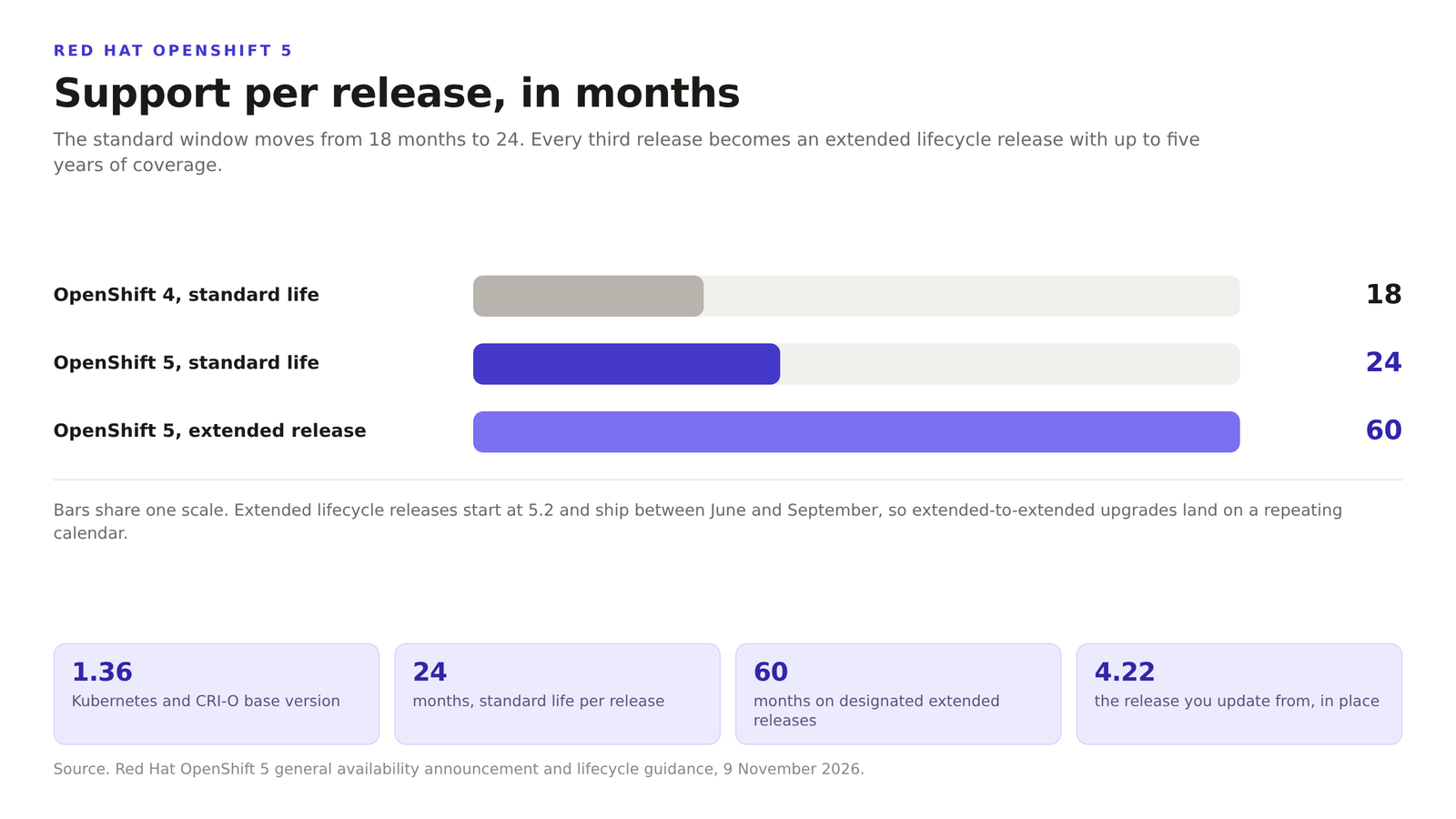
Five years on a designated release changes the upgrade math
The numbers are in Red Hat’s lifecycle guidance. Standard life per release goes from 18 months to 24. Every third release of the 5 line, starting at 5.2, becomes an Extended Life Cycle release, which replaces Extended Update Support and carries up to three years of extra coverage for five years in total. Those releases ship between June and September, so extended-to-extended upgrades land on a repeating calendar slot.
Why that beats the agent on value. A Kubernetes platform upgrade is mostly an application compatibility exercise, and every one of them costs prequalification time whether or not anything breaks. Moving from 18 to 24 months removes roughly a third of that churn per release. Concentrating the long-life versions onto a predictable season turns recertification into an annual planning item rather than an unplanned interrupt. That is what wrecks a quarter.
An MCP server that defaults to read-only is the quiet win
OpenShift 5 ships a Model Context Protocol server and an MCP gateway as generally available. The server integrates with OAuth and OIDC identity providers, enforces Kubernetes role based access control, defaults to read-only access and tags its actions for audit logging. An agent can inspect pipeline runs, query service mesh telemetry or look at virtualization resources using permissions the cluster already understands.
Read-only by default is the right call and the interesting question is what happens after a customer turns writes on. The security release notes also add install-time network policies around control plane operand namespaces, hardened multitenancy aimed at sovereign deployments, and hybrid post-quantum key exchange using ML-KEM with TLS 1.3 clients, which addresses the harvest-now-decrypt-later case rather than data at rest. Device handling gets dynamic resource allocation with partitionable devices and consumable capacity, so a workload can claim a slice of a GPU through a ResourceClaim instead of a whole card.
Three questions before you plan the update. Which of your releases qualify as extended lifecycle releases, and does that window cover your longest application recertification. Who holds the approval gate when the agent proposes a change at three in the morning. And does your identity provider speak external OIDC, because the built-in OAuth server is now optional.
Related reading. Broadcom’s move to make virtual machines into Kubernetes objects on the VM API project covers the same convergence from the other side, since a platform that runs containers, virtual machines and models side by side is now the default shape for both vendors.
Get the next one before it is old news
Independent analysis of cloud-native infrastructure, Kubernetes and data center economics. No vendor spin.