

Executive Summary
DeepSeek said on Sunday that DeepSeek Harness, its open-source agent app, carried 1.54 million daily active users on 4 November and moved roughly 92 trillion tokens in a day. Both figures count only traffic through DeepSeek’s own API, and the company is the only one measuring them. The app launched on 13 August.
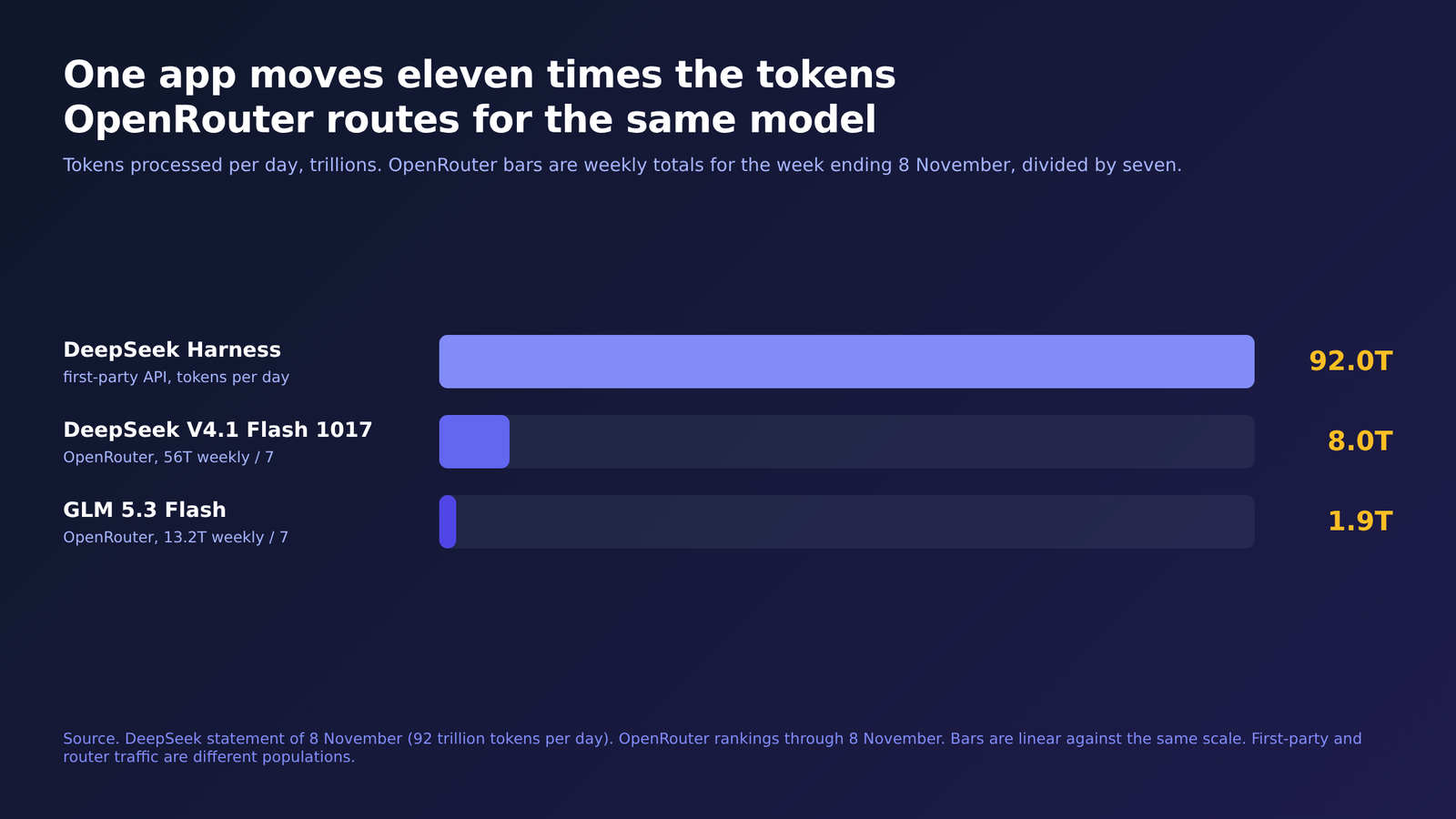
Growth is not the story here. The ratio is. One first-party application now carries about eleven times the tokens that DeepSeek’s flagship model handles across OpenRouter in a single day, which works out to 60 million tokens per user per day. DeepSeek plans an official plugin marketplace and an author support program that pays plugin writers in tokens. That is not charity. It is how a lab turns a popular runtime into a place where inference demand gets locked in.
TechNode reported the user figure, and AI Weekly tied the 92 trillion token number to the same statement, which DeepSeek made on X. Neither is audited. The count covers only people reaching Harness through DeepSeek’s hosted API, so anyone running the open-source build against another provider disappears from it. Daily users sat near 271,000 at the end of September, which makes the climb a factor of about five in five weeks.
Compare it to the router. DeepSeek’s flagship, V4.1 Flash 1017, processed 56 trillion tokens on OpenRouter across the whole week ending 8 November. Divide by seven and the busiest model on the largest third-party router comes to 8 trillion tokens a day. One app moves eleven times that.
Sixty million tokens is what one agent user costs a day
Run the division. 92 trillion tokens across 1.54 million daily users is 59.7 million tokens per person per day, sustained. Call it 690 tokens a second, every second, for every active user. Chat does not look like this. An agent loop resends its context on each step, calls tools, reads the results, then goes again, so the bill scales with steps rather than with messages.
DeepSeek’s list prices make the shape of the business visible. At the off-peak cache-miss rate of 15 cents per million input tokens, 92 trillion tokens a day is about 13.8 million dollars, and the peak rate doubles it. Output tokens cost four times input, so a real bill lands above that range. Cache hits would pull it down hard, which is why the hit rate matters more than the headline price.
The marketplace is a demand lock, not a developer gift
Harness already carries about 35,000 third-party plugins, and roughly 60 percent of active users have built or installed at least one. Everything in the runtime is a plugin, including the model adapter, the tool registry and the agent loop itself, so replacing a capability is a configuration change rather than a fork. The repository says exactly that on its first line.
An official store changes what the plugin count means. Today authors distribute through community indexes and repositories, and discovery goes to whoever shouts loudest. A store with review, featured placement and a support program gives DeepSeek the lever every app store has, which is control over what is easy to install. What is easy to install is what runs against DeepSeek’s endpoint. The company has already started handing tokens to plugin authors, so the priming began before the storefront existed.
The weights are becoming the least interesting part
Look at the same week. Tencent shipped Hy4 with vision and computer use and left the weights unpublished. Baidu put ERNIE 5.5 Flash Base online, a 280 billion parameter model pre-trained on 33.5 trillion tokens, under a license that refuses the European Union, the United Kingdom and South Korea. Moonshot shipped Kimi K3.1 Pro weights under its own license. Every lab draws a different line around the word open, and the runtime sits inside all of them.
For a team picking a stack, model swaps are getting easy and runtime swaps are not. A model is a config row. The runtime sets your token budget, your cache behavior and your audit trail, and that is the part procurement actually buys. We made a related point when the fastest growing AI projects on GitHub turned out to be harnesses rather than servers. The token numbers here are the first hard evidence for it.
Three questions before the next pilot. What does one completed task cost, rather than one million tokens. How much of that traffic is served from cache. And who can read the agent’s event log in six months, when the person who configured it has moved teams.
Get the next one before it is old news
Independent analysis of cloud-native infrastructure, Kubernetes and data center economics. No vendor spin.