
Executive Summary
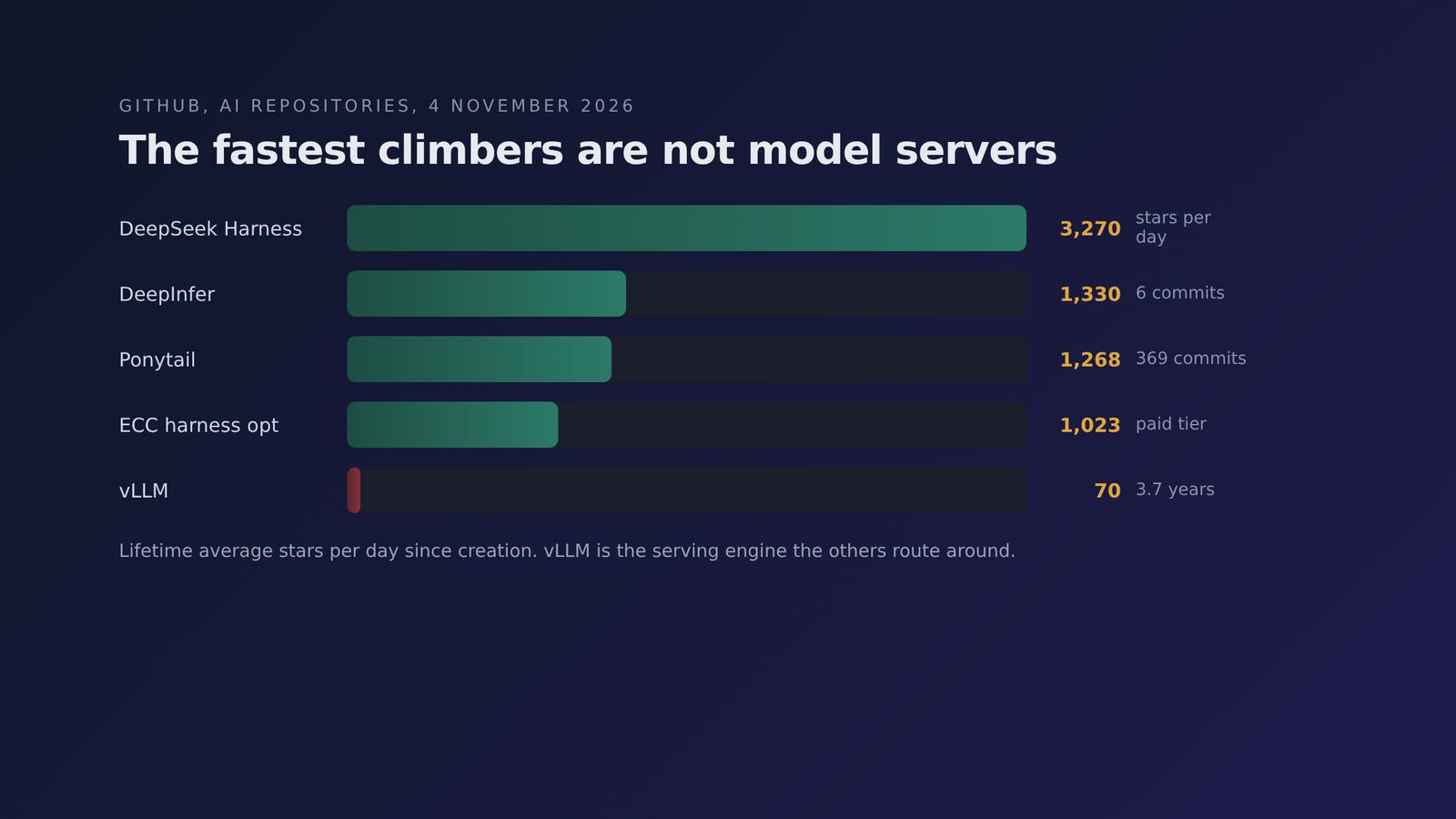
The fastest growing AI repositories are not inference servers. DeepSeek’s most starred AI project is an agent harness at 271,439 stars and 3,270 per day. Google Research shipped a harness. One project sells harness tuning as a nineteen dollar subscription.
Four of the twelve largest recent projects exist only to make context smaller, which is the market saying the binding constraint is token cost rather than model capability. And star count has decoupled from code, so the useful test is commit and contributor count, not stars. One repository reached 25,271 stars in nineteen days on six commits, which is a launch rather than adoption. Another carries 183,892 stars on 369 commits, which is a prompt artifact rather than software. Both will trend and neither tells you what to install.
GitHub data pulled on 4 November, unauthenticated public API, no row missing to rate limits. Star velocity here is a lifetime average, which hides whether growth was one spike or a steady climb.
Three repositories tell most of the story. DeepSeek’s harness sits at 271,439 stars after 83 days, carrying 25,588 commits from 66 contributors. It is a vendor garage rather than a community, and the plugin economy appeared within weeks. Morluto’s reverse engineering MCP server leads on absolute count at 427,817, though its fork to star ratio of 0.25 is the number that matters, because a tool like that only does anything if you install it.
The harness became the product
DeepSeek chose a harness, not a model, as its headline repository. Google Research shipped one. Another project sells harness optimisation as a subscription with a Pro tier at nineteen dollars a seat.
The competitive ground moved from weights to the loop between the model and the toolchain, because the loop is where a vendor sets defaults, owns telemetry and controls which model gets called. Nine of sixteen entries on the weekly trending page are agent skill packs rather than software you deploy.
For a platform team the integration surface worth watching is no longer the inference server. It is the agent runtime and its plugin contract.
Token compression is the real infrastructure signal
Three independent teams reached for the same wedge. One in Go strips prose before it reaches the model, one in Rust compresses command output, one in Python shrinks tool logs and retrieval chunks. All three cleared 75,000 stars.
That is a cost signal pointing at a failure in current serving stacks. If an engine handled tool output and long transcripts well, a proxy that removes adjectives from logs would not be worth 117,000 stars. Context is priced linearly and cached poorly, so people are building around it rather than fixing it.
Expect the workaround to be absorbed. These become features of harnesses within eighteen months.
Stars have stopped meaning what they used to
DeepSeek’s DeepInfer reached 25,271 stars in nineteen days on six commits and five contributors. For scale, vLLM has 96,264 stars after three years and eight months, about seventy a day. DeepInfer is climbing nineteen times faster on a codebase nobody has run a batch through.
That is a distribution event, not adoption. At the other end, a skill that makes agents write less code carries 183,892 stars on 369 commits, which is a prompt artifact with enormous attention and a modest code surface.
The API gives away three better numbers for free. Commit count, contributor count and open issue count. High stars with low commits means a launch. High stars with high commits and a large open issue queue means people are running it and hitting walls. One orchestrator showing 8,083 open issues against 19,011 commits reads healthier than anything on a trending page.
For a platform team the practical read is to stop reading trending pages and start reading the commit graph. The same divergence shows up in model downloads, where a community re-upload outruns the original weights by twelve times.
The projects that survive will sit on a credential boundary or a serving path, where being wrong breaks something. The ones that fade made a model talk differently. DeepSeek Harness and the open weight supply behind it are the same story from two directions, which is why we track both.
Get the next one before it is old news
Independent analysis of cloud-native infrastructure, Kubernetes and data center economics. No vendor spin.