


Executive Summary
Bank of America, Blackstone, Citi and Morgan Stanley committed $63 billion on 26 October to buy Broadcom accelerators and networking, then lease the hardware to Anthropic. Broadcom will cover the difference if the returned racks are worth less than 72.5 percent of what is still owed on the lease. Peak exposure is put at $43 billion a year in, falling on a straight line to $2 billion in the final quarter of year five, with first deliveries in 2027.
The finding is that a chipmaker has become the underwriter of its own silicon, and it disclosed the guarantee as a schedule rather than a sentence. Broadcom says the support is not a cash outlay and expects to pay nothing. The verdict is that the structure answers the only question a lender had, which is who eats the residual, and it moves part of the risk of an AI buildout onto the vendor that profits from the equipment. This is the second deal of its shape with the same customer.
Four banks put $63 billion behind Broadcom chips. The part worth reading is the clause that decides who pays when those chips lose value.
The leases run to Anthropic. The guarantee runs back to the supplier, and it is the first time the asymmetry has been published with a quarter by quarter schedule.
The floor is 72.5 percent and the clock runs five years
The money moves through a special purpose vehicle. The vehicle buys Broadcom XPU accelerators and networking, borrows against them, and leases the hardware to Anthropic. Bank of America, Citi and Morgan Stanley arrange the first lien. Blackstone is the sole provider of the committed second lien. Broadcom supplies residual value support equal to the first lien portion.
The deck published with the announcement defines the exposure precisely. Liability is the difference between 72.5 percent of the outstanding amounts owed on the lease and the value of the AI racks received. Peak exposure is expected at $43 billion, reached a year in, then falls linearly to $2 billion in the last quarter of year five. Broadcom calls the support not a direct cash outlay, and the shape of the curve backs the wording.
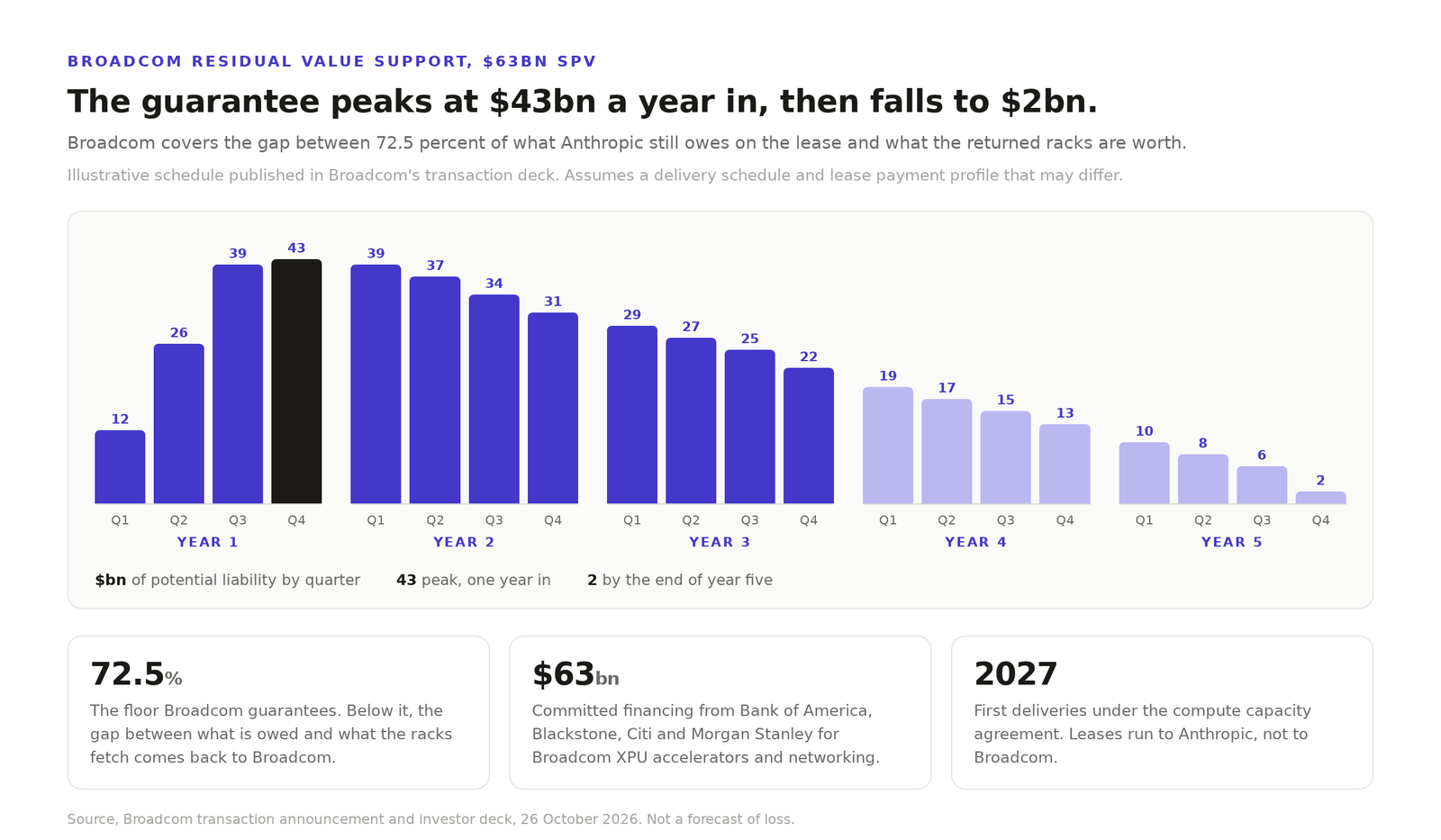
Four layers of protection sit ahead of that number in Broadcom’s own framing. Anthropic’s scale and market position, contractually obligated payments, the option to re-lease or redeploy the hardware, and the collateral value of the technology. Three of the four assume another buyer exists for a bespoke accelerator in a soft market.
This is the second time, which makes it a template
Reuters reported that Apollo and Blackstone had already financed a $35 billion expansion of Anthropic’s compute capacity under an earlier Broadcom agreement, with a backstop of up to $29 billion disclosed in a filing. The size changed. The shape did not.
That shape is a supplier deciding its constraint is not demand but the buyer’s ability to pay for the hardware. Hock Tan, Broadcom’s chief executive, said the transaction shows capital is available to finance the growth. That is a supplier describing its own deal as evidence about the market, which is what a company does when it has started to act like a lender.
Neoclouds have run a version of this for a year, borrowing against GPU contracts whose value depends on rental rates two years out. What is new here is the identity of the guarantor. The party with the deepest margin on the hardware is now the party holding the residual.
A resale floor changes the math on buying
If leased capacity arrives with a guaranteed residual, owning the same hardware carries different economics, and the gap is now measurable rather than theoretical. A finance team comparing a purchase against a lease should ask whether the lease carries a floor, who holds it, and what it covers.
The decay rate is the detail that travels. Support reaches zero after five years of lease payments. Any model that assumes the fleet still holds collateral value past that point is assuming it without a backstop, and the assumption is now visible to the people pricing the debt.
Three questions before the next capacity negotiation. Does your lease or your purchase agreement contain a residual guarantee, and who is behind it? If your supplier is now underwriting the hardware you buy, where does that risk show up in their disclosures? And if a counterparty can re-lease the racks, what is the resale market for your accelerator model in year four?
Related reading. Our piece on the $40 billion GPU loan covers who could borrow against compute and who could not, and the repricing that followed explains why lenders started asking harder questions.
Get the next one before it is old news
Independent analysis of cloud-native infrastructure, Kubernetes and data center economics. No vendor spin.