


Executive Summary
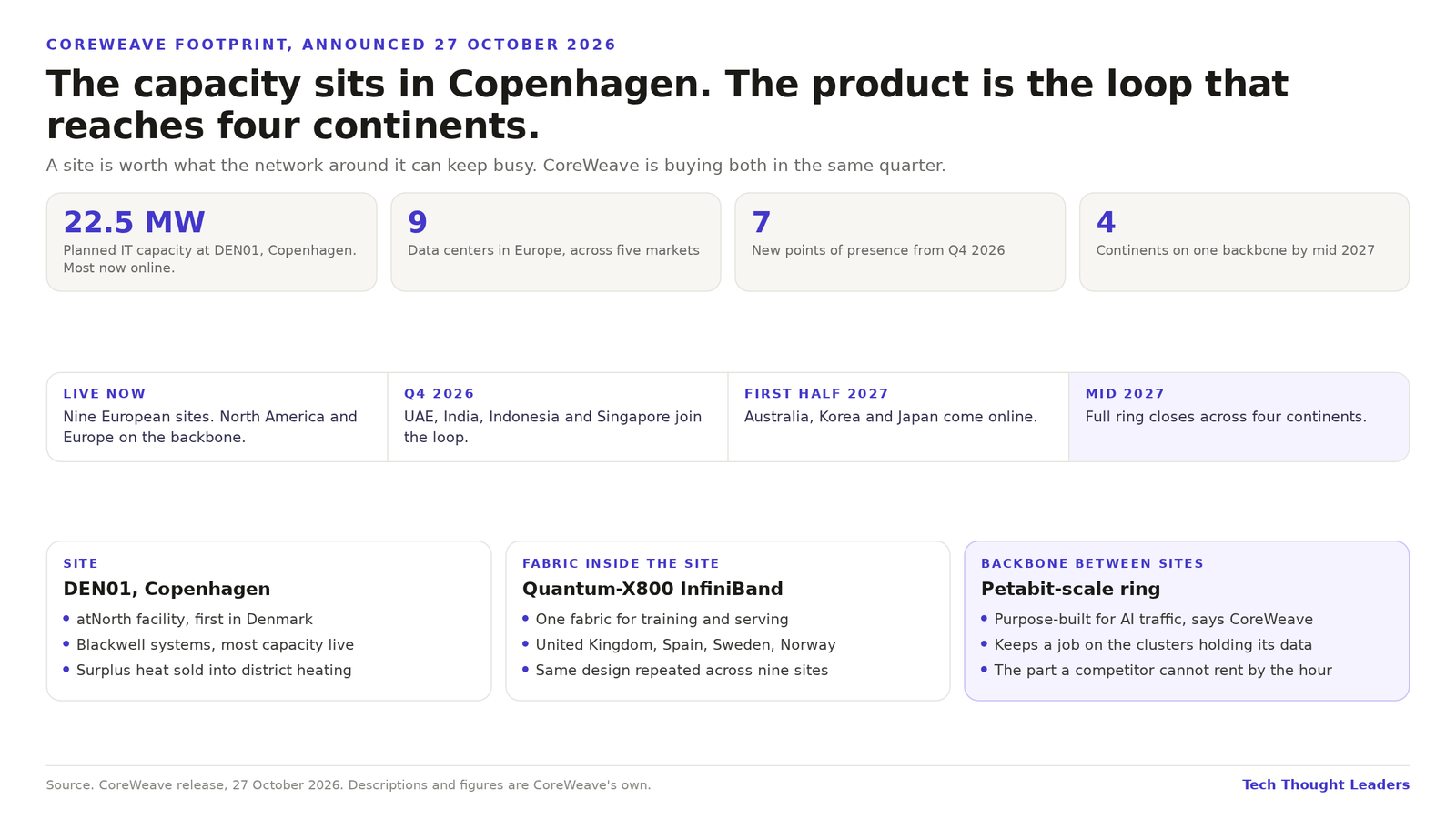
CoreWeave brought most of a planned 22.5 megawatts of IT capacity online at atNorth’s DEN01 site near Copenhagen on 27 October, its first Danish deployment and its ninth data center in Europe across five markets. The same release extends a petabit-scale backbone that already spans North America and Europe, adding points of presence in the UAE, India, Indonesia, Singapore, Australia, Korea and Japan from the fourth quarter of 2026, with a full ring expected by the middle of 2027.
The megawatts are the unremarkable part. Any operator with capital and a signed power contract can build a hall that size. The finding is that CoreWeave is spending its next year on the path between halls rather than on more of them, and that shifts what a neocloud sells. Agent and inference traffic care about where the context lives, not how many accelerators exist somewhere else. The verdict is that network reach becomes the differentiator at renewal, when a customer learns how much of the bill is idle capacity sitting in the wrong region. Watch utilization by region, not megawatts.
CoreWeave switched on most of 22.5 megawatts in Copenhagen this week. The part of the announcement worth reading is not in the first paragraph and it is not measured in power.
A point of presence is a small thing. A router, a cross connect, and a contract with a fiber provider. Seven of them, spread from the Gulf to Tokyo Bay, turn a set of regional clouds into one AI network backbone that a customer can route across, and the ring closes in the middle of 2027. That is a different purchase from a GPU hall, and it is a bet about what buyers will care about next year.
A GPU hall is rentable. The path between two of them is not.
Accelerator time is close to a commodity. Our own count of the rental market runs to 323 providers selling GPU capacity, and a buyer with a budget can find hardware somewhere this quarter. What a buyer cannot do is conjure a cheap private path from Frankfurt to Virginia, or keep a job pinned to the region where its data sits.
Inside a single site the fabric is standard now. DEN01 runs NVIDIA Blackwell systems on NVIDIA Quantum-X800 InfiniBand, the same design CoreWeave repeats across a European estate that now covers the United Kingdom, Spain, Sweden, Norway and Denmark.
A chat request is one call in and one response out. An agent is a loop. It fans out across tools, reuses a long prefix, and arrives in bursts. The context for that loop sits on whichever replica holds the cache, so routing decides both latency and cost.
When the replica holding that context is a continent away, the loop slows for reasons no kernel optimization fixes. That is the case for owning the link rather than renting transit on it. A provider that can keep a customer’s traffic in the region where the data sits sells utilization. A provider that cannot sells hours and hopes the customer does not measure them.
Heat reuse is a siting argument dressed as an engineering one
DEN01 sends surplus heat into a district heating network under an agreement with atNorth. atNorth runs seven sites across the Nordics and has four larger sites under development in Finland, Denmark, Sweden and Norway, plus a metro build in Stockholm.
Power is the constraint everywhere in northern Europe. A campus that gives heat back to the town is easier to defend in front of the people who approve the grid connection than one that only draws from it. That makes the clause a capex line with a political component, and it is why it sits near the top of the release.
The bill lands at renewal, when idle hours show up
Neoclouds bill by the GPU hour, so revenue follows utilization. Utilization follows how well a provider keeps a customer’s workload on hardware that is already paid for, and that is what a backbone does across regions. It lets one pool be sold instead of several islands.
That is the argument. The evidence will arrive in two figures CoreWeave does not publish today, inter-region traffic and utilization by region. If the ring closes on schedule and customers start signing commitments that span regions, the network thesis holds. If the loop slips into 2028 while European capacity keeps growing, the backbone becomes a stranded cost with excellent latency.
Three questions worth carrying into your next capacity review. How much of your paid GPU time sits idle in a region your data is not in? If your provider adds a region, can your workload follow the data without a rewrite? And what does the contract say about inter-region transfer and data location when the topology changes underneath you?
Related reading. We covered the borrowing side of neocloud expansion in The $40 Billion GPU Loan Nobody Else Could Get, and the crowding in the rental market in The GPU Cloud Market Grew to 323 Providers.
Get the next one before it is old news
Independent analysis of cloud-native infrastructure, Kubernetes and data center economics. No vendor spin.