

Executive Summary
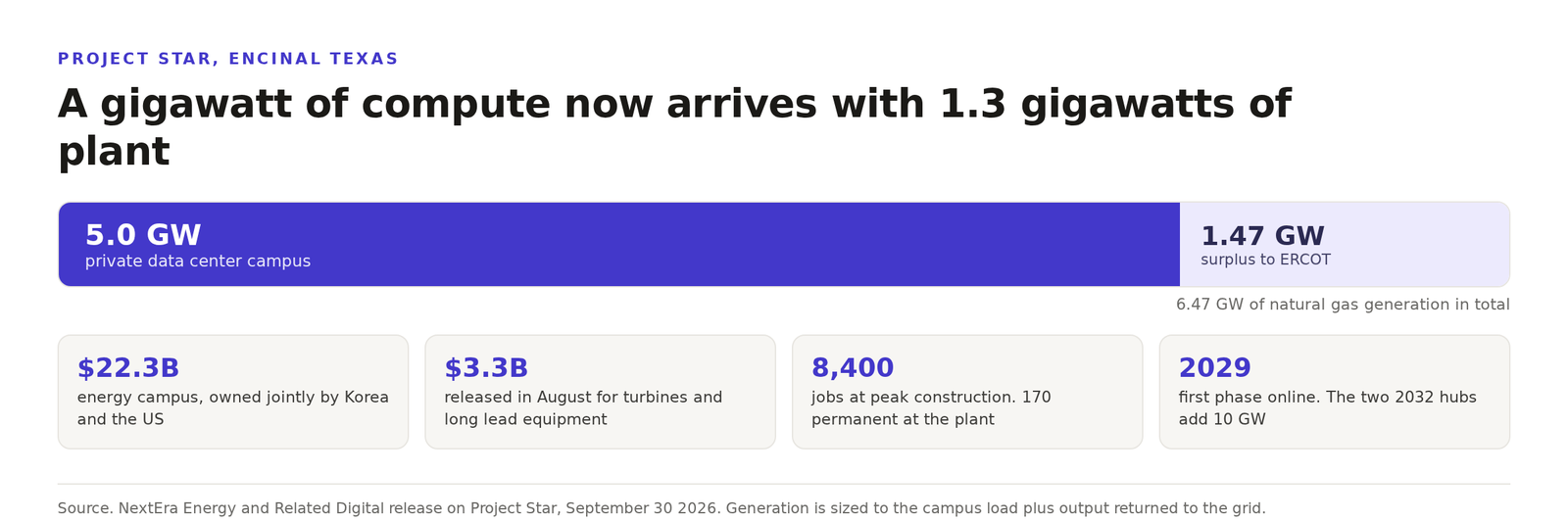
Project Star in Encinal, Texas is a 6.47 gigawatt natural gas plant built to serve an adjacent 5 gigawatt data center campus, at a cost of 22.3 billion dollars and with 1.47 gigawatts of output sold back to ERCOT. Generation is sized at about 1.3 gigawatts per gigawatt of compute, the ratio a lender will ask about on every behind the meter campus from here.
NextEra Energy Resources builds and operates the plant through a joint venture with Related Companies and Lewis Energy, while the Republic of Korea and the United States own the asset jointly under a trade agreement. NextEra puts up no capital and still expects at least half the earnings an owned asset would produce. Three hubs have reached definitive agreements and drawn 5.7 billion dollars this year, 3.3 billion of it committed to turbines and other long lead equipment. The constraint moved from the grid queue to the factory floor.
The biggest power deal of the quarter is not a utility signing a supply contract. It is a data center buying the plant that feeds it.
On September 30 the United States Department of Commerce and the Republic of Korea announced Project Star, a 22.3 billion dollar energy campus in Encinal, Texas. It pairs 6.47 gigawatts of natural gas generation with an adjacent 5 gigawatt data center campus that Related Digital is developing and funding privately. Output above what the campus draws goes back to ERCOT. A joint venture of Related Companies and NextEra Energy Resources builds and operates the plant, with Lewis Energy Group supplying gas.
The ownership is the unusual part. Korea and the United States hold the campus jointly under their trade agreement, with Korean suppliers expected to feed the build, and the release ties the design to Texas Governor Greg Abbott’s directive that data centers bring their own generation to ERCOT.
The plant is sized to the load, and then some
Run the arithmetic on the AI data center power pair and you get 1.29, which is 6.47 gigawatts of plant for 5 gigawatts of compute. The 1.47 gigawatt gap is reserve capacity, turbine reliability margin and, in this case, a sellable product. For an operator modeling a behind the meter campus, 1.3 is the number to take to a lender. A plan built on one to one assumes no unit is out for maintenance in July and the campus never runs flat out in the same week.
That is where the grid story attaches. A 5 gigawatt load on the ERCOT queue is a multi year study plus upgrades somebody pays for. Six gigawatts of gas next door with a surplus feed is a different conversation.
Nobody is putting capital on the table, which is the whole point
On Wednesday’s third quarter call, chief executive John Ketchum described a financing model worth studying. NextEra invests no equity in these hubs and still expects at least half the earnings it would book from an asset it owned and operated. Three hubs now hold definitive agreements and have brought in 5.7 billion dollars this year. The pipeline behind them runs 30 to 40 projects. The earnings deck has the detail.
The 3.3 billion dollars released in August went to turbines and other long lead equipment. Not the permitting queue, not the GPU allocation. The factory floor, and the money moved early to hold a slot. NextEra is one of very few companies that can place that order at this size, which is why developers sign with it.
The plant lands in 2032. The GPUs will not be the ones you ordered.
Project Star targets a first phase as early as 2029. The Texas and Pennsylvania hubs backed by Japan and the Commerce Department expect up to 10 gigawatts of gas between them, finished in 2032. That is six years between the decision and the megawatt, against a silicon cadence of about two. A capacity plan that assumes a 2026 cluster model still describes a 2032 fleet is planning for an asset replaced twice before the plant is commissioned.
Another hub shows the opposite shape. NextEra joined a coalition for a privately owned project in western Kentucky with 2 gigawatts of gas and 2.6 gigawatts of battery storage. Storage larger than generation is a capacity and arbitrage bet on a grid that already has the energy, not a bring your own plant bet.
The counterargument is not small. The Institute for Energy Economics and Financial Analysis has questioned the clean energy commitment in NextEra’s pending Dominion merger, and a gas fleet built for a 2032 campus is a 30 year carbon decision made on a 5 year compute forecast. That trade works if the plant can be re-contracted.
Three questions to put to any co-located generation proposal. What reserve margin is baked into the plant size, and who pays for it in year seven. What happens to the surplus if the campus load slips a year. And what the exit looks like if the customer changes model architecture.
Related reading. Google Bought a Gigawatt of Power It Has to Switch Off is the demand side of the same story, and PJM Wants to Review a Ten-Gigawatt AI Campus as One Project covers the queue this is trying to avoid.
Get the next one before it is old news
Independent analysis of cloud-native infrastructure, Kubernetes and data center economics. No vendor spin.
[…] reading. I worked through what a behind the meter gas plant costs per gigawatt of compute in the Project Star numbers, and how Saudi Arabia sized its first national cluster in the Humain […]