


Executive Summary
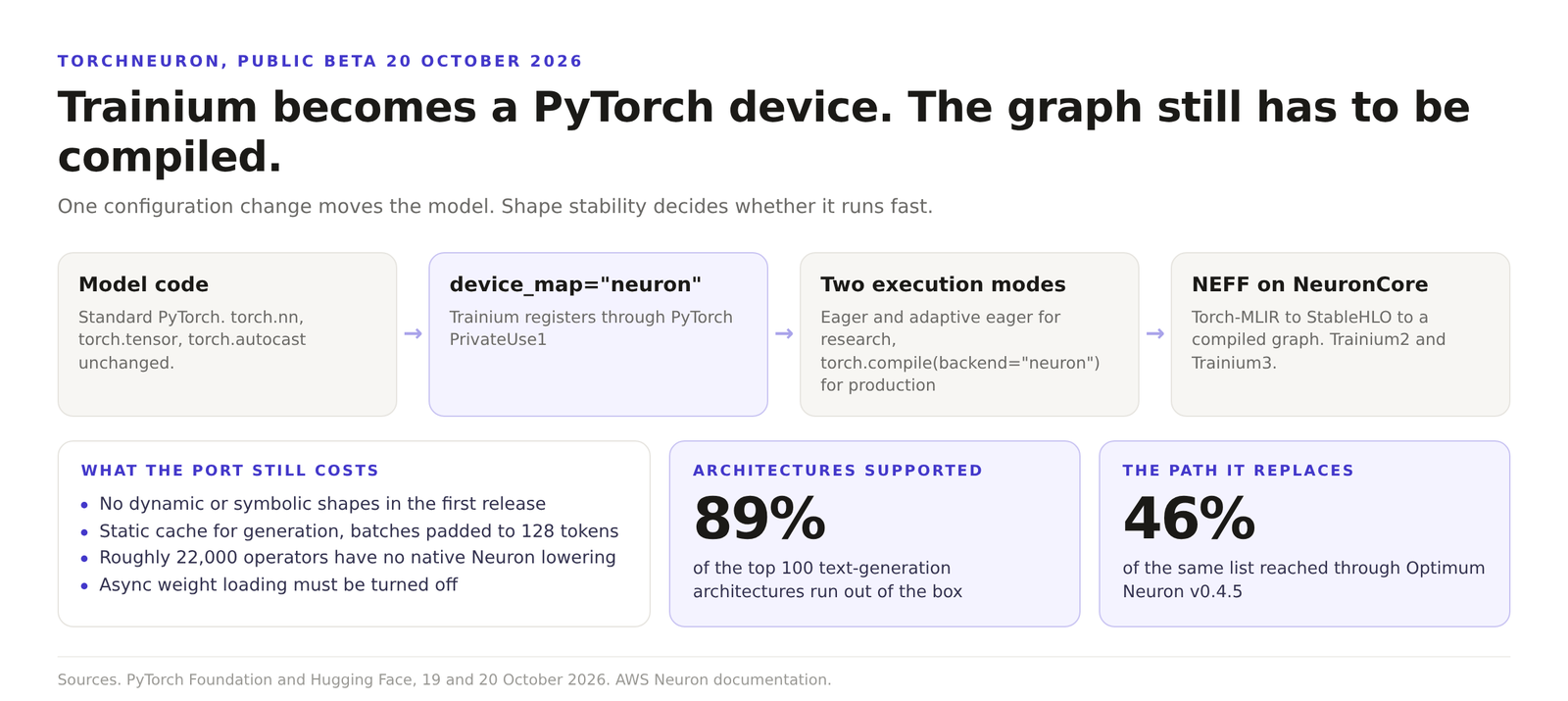
TorchNeuron went live as a public beta on 20 October under Apache 2.0. It registers Trainium as a standard PyTorch device, so a model that already runs on PyTorch moves with a device setting and runs in eager mode or through torch.compile. The measurable gain is model coverage. Hugging Face puts 89 percent of the top 100 text-generation architectures as working out of the box, against 46 percent through Optimum Neuron v0.4.5, the library it replaces.
The constraint is shape stability, not silicon. The first release supports no dynamic or symbolic shapes, generation needs a static cache, batches pad to 128 tokens, asynchronous weight loading is switched off, and roughly 22,000 operators have no native Neuron lowering. Accelerator portability has stopped being a kernel problem and become a serving configuration problem, which means the team that owns your batch and sequence shapes now owns your hardware choice.
PyTorch on Trainium has meant three things for most teams. A fork of the model, a translation layer to hide the compiler, and a fresh validation pass against every upstream release. TorchNeuron, described in the PyTorch Foundation announcement, is AWS arguing that the list is now down to one item.
PyTorch has always had a default hardware path, and for a decade that path ran through CUDA. Not because the framework is secretly Nvidia code, but because the backend, the kernels, the profiler and the debugging habits all grew there first. A chip that wants that traffic has to arrive as a backend and then survive contact with real models.
The lock was never the chip. It was the kernel path.
The old route onto Trainium was Optimum Neuron, a translation layer that hid the compiler. It worked, and it was the natural choice when it shipped. The cost was that you had to think like a compiler. Lazy tensors instead of eager execution, static shapes only, a recompile every time a graph broke, and a set of custom modeling classes maintained to keep the illusion intact.
Trainium itself was never the problem. The porting bill was. Every model that arrived needed a Neuron-specific fork, and every fork needed re-validation against an upstream library that kept moving. That is the shape of every non-Nvidia acceleration attempt so far, and it is why a one-line configuration change is worth more than another teraflop.
One line gets you onto the device. Throughput is a separate bill.
TorchNeuron registers Trainium through PrivateUse1, the extension point PyTorch provides for new hardware, and then stays out of the way. torch.nn, torch.tensor, torch.autocast, torch.distributed and torch.profiler all address the neuron device. Set the device map and the weights land there. The backend is open source under Apache 2.0 and installs with pip from torch-neuronx.
Production throughput comes from torch.compile with the neuron backend. TorchDynamo captures the graph, Torch-MLIR lowers it to StableHLO, and the Neuron compiler emits a NEFF that runs on the chip. Eager mode stays for research, and an experimental adaptive eager mode fuses queued operations to close some of the gap without a code change.
The honest part is what the first release refuses. Dynamic and symbolic shapes are out. Generation wants a static cache. Hugging Face pads batches to a multiple of 128 tokens with TRL 1.16 or later, and switches off Transformers asynchronous weight loading on Neuron entirely. Roughly 22,000 operators have no native lowering. The Neuron documentation lays out the shape contract rather than glossing it, and Hugging Face now recommends dropping Optimum Neuron in favor of Transformers directly. Each constraint is shape-shaped, which is why it bites hardest on agent workloads, where prompt length is whatever the tool loop happened to produce.
What actually changes is the arbitrage on a GPU bill
The commercial argument AWS is making is not the cheapest token. Amazon pitched the release as a single configuration change for every PyTorch developer. Colin Brace, vice president of technology software at Annapurna Labs, told TechCrunch’s Julie Bort that "Trainium’s value is price-performance plus the fact that it’s one platform for both training and inference, which improves the economics across a full workload." Read that as a claim about a fleet, not a benchmark score.
That is the part operators can use. A sandboxed port is now cheap enough to run against a real workload before you commit capacity, and the answer comes back as recompiles and padded tokens rather than opinions. Deepgram has already moved. The question is no longer whether a model can run on Trainium. It is what fraction of your steady-state inference would stop recompiling long enough to be worth moving, and how much of your peak traffic arrives with a shape nobody tested.
Three questions before you port anything. How much of your traffic has a stable sequence shape? How many custom operators does your stack actually depend on? And who owns the batch configuration when latency and utilization disagree?
Related reading. NVIDIA turned its Kubernetes scheduler loose as open source in the Run.ai release into the DSX stack, and the bandwidth bill behind disaggregated serving is covered in the KV transfer problem.
Get the next one before it is old news
Independent analysis of cloud-native infrastructure, Kubernetes and data center economics. No vendor spin.