

Executive Summary
The Hy4 weights went public on 20 November. The Tencent account on Hugging Face now carries three Hy4 repositories with real shards in them, including a flash variant that sells for $0.14 per million output tokens on OpenRouter. That is nine times below the price of the flagship Tencent distilled it from.
The catch sits in Section 10 of the Tencent Hy License. Anyone running a model serving business above $50 million in worldwide revenue needs a separate written license before serving these weights to customers. Qwen ships under Apache 2.0 and DeepSeek under MIT, with no such clause. The release is genuine, and it still has a door most teams will never open the license to find.
On 12 November we reported that Tencent’s Hy4 was serving 20.2 trillion tokens a week on OpenRouter with no checkpoint to download. That is no longer true. The tencent/Hy4 repository holds one commit, dated 20 November, and 245 safetensors shards. A second repository, tencent/Hy4-flash, appeared three days earlier and already out-pulls it. The Tencent Hy4 open weights are real.
Hy4 is 770 billion parameters with 49 billion active per token, 256 routed experts in each of its 77 MoE layers, and a vision encoder grafted onto a text backbone. Almost nobody can serve it. Two hundred and forty five shards is a multi node deployment before you reach the KV cache.
Hy4 flash is the release that matters to anyone with a budget. It carries 220 billion parameters in total, including 64 billion Engram parameters, and activates 12 billion per token. Context runs to 1,048,576 tokens. Tencent says its hybrid of sparse attention and sliding window attention cuts the KV cache to one sixth of Hy4’s and one twenty fourth of Hy3’s.
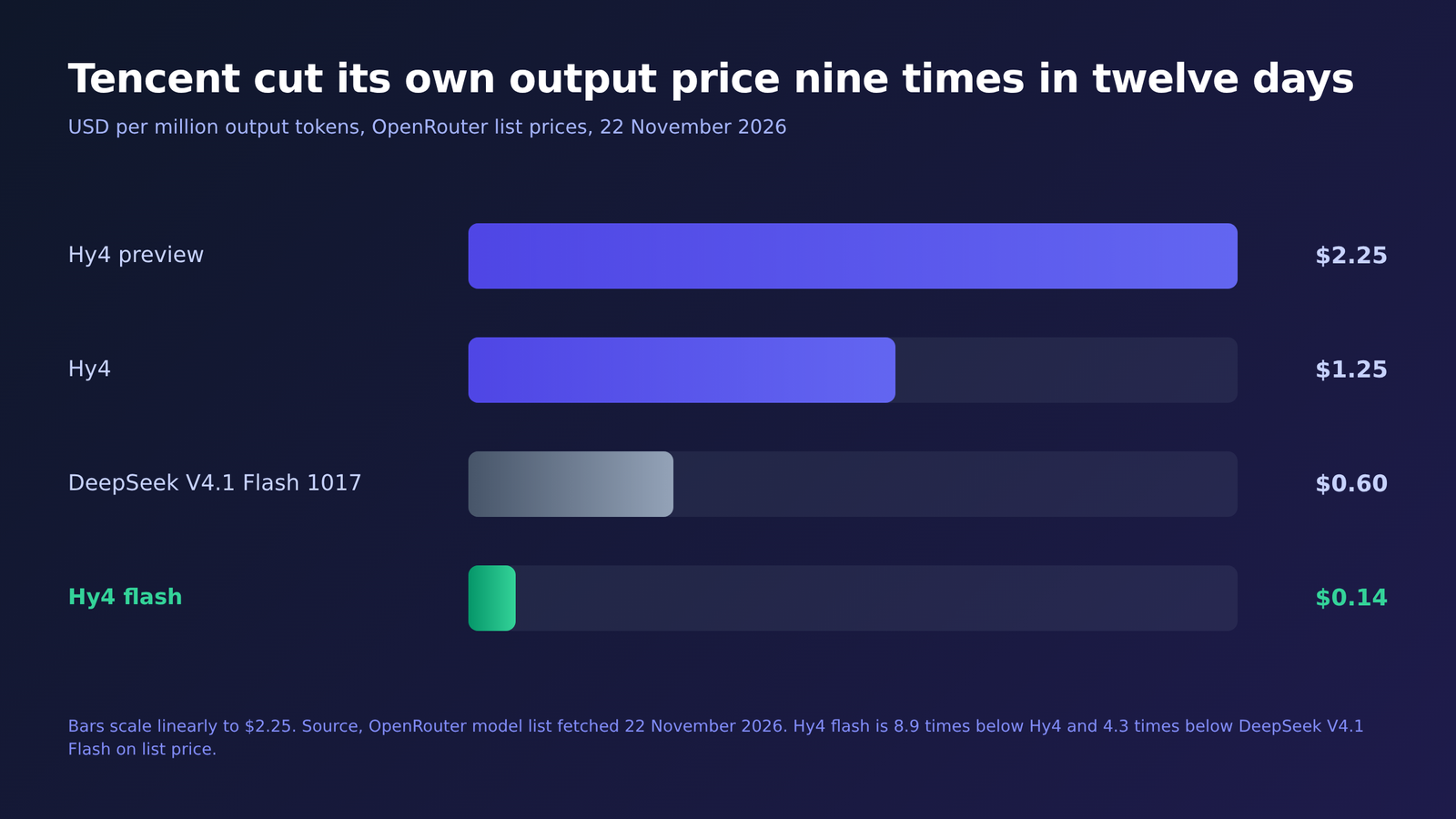
The flash variant is nine times cheaper than the model it came from
On OpenRouter, Hy4 flash lists at $0.035 per million input tokens and $0.14 per million output tokens. Hy4 lists at $0.417 and $1.25. That is twelve times cheaper on input and nine times cheaper on output, for a model released twelve days after the flagship launched.
Tencent’s model card claims a cost per task one twentieth of Hy4 and one eighth of DeepSeek V4.1 Flash 1017. The second number needs care. On list price today, Hy4 flash is 4.3 times cheaper than DeepSeek V4.1 Flash 1017 per token, not eight. The eighth comes from a per task ratio on Tencent’s internal WorkIndex benchmark, measured against the Max tier at peak hour pricing. Read the ratio as a vendor benchmark, the price list as the price list.
What transfers is the architecture. Twelve billion active parameters behind a million token context is a different hardware conversation than 49 billion, and the Engram table costs memory rather than compute. The KV cache ratio is the number that decides how many concurrent requests fit on one node.
Section 10 asks for a written license above fifty million dollars
The Tencent Hy License is Apache 2.0 with one addition. Section 10.2 requires a separate written license before you give third parties remote access to inference, if your worldwide gross revenue passed $50 million in any twelve month period, or if the product in question has more than 100 million monthly active users. The revenue test applies whether or not the money came from the model.
Section 10.3 exempts internal use, provided the weights and their outputs never reach third parties. An enterprise running Hy4 flash behind an internal assistant is clear. A platform company selling inference against the same weights is not, unless it writes to hy_partners@tencent.com first. Qwen3.8-27B ships under Apache 2.0 and DeepSeek V4.1 Flash 1017 under MIT, where a competitor can resell the endpoint without asking.
That is the pattern across the Chinese labs. Publishing the weights buys adoption and a stream of fine tunes. The serving business stays behind a permission gate. If your company clears $50 million, the download is a trial and not a product.
The rebuild out-pulls the official repo sixteen to one
tencent/Hy4-flash shows 6,617 downloads and 618 likes on the board today. AngelSlim’s GGUF conversion of the same weights shows 109,018. The unquantized flagship shows 1,355. The flash repo has held a top four slot on the trending board for four days.
Hugging Face counts pulls over a rolling window and does not deduplicate them, so a build pipeline that refetches a repo hourly reads as adoption. Read the split for its shape, not its size. Most people running Hy4 flash run a quantized copy on one machine, not the official checkpoint on a cluster.
Tencent shipped this one properly. An FP8 build and a pre-trained base model landed the same week, and the model card documents vLLM and SGLang deployment paths.
Three questions worth putting to your own environment. If you serve a Chinese open weight model to customers, which clause in its license governs that, and has anyone on your legal team read past Section 9? Does your evaluation baseline name the exact repository and quantization you deploy? And when a lab publishes weights eight days after declining to, what changed in its business case?
Related reading. Our 12 November report on Hy4 serving traffic with no checkpoint, and the piece on why community rebuilds outrank the original repos.
Get the next one before it is old news
Independent analysis of cloud-native infrastructure, Kubernetes and data center economics. No vendor spin.




[…] reading. Tencent put a revenue gate on open weights, and the gate reaches everyone […]
[…] reading on this beat. Tencent opened the Hy4 weights and the license stopped at fifty million dollars. Two labs cut the cached context and only one published the weights. Tencent shipped Qwen a 3.8 […]