
Executive Summary
Nutanix said on 24 November that its board is working with Rajiv Ramaswami to find his successor, and that he stays until that person is in place. The same release carried a quarter that beat its own guidance. ARR of $2.63 billion, up 15 percent. GAAP operating margin of 18.5 percent against 7.4 percent a year earlier. Free cash flow of $209.3 million against $174.5 million.
A chief executive leaving at the top of a margin curve is usually a signal about the next job rather than about the health of the company, and nothing in these numbers suggests distress. What it does signal is a strategy reset, because the next leader is hired to sell AI infrastructure against the hyperscalers rather than to convert VMware refugees. Treat the next twelve months as the roadmap risk window and get storage, Kubernetes and renewal commitments in writing before you sign.
Nutanix is looking for a chief executive. The board has hired a national search firm, and Nutanix CEO Rajiv Ramaswami keeps running the company until his successor arrives.
He joined in December 2020 from VMware, where he was chief operating officer, arriving two days after he resigned there. Six years on, the business he leaves is a different one. His note to staff puts revenue at more than double the fiscal 2020 figure and free cash flow at $841 million, up from a negative $249 million.
The exit lands on a quarter that beat its own guidance
The numbers came out the same afternoon. ARR of $2.63 billion, up 15 percent. Revenue of $772.4 million, up 15 percent. GAAP operating margin of 18.5 percent against 7.4 percent. Free cash flow landed at $209.3 million, from $174.5 million. Ramaswami’s own summary was that the quarter exceeded all guided metrics.
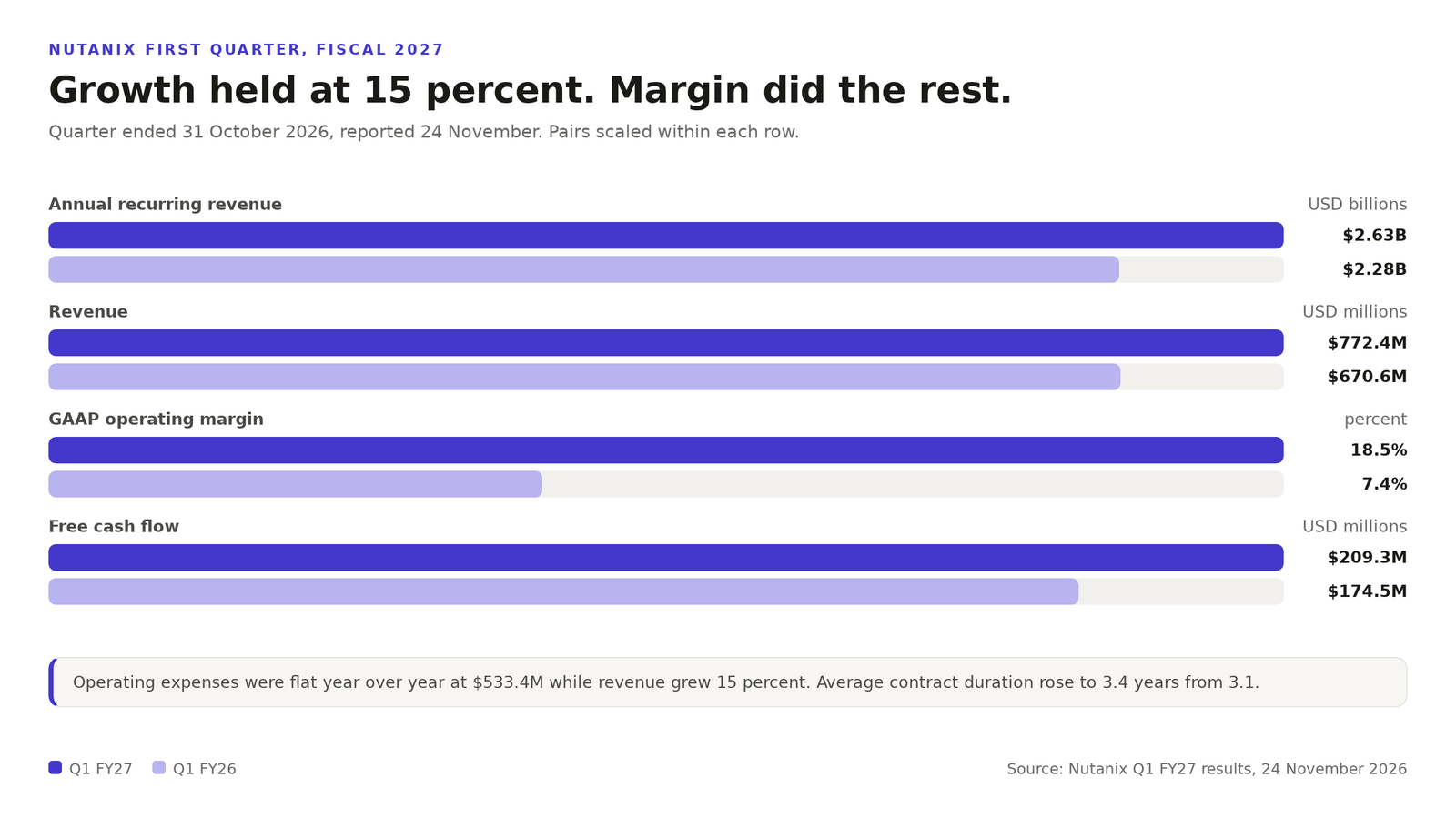
The mechanism matters more than the headline. Operating expenses were $533.4 million against $533.8 million a year earlier, which is flat. Revenue grew 15 percent on the same cost base, so the margin expansion is arithmetic. Average contract duration stretched from 3.1 years to 3.4 years, meaning the deals got bigger and longer.
The storage line in that release deserves attention. Ramaswami pointed to broadening support for external storage, and his letter says the platform now works across major hyperscalers and major external storage platforms. For a company that grew up selling its own appliance, that is a real shift. It widens the deals Nutanix can enter and loosens the grip of its own hardware.
Flat spending is what the VMware exit looks like once it converts
The migration wave has been Nutanix’s best growth engine since Broadcom moved vSphere to per-core subscriptions. Customers with smaller footprints found the new bundles hard to justify, and Nutanix was an obvious landing place. He told The Register the company keeps winning customers who want an alternative to VMware, and that hardware costs remain a headwind.
That engine has a shape. Displaced customers sign multi-year deals, which lifts recurring revenue and contract duration quickly in the first cycle, then less quickly. Fifteen percent growth with a flat cost base is what the second cycle looks like. It is a good business. It is not the same business as taking share from a competitor in the middle of a repricing.
What to ask before you renew into a leadership search
Three questions. Will external storage support hold its place on the roadmap, since it changes which hardware you can buy. What happens to the Kubernetes platform, the piece that puts Nutanix in front of platform teams rather than VM administrators. And who signs the pricing and co-term commitments on your renewal if the person who set the strategy has left by then.
None of this says the platform is in trouble. A company that can hand over a profitable, growing subscription business is in better shape than most of the on-premises infrastructure market. The channel message was no changes, and the search is being run before a successor is named so the board can look outside. The risk here belongs to the buyer, and it is the dull kind. Promises made to a departing chief executive are worth getting in writing.
Related reading. What the cheapest VMware tier costs now that it is gone outside Europe, and how Nutanix rewrote the migration path after Broadcom pulled the VDDK. The Broadcom VMware licensing tracker keeps the running record of every edition and date change.
Get the next one before it is old news
Independent analysis of cloud-native infrastructure, Kubernetes and data center economics. No vendor spin.