


Executive Summary
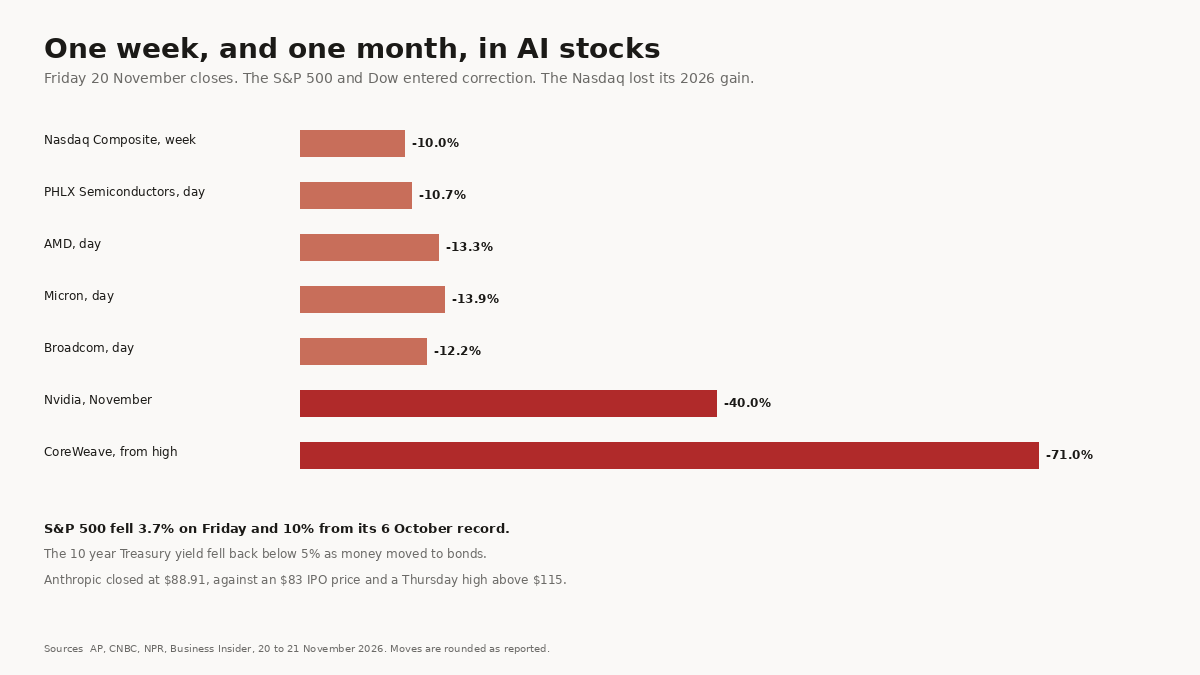
The AI trade had its worst week since March 2020. The S&P 500 fell 3.7% on Friday 20 November and closed more than 10% below its 6 October record, the Dow joined it in correction, and the Nasdaq composite lost 5.3% on the day and 10% on the week, erasing its gain for 2026. Semiconductors were hit hardest, with the PHLX index down 10.7% and Nvidia down 23% for the week.
The cause is not that the models stopped working. It is that the bill came due in the same week. Rates are rising, oil is above $83, Democrats won the midterms on a data centre slowdown, Nvidia lost its chief executive to a spy scandal and an accounting probe, and Anthropic’s IPO became the moment large holders sold. The AI buildout continues. The cost of financing it just changed.
The milestones matter because they are the ones institutions act on. A 10% fall from a record is a correction, and corrections trigger mandates, risk limits and conversations with clients. The S&P 500 broke its 200 day moving average on Tuesday and stayed below it, which turned trend following funds into sellers. The Nasdaq 100 briefly entered bear market territory during Friday’s session. None of that is a judgment about artificial intelligence. All of it is a mechanical response to price.
The week in numbers
Friday alone took 3.7% off the S&P 500 and 1.9% off the Dow. The Nasdaq composite fell 5.3%, its worst week since the pandemic shutdown, and is now negative for the year. The PHLX Semiconductor Index lost 10.7% in a day. AMD fell 13.3%, Micron 13.9% and Broadcom 12.2%. Nvidia fell 14% on Friday after a report that its accounting is under SEC scrutiny, ended the week down 23%, and is down roughly 40% in November.
The Anthropic listing was supposed to be the counterweight. It priced at $83, traded above $115 on Thursday, and closed Friday at $88.91, down 8.5% on the day. It was the largest IPO on record, and the company had increased the offering the day before. That decision now reads as the top of the market rather than a raise into strength. CoreWeave, the debt funded neocloud, is 71% below its high. Caterpillar, which became an AI proxy through data centre construction and generators, is down more than half.
What actually changed
Four things moved at once, and they reinforce each other. The first is the cost of money. The Federal Reserve raised rates in September for the first time in three years, skipped October, and watched the 10 year Treasury yield push above 5%. Governor Christopher Waller said this week the Fed may need a half point hike in December to catch up with inflation. A buildout financed with debt is worth less when debt gets more expensive, and the hyperscalers have been borrowing at scale.
The second is politics. Democrats took both chambers and the governorships of Texas and Georgia, two states central to data centre construction. Their platforms promise tougher permitting, local approval and cost allocation, not bans. That distinction matters for the long run, but markets price the near term first, and the near term now includes delay risk on projects that were sold as certain.
The third is Nvidia itself. Jensen Huang resigned as chief executive this month after reports of an affair with a woman suspected of spying for China. The board has ruled out his return, the company still beat expectations on Tuesday, and the stock fell anyway. A report that the SEC is examining its accounting turned a leadership crisis into a governance one. The company is also exposed to the Commerce Department’s new rule restricting remote access to US chips from data centres in Singapore, Malaysia, Thailand, Indonesia and Brazil.
The fourth is the growth rate. Anthropic’s third quarter revenue grew 47%, down from 144% in the second. That is still fast. It is not the curve that a $1.5 trillion valuation was priced against, and the IPO gave holders the first chance in years to sell into it. When the best story in the sector slows and lists in the same week, the market does not need a recession to reprice.
The outlook, and what would prove it wrong
The banks are calling this a positioning reset rather than the end of the cycle. UBS expects AI capital spending of $1.0 trillion in 2026, $1.4 trillion in 2027 and $1.5 trillion in 2028, and notes that hyperscalers raised $199.9 billion in new financing since 1 October alone. Eastspring puts the near term risk in delays, not cancellations. It counts 85 gigawatts of US data centre capacity already under development against 8.4 gigawatts delayed, and treats the 464 gigawatts in pre-development as aspiration rather than pipeline.
The bear case is not stupid. Jeremy Siegel at Wharton calls this a reset of expectations after three years of double digit returns, and says the average is 8% to 9%, not 15% to 20%. David Trainer at New Constructs says the bubble is popping and has further to go. Hank Smith at Haverford Trust says the market has spent three weeks learning that this will not bounce back like the previous sell-offs. The bull case is that demand is still real, earnings are still growing, and the sell-off has done a lot of the repricing already.
The next tests are specific. Nvidia’s data centre utilisation and order visibility, not its headline revenue. The December Fed decision and whether the 10 year stays below 5%. Whether state permitting actually delays projects or merely adds process. Whether credit spreads on neocloud debt widen, which is the first place a financing problem would show. And whether Anthropic’s research claims translate into products that justify the multiple, which is a question no infrastructure forecast can answer.
Sources, Business Insider, NPR and Eastspring.
Get the next one before it is old news
Independent analysis of cloud-native infrastructure, Kubernetes and data center economics. No vendor spin.