

Executive Summary
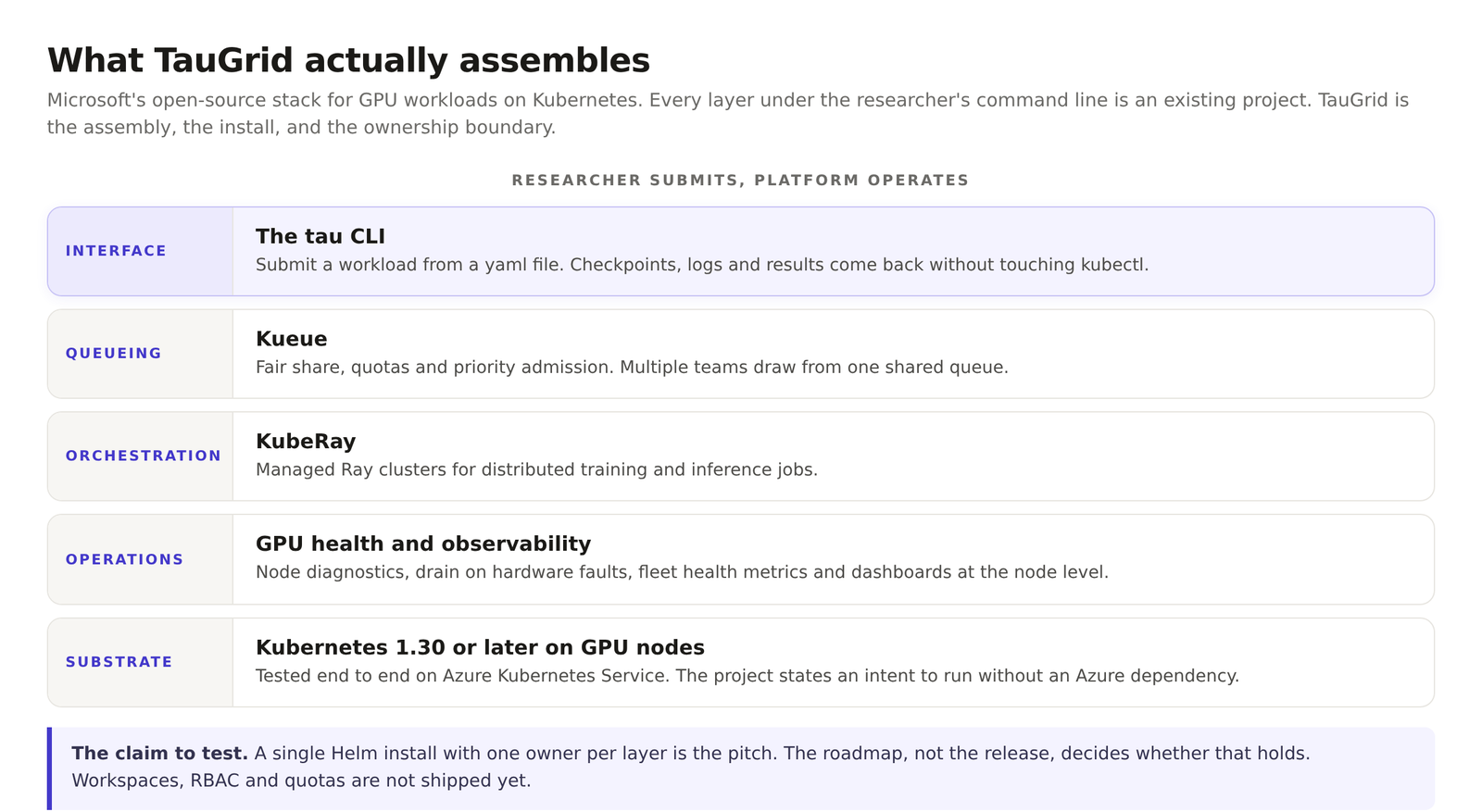
Microsoft open sourced TauGrid, a stack that queues, schedules, monitors, and recovers AI workloads on Kubernetes clusters with GPU nodes. Every component under its command line already existed. Kueue handles queueing, KubeRay manages Ray clusters, and the rest is GPU node health and observability. What TauGrid adds is one Helm install, one owner per layer, and a command line that keeps researchers out of kubectl. It is MIT licensed and asks for Kubernetes 1.30 or later.
The open question is not whether the parts work. It is whether a curated assembly survives contact with real platform teams. Multi-tenant workspaces, role-based access control, and quotas sit on the roadmap rather than in the release, and end-to-end testing runs on Azure Kubernetes Service. Microsoft states an intent to run the project without an Azure dependency. Until that lands, TauGrid is a strong Azure-first default rather than a neutral one.
Every platform team running AI on Kubernetes has written the same code twice. A submission wrapper, a queue configuration, a health check for a GPU that quietly fell off the bus, and a script to go find the results afterward.
Microsoft open sourced its version of that layer in August, and published the write-up in September. TauGrid puts a command line in front of a stack that platform teams already know by name.
Nothing in it is new, and that is the pitch
The queueing is Kueue, the Kubernetes SIG batch project that handles quotas, fair share, and priority admission. The orchestration is KubeRay, which manages Ray clusters on Kubernetes. Around those sit node-level GPU health checks, automatic drain when hardware faults, and observability. A single Helm install wires them together and gives each layer one owner.
The alternative is what most teams do today. Install each project, then maintain the integration yourself, which is where the submission scripts and retry logic come from. The open source announcement is direct about this. The glue is the deliverable.
The researcher side is where the friction actually lives
A researcher writes a yaml file and runs one command. TauGrid validates the configuration, creates a Kubernetes Job or a Ray job, queues it against remaining quota, then tracks status, logs, and checkpoints. When a run fails, it can resume from the last checkpoint. It also stores the evidence from each experiment so a result can be reproduced or a failure diagnosed later.
That last part is quietly the most valuable. Reproduction is the first thing to break when a machine learning team grows, and most internal platforms never solve it.
Kubeflow covers some of the same ground and reached CNCF Graduated status in August 2026. It is a broader platform with a longer history behind it. TauGrid is narrower, younger, and shaped around a cluster you probably already run.
The roadmap, not the release, decides the claim
The gap between an interesting repository and a platform is multi-tenancy. TauGrid does not ship workspaces with scoped identity, role-based access control, and quotas yet. Those are roadmap items, alongside PyTorch DDP and FSDP examples, DeepSpeed support, and multi-cluster execution.
Test coverage is the other tell. The project reports end-to-end testing on Azure Kubernetes Service, and some observability integrations stay Azure specific. The repository states an intent to support cloud and on-premises clusters without an Azure dependency and invites contributions toward that goal. Until the work lands, treat portability as a stated aim rather than a shipped property.
None of this makes TauGrid a bad bet. It is MIT licensed, small enough to read, and built from projects that already run in production. It is a faster path to a working GPU platform than assembling the same pieces by hand, and it is a harder thing to walk away from than the documentation suggests.
Watch two signals. Whether the multi-tenancy work lands on the published roadmap, and whether the Azure-specific surface shrinks. The first tells you if enterprises can adopt it. The second tells you whether it is a platform or a front door.
Related reading. The Kubernetes Scheduler Is Being Rebuilt for Accelerators covers the upstream scheduling work. Kubernetes for AI Is Not Kubernetes for Apps explains why the workload model diverges. Your Kubernetes Bill Is an Architecture Problem, Not a FinOps Problem covers where the money leaks.
Every announced commitment in this space is tracked with its source in our AI data centre power commitments record.
Get the next one before it is old news
Independent analysis of cloud-native infrastructure, Kubernetes and data centre economics. No vendor spin.
[…] reading. Microsoft open sourced the glue AI teams keep rebuilding on Kubernetes. OpenAI turned the agent harness into a managed service. And root on a single Kubernetes node is […]