

Executive Summary
Lambda has put Nvidia co-packaged optics into production at a QScale campus in Quebec, linking GB300 NVL72 racks and more than 10,000 GPUs. The physical change is that the optical engine now sits on the switch package rather than in a transceiver plugged into the front panel, which shortens the electrical path from inches to millimeters and removes the DSP retimer.
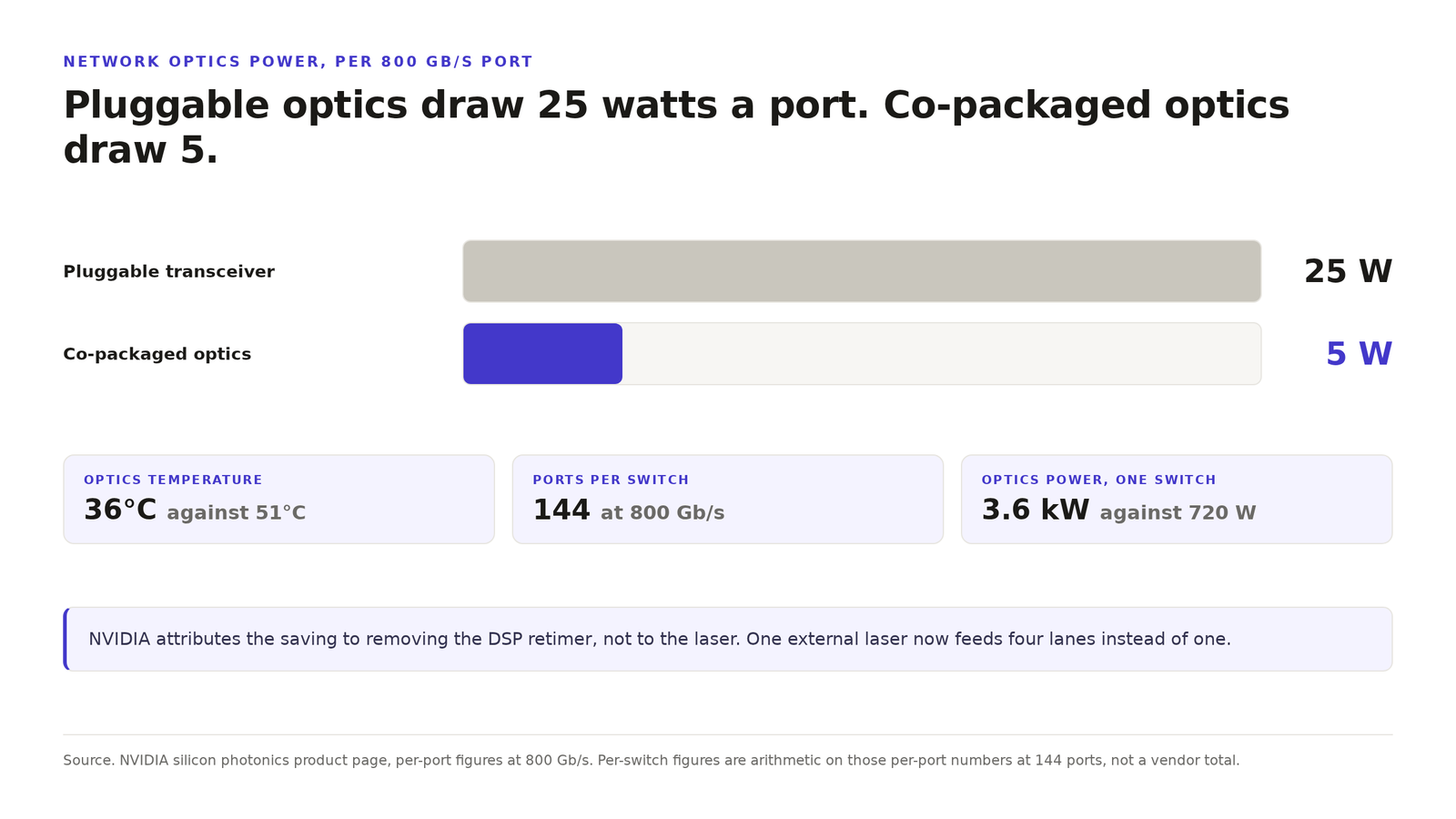
Nvidia publishes 25 watts per port for pluggable transceivers against 5 watts for co-packaged optics, so a 144 port switch carries 3.6 kW of optics instead of 720 W. The optics run at 36C rather than 51C. Verdict. The network now sits inside the power and thermal budget of the rack, and the trade is a new failure shape. One laser feeds four lanes, and a failed optical engine is a switch package, not a transceiver swap.
Lambda put the optics inside the switch and the pluggable transceiver disappeared. At more than 10,000 GPUs, that is the point where the network stops being a rounding error in the power budget.
The deployment sits at a Lambda footprint inside a QScale campus in Quebec, on GB300 NVL72 racks. Lambda calls it the first large-scale deployment of the technology. The vendor claim is unverified, but the port count is not. Each switch carries 144 ports at 800 Gb/s.
The conversion moved from the front panel onto the package
A pluggable transceiver converts electrical signals to light at the front edge of the switch, after the signal has crossed the board, a connector and the module itself. Co-packaged optics puts the optical engine on the same package as the switch ASIC. Nvidia puts the electrical loss at 22 dB for the old path and about 4 dB for the new one, which is why the DSP retimer stops being necessary.
Latency follows. Tests reported by Data Center Dynamics show about four percent less at rack scale and up to ten percent at pod scale. That is not a headline number on its own. It matters because a training job that stalls on collectives stalls on every node at once.
Five watts a port changes what fits in the row
The power figure is the one that changes architecture. At 25 watts a port, a 144 port switch spends 3.6 kW on optics alone. At 5 watts, it spends 720 W. Strip the arithmetic out and the fact is simple. Co-packaged optics takes roughly 2.9 kW of heat and load out of a single switch and gives it back to GPUs.
Rack power is the reason this lands now. TrendForce expects Nvidia rack draw to climb from about 150 kW on GB300 to 225 kW on Vera Rubin and 660 kW on Rubin Ultra, and Nvidia’s own documentation warns that at million-GPU scale the transceiver count grows faster than the GPU count, so optics can cap total system size in a power-limited facility.
The Quebec site explains the choice of first deployment. QScale runs a 142 MW campus on almost entirely renewable power with free cooling for up to 80 percent of the year. Canada does not appear on Lambda’s public cloud region list yet. Capacity went where the electrons and the cold air are.
Fewer lasers, each doing four times the work
The trade is in the failure model, and it is the part the announcement does not dwell on. Nvidia says external laser modules need four times fewer lasers, one per four lanes instead of one per lane. Fewer components is fewer things to break. It also means one laser failure removes four lanes rather than one.
Serviceability splits in two. Fiber plugs straight into the switch, and the external laser arrays are replaceable field units. The optical engine on the package is not. A fault there is a switch replacement, which is a different spare part, a different truck roll and a different maintenance window than swapping a transceiver out of a cage.
None of that makes the design wrong. It makes the operational plan different, and at 10,000 GPUs the operational plan is the product.
Three questions before you spec a fabric like this. How many lanes does a single laser failure take down in your topology? Can your spares strategy cover a switch package rather than a transceiver? And does your colo contract price cooling per rack or per megawatt, because the answer decides which design wins?
Related reading. We looked at why 181 GW of on-site gas is a bet rather than a bridge, and at how one neocloud cut a third of its GPU power and kept 97 percent of its tokens.
Get the next one before it is old news
Independent analysis of cloud-native infrastructure, Kubernetes and data center economics. No vendor spin.