

Executive Summary
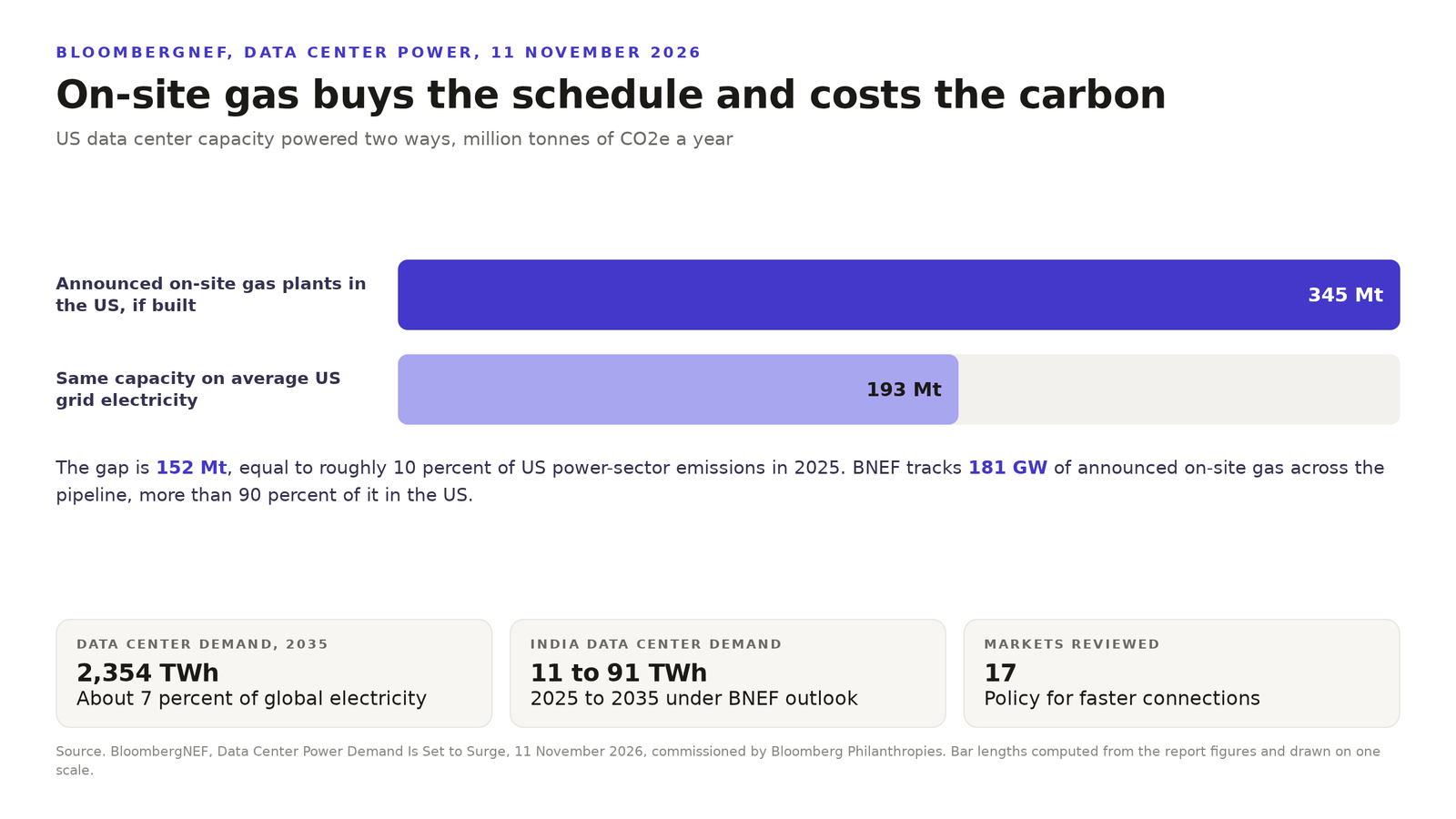
BloombergNEF tracked 181 gigawatts of announced gas-fired generation proposed alongside data centers, more than 90 percent of it in the US, in a report commissioned by Bloomberg Philanthropies. Built and run on the firm assumptions, the US projects would emit about 345 million tonnes of CO2e a year. That is 152 million tonnes more than the same capacity would emit on average US grid electricity, equal to roughly 10 percent of US power-sector emissions in 2025.
Data center power demand is the reason. It almost quadruples to 2,354 terawatt hours by 2035, about 7 percent of global consumption. Grid constraints in the US and Europe are delaying connections for large loads, so developers buy turbines while they wait. BNEF warns the economics may keep those turbines running after the grid arrives. The temporary plant is the risk that goes unreported, because nobody builds a power station intending to switch it off.
A hundred and eighty-one gigawatts is nearly four times the peak electricity demand of Great Britain. That is the volume of on-site gas generation BloombergNEF has tracked in proposals attached to data centers, and most of it is described as temporary.
The report landed on 11 November and the Guardian read it as a climate story, which it is. Read as an infrastructure decision it says something sharper. Speed to power now outranks cost of power in siting, and a developer who can’t get an interconnection date will buy a generator instead.
The interconnection queue became the launch date
BNEF states the constraint plainly. Grid constraints in the US and Europe are delaying new connections for large loads, while the return for energizing quickly pushes developers toward on-site generation. BNEF’s phrase for it is speed to power.
The pipeline behind that incentive is large. BNEF tracked 181 GW of announced on-site gas, more than 90 percent of it in the US, and it is careful to say the pipeline varies widely in maturity and timing. Read the 181 GW as an indication of what developers want to build rather than a forecast of what will get built. The direction is still clear.
A paid-for turbine doesn’t switch off politely
The emissions arithmetic is the part that travels. If every announced US on-site plant were built and operated as modeled, the annual bill would be about 345 million tonnes of CO2e, 152 million more than the associated data center capacity would emit on average US grid power. The full report draws the line at one comparison and stops there. The operational logic does not.
A gas plant bought to bridge a two year wait is a sunk asset whose marginal cost is fuel. Grid power bought afterwards arrives with demand charges and capacity commitments attached to it. Once the turbine is paid for, the arithmetic tends to favor running the turbine. BNEF warns exactly this, saying the economics could encourage continued generation and create lock-in beyond the annual emissions.
The policy side is thinner than the problem. BNEF reviewed approaches across 17 markets, including faster connections, financial commitments, flexible connections, special zones and clean power procurement, and found limited evidence so far on which of them work. Operators are making twenty year power decisions against eighteen months of policy evidence.
Where the grid is coal, the generator is the cleaner option
BNEF finds the opposite of the intuitive answer outside the US and Europe. Where a power system remains heavily reliant on coal, a grid-connected data center can be worse than one running on-site gas. Siting is a generation-mix decision before it is a property decision.
The demand numbers make that concrete. India goes from 11 TWh of data center demand in 2025 to 91 TWh in 2035 under the BNEF outlook. Malaysia moves from 7 TWh to 45 TWh. Indonesia drew 82 percent of on-grid power from coal and gas in 2025, and current rules don’t let data centers contract directly with independent renewable generators. Brazil looks different, with almost all incremental generation coming from renewables and new demand able to absorb output that is currently curtailed.
Three questions decide whether the bet is yours. What is the marginal generator on the grid you are connecting to, rather than the average one, since a coal-heavy grid can make the on-site plant the cleaner choice and an average hides that. Does your contract let the plant keep running after the grid connection lands, and who books the emissions if it does. Is your delivery date tied to an interconnection queue you don’t control, and what does the lease say when the date moves.
Both of those questions already have live examples. Twenty year compute leases carry uncapped fuel exposure, and the generator order book now runs a year ahead of the sites that need it.
Related reading. Anthropic paid $3.4 billion for generators someone else already ordered shows what speed to power costs at the top of the market.
Sources. BloombergNEF published the report on 11 November 2026. Figures for emissions, demand and the 181 GW pipeline are the firm’s own.
Get the next one before it is old news
Independent analysis of cloud-native infrastructure, Kubernetes and data center economics. No vendor spin.
[…] reading. We looked at why 181 GW of on-site gas is a bet rather than a bridge, and at how one neocloud cut a third of its GPU power and kept 97 percent of its […]
[…] have argued before that on-site gas is a stopgap and not a bridge. Arizona is the version where the load lands on a public grid […]