

Executive Summary
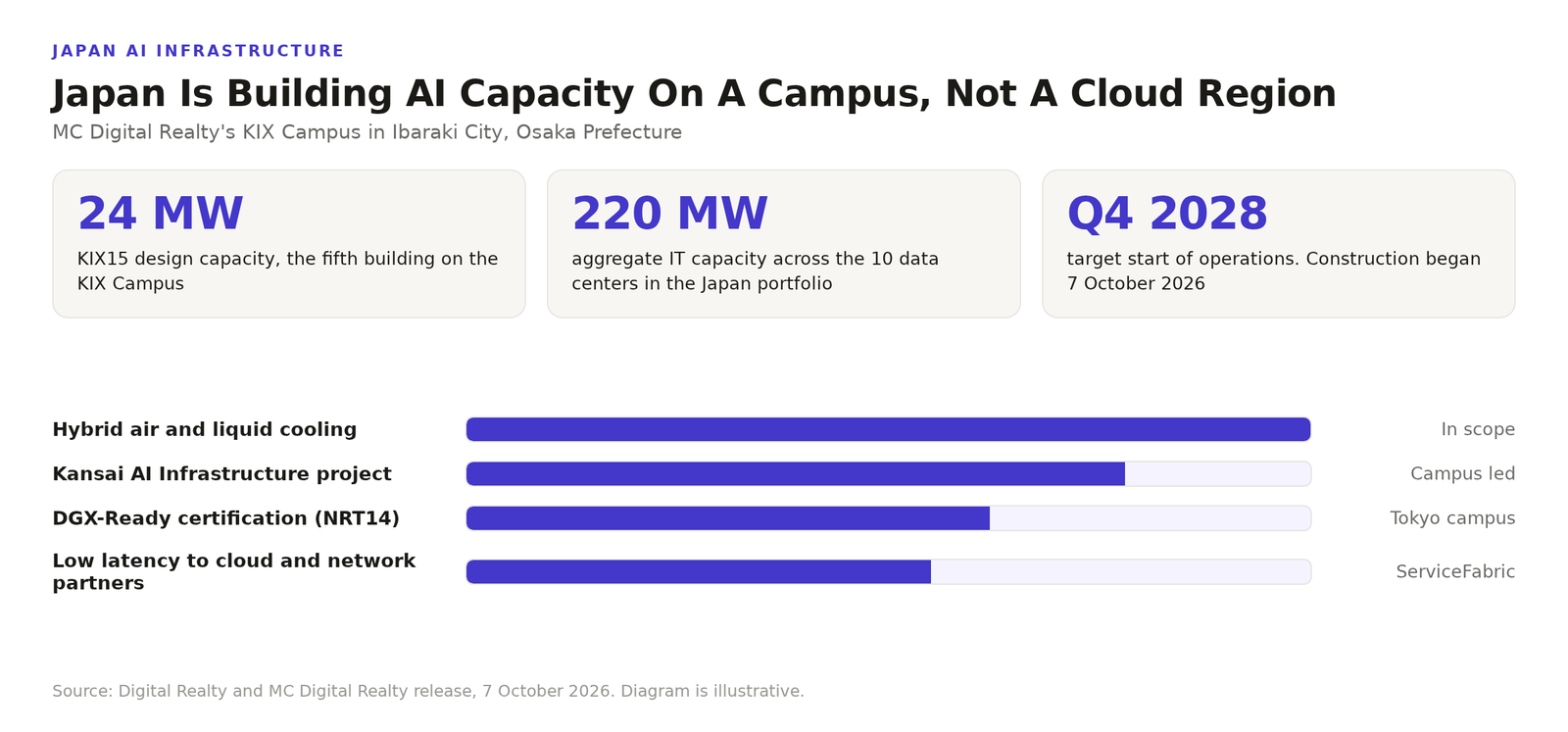
Digital Realty has started construction on KIX15, a 24 megawatt data center at its KIX Campus in Ibaraki City, Osaka Prefecture. It is the fifth building on the campus and is scheduled to open in the fourth quarter of 2028. When it lands, the Japan portfolio under the MC Digital Realty joint venture reaches 10 data centers and roughly 220 MW of aggregate IT capacity.
The detail worth reading is the cooling. KIX15 is designed for hybrid air and liquid systems, which tells you the operator expects older and denser hardware in the same halls rather than a pure high-density build. Japan is adding AI data center capacity in measured campus steps instead of announcing cloud regions, and the reason is physical. Land, power and cooling are all tight, so the build goes where the interconnection and the campus already are.
The most useful number in Japan’s AI build this week is 24 megawatts. Not a gigawatt. Not a region. A building on a campus that already has power and fiber.
KIX15 is the fifth building, not the first
Digital Realty said on 7 October that construction has begun on KIX15 at its KIX Campus in Ibaraki City, Osaka. The facility is designed for 24 MW and is scheduled to start operations in the fourth quarter of 2028. It will be the fifth data center at the campus.
The campus sits inside the Kansai AI Infrastructure Co-Creation Project, an initiative that pairs campus growth with domestic and international connectivity and work with telecom and technology partners. MC Digital Realty, the 50/50 venture between Digital Realty and Mitsubishi Corporation, runs it.
The arithmetic is the point. KIX15 brings the Japan portfolio to 10 data centers and about 220 MW of aggregate IT capacity. That is a national number built from buildings, not from a single headline.
Hybrid cooling is the honest design choice
KIX15 is specified for hybrid air and liquid cooling. That is a hedge, and a sensible one. A campus serving hyperscalers, cloud providers and AI operators has to host both traditional racks and dense AI trays. Air still covers the first group. Liquid covers the second, and the building has to be ready for both.
The densest production systems now arrive liquid cooled by default. Nvidia builds its GB200 and Vera Rubin NVL72 racks that way, and a multi-tenant campus that wants those tenants has to be plumbed for it before the first rack ships.
Sizing for both is also a bet on time. A hall wired for liquid can take an air-cooled rack today and a dense one next year without a rebuild, which matters when hardware generations turn over faster than buildings do.
The Japan build is local because the constraints are local
Japan has the same power and land pressure as everywhere else, plus a stronger instinct for control. Its largest power producer has already moved a data center inside the fence at one of its own sites to secure supply, a pattern this publication covered when JERA did it in Chiba.
SoftBank plans a GPU cloud in Japan built on GB200 NVL72 systems inside its own data centers, offered with managed Kubernetes and inference services and framed around sovereign AI. Both moves point the same direction. Capacity lands where the power, the cooling and the interconnection already exist.
Read together, the message is that AI capacity in Japan is being sold to enterprises as a local, governed service rather than as a cheap cloud region. That favors operators with land, power and a cooling design that spans two hardware generations, and it rewards the campus over the greenfield announcement.
Three questions for anyone planning capacity in a constrained market. Does your site already have power and cooling, or are you waiting on both. Can one hall take an air-cooled rack today and a liquid-cooled rack next year. And is your capacity an asset you control, or a cloud region someone else can reprice.
Related reading. Japan’s largest power producer moved the data center inside the fence to secure supply. The real AI buildout number is 180 gigawatts, not 420. And Google bought a reactor worth of power without building a reactor.
Get the next one before it is old news
Independent analysis of cloud-native infrastructure, Kubernetes and data center economics. No vendor spin.