

Executive Summary
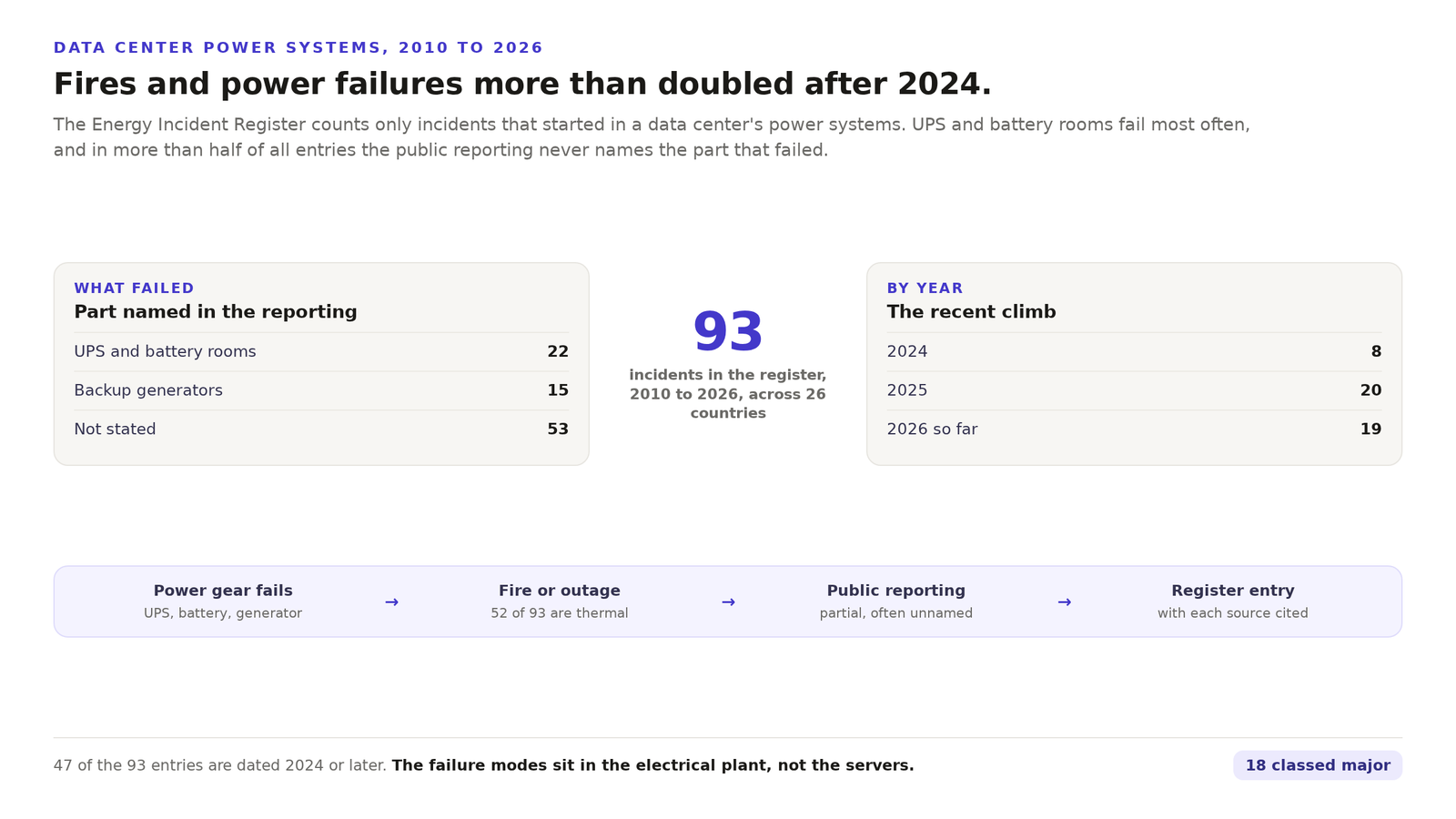
Data center fires and power failures more than doubled after 2024, and the pattern points at the electrical plant rather than the servers. The Energy Incident Register, an independent public record of energy and grid incidents, counts 8 such events in 2024, then 20 in 2025 and 19 so far in 2026. Of 93 incidents logged from 2010 to 2026, 47 fall in 2024 or later.
Where the reporting names a part, uninterruptible power supplies and battery rooms lead with 22 entries, followed by backup generators at 15. Fires and thermal events make up 52 of the 93, and 18 are classed as major. The finding is uncomfortable for anyone standing up dense AI capacity. The gear that carries the most electrical load is the gear that fails, and in 53 of the 93 incidents the public record never says what broke. Read your own site against the register before you assume it is covered.
The failures clustered in the power gear
Every incident in the register started in a data center’s power systems. That is the point of the collection. It counts uninterruptible power supplies and battery rooms, backup generators, switchgear, transformers and fuel, the parts that share their failure modes with the grid and with grid-scale battery storage.
The yearly numbers tell the story. The register counted 8 of these events in 2024. It counted 20 in 2025 and 19 in the first three quarters of 2026, according to Data Center Dynamics, which reported the register’s latest count. Across the full 2010 to 2026 window there are 93 entries in 26 countries. The United States accounts for 33 and the United Kingdom for 14.
Where a part is named, UPS and battery rooms lead at 22 of the 93 entries, then backup generators at 15. Six entries name lithium-ion batteries specifically, including an explosion in Daejeon and a battery room fire at a Digital Realty site in Hillsboro, Oregon, both from 2025.
The reporting gap is part of the risk
In 53 of the 93 entries, the public reporting never names the part that failed. It usually names the operator and stops there. The battery chemistry, the UPS make and the cause often go unstated, and the register is careful not to guess them.
That gap matters more as density rises. A modern AI hall pulls far more electricity per rack than the halls these failure modes were learned in, which pushes harder duty cycles onto the same UPS, battery and generator plant. If nobody writes down which part failed, the next site repeats the mistake. Uptime Institute ‘s 2026 outage analysis still puts power first, with failures in UPS systems, transfer switches and generators dominant. The register now publishes every data center entry free, with its sources, so an operator or an insurer can check a site and a region before a project is financed.
The register is also a reminder about measurement. It records what reached public reporting, so a site with a quiet incident is invisible in the aggregate. The count is a floor, not a total.
Uptime Institute’s 2026 outage analysis puts power behind 45 percent of impactful outages in 2025, down from 54 percent in 2024, and reports that 57 percent of operators say their last major outage cost more than $100,000, with one in five above $1 million.
What to check before the next inspection
Three questions to run against your own estate. When did your battery and UPS rooms last get a real inspection, not a visual pass? Do you log the specific part that failed, or just the outage? And does your insurer see the same picture your facilities team does?
Related reading. We covered why a battery beat a gas peaker in every market modeled, and how Texas now charges a large load for its place in the grid queue.
Get the next one before it is old news
Independent analysis of cloud-native infrastructure, Kubernetes and data center economics. No vendor spin.