
Executive Summary
Google shipped Antigravity on 18 November 2025 and it changed how every competitor presents itself. The agent-first layout, the reviewable artifact and the browser in the loop were its arguments first. All six major platforms now ship some version of them.
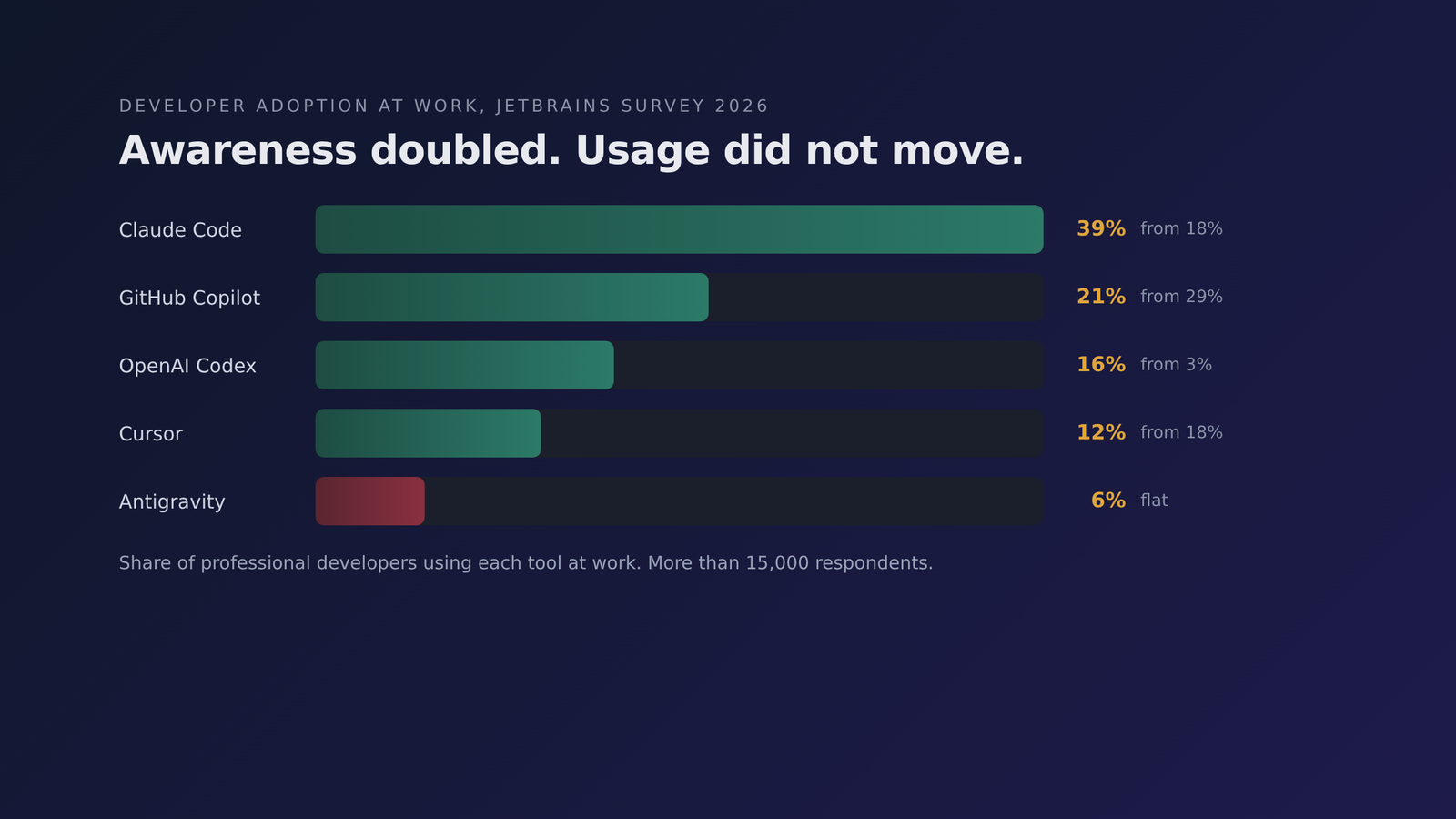
It did not win Google the developers. JetBrains surveyed more than 15,000 professionals and found Antigravity flat at 6 percent while awareness climbed from 29 to 47. Claude Code went from 18 to 39 in the same window. Antigravity is a strategic success and a product also-ran. The blockers are structural rather than technical. There is no bring your own key, the quota rules changed three times in a year, and the security record includes a sandbox bypass. Google also folded the open source Gemini CLI, past 100,000 stars, into a closed replacement, which developers read as a bait and switch.
The launch was loud. Antigravity arrived as a free preview the same day as Gemini 3, and the Hacker News thread drew 1,088 points and 1,085 comments. This week three submissions about it gathered two points and seven.
That gap is not a verdict on the software. It is what a year looks like for a product that reshaped the category without capturing it.
What it actually got right
The mechanism is the artifact. Instead of a diff and a hope, the agent produces task lists, implementation plans, walkthroughs, browser recordings and test logs. You review those at the task level rather than reading every tool call or accepting a patch blind.
Google’s argument was that the alternatives sat at two useless extremes, showing either everything or nothing. That framing won. Every major platform now ships something that looks like an artifact, and browser driven verification is no longer distinctive.
The 2.0 release in May 2026 dropped the IDE entirely and became a standalone desktop application with a CLI and a Python SDK sharing one Gemini-tuned harness. That consolidation is the genuinely correct architectural call. Four overlapping tools became one engine with four surfaces, and they now improve together.
What it did not get
The JetBrains Developer Ecosystem Survey 2026 is the cleanest independent number available, covering more than 15,000 professional developers between May and July. Claude Code reached 39 percent at work, up from 18. Antigravity sat at 6, unchanged, while awareness nearly doubled.
Six percent flat across six months is a floor, not a growth story. The reasons are structural and they compound.
There is no bring your own key. The quota rules changed three times in a year, in March and May, which makes cost forecasting impossible for a team. And the security record includes a Pillar Security chain from April that turned a file search into remote code execution by passing an unsanitised flag into a utility, which bypassed Secure Mode because the tool fired before the security boundary was evaluated.
The most damaging move was strategic. Google folded Gemini CLI, an open source project past 100,000 stars, into a closed source replacement and cut off free, Pro and Ultra users on 18 June. Developers who had built on it read that correctly.
Where the market actually went
Consolidation, mostly. SpaceX closed its purchase of Anysphere for 60 billion dollars in stock on 14 August, then merged Grok, Cursor and X Premium into one bill on 12 October. Cognition renamed Windsurf to Devin Desktop in June. GitHub Copilot fell to 21 percent from 29.
Antigravity’s realistic position is inside Google Cloud. For a platform team already on Gemini Enterprise it arrives with single sign-on, VPC Service Controls and data residency, with no separate per seat licence. Nothing else integrates into a Google Cloud estate that cleanly.
That is a real business and a bounded one. It sells to procurement officers, which is exactly the strength that makes it inflexible for a senior engineer who wants their own model endpoint. Our analysis of agent runtime security covers why the containment question now matters more than the interface.
Two signals would change this. Whether bring your own key ships, and whether adoption clears single digits outside India, where it already sits near 15 percent. Until both happen, Antigravity remains the platform that taught the industry what an agent-first tool should look like and then watched five rivals ship it.
Get the next one before it is old news
Independent analysis of cloud-native infrastructure, Kubernetes and data center economics. No vendor spin.