


Executive Summary
The CNCF Technology Radar for the third quarter of 2026 asked 324 professional developers how their organizations own their platform, then asked how those same organizations handle AI workflows. Ownership predicts the answer almost completely. Teams with one team building a custom internal platform take a hybrid approach 5 percent of the time. Teams where individuals pick their own tooling do it 54 percent of the time. Central ownership produces one decision, and distributed ownership produces several.
The tool ratings point the same way. The projects developers recommend most strongly are not the ones they rate highest. Fluent Bit draws 99 percent recommendation on mid-table maturity and usefulness scores. OpenTofu draws 96 percent and carries the largest infrastructure as code user base in the survey while still sitting in CNCF Sandbox. Adoption is following defaults and inherited codebases, not measured confidence. The verdict is blunt. AI tooling sprawl is a governance outcome, and hiring a platform team changes it faster than buying another vendor does.
The clearest predictor of how a company runs AI workloads is not which cloud it bought. It is whether one team owns the platform.
The numbers are in the CNCF Technology Radar for Q3 2026, produced with SlashData and published on November 10. It splits platform ownership into four models and reports, for each, how organizations approach AI workflows. Hybrid here means separate experimentation environments with a shared production deployment path.
One owner closes the seam
Only 5 percent of teams that build a custom internal platform use a hybrid approach. Their two most common answers are extending the existing platform to AI, at 33 percent, or standing up a separate dedicated AI platform, at 38 percent. Either way they commit to one direction. Teams that curate third-party tools behave similarly, at 18 percent.
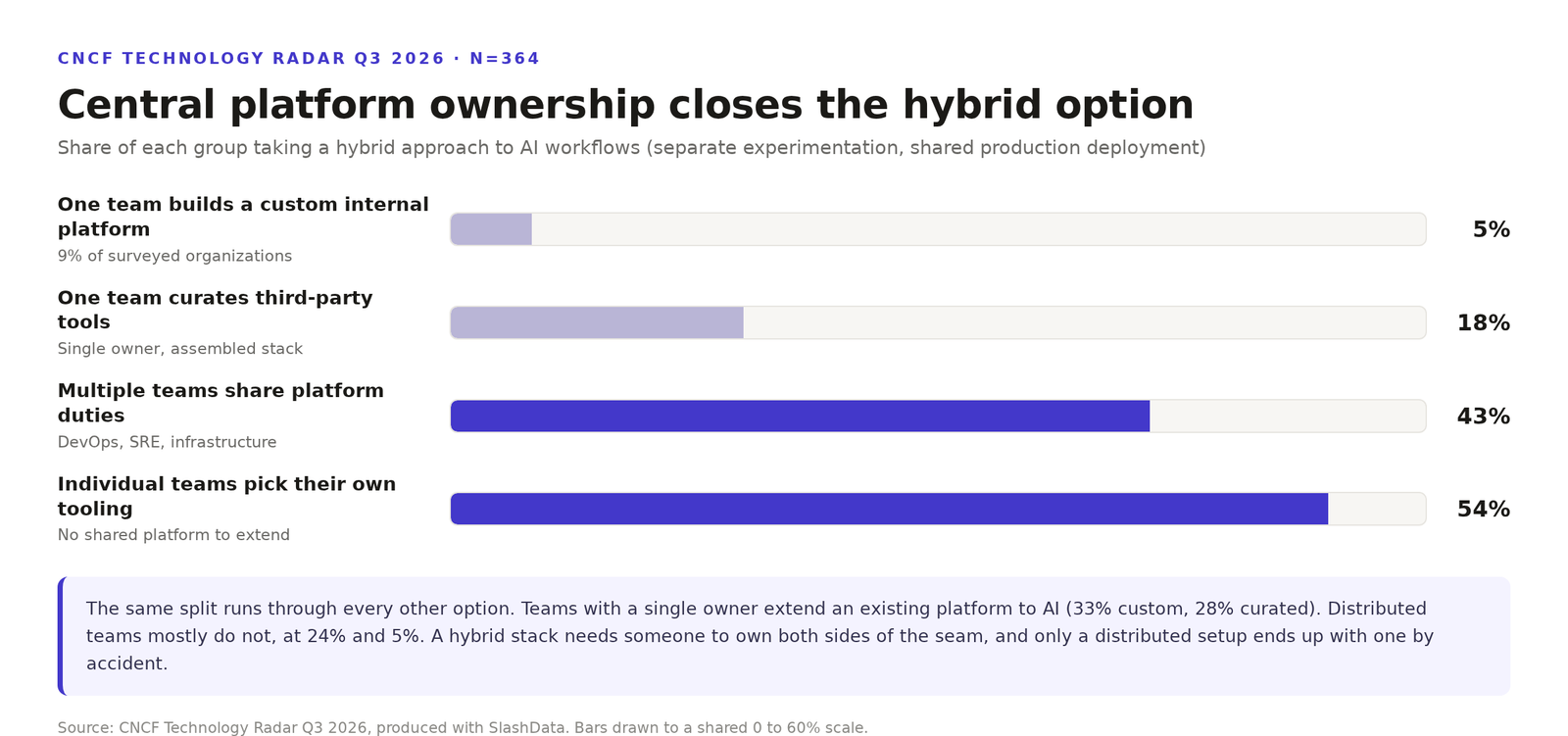
Then the line breaks. Where multiple teams share platform duties, hybrid jumps to 43 percent. Where individual teams choose their own tooling, it reaches 54 percent. The report puts the mechanism plainly. A hybrid stack creates a seam between environments, and somebody has to own both sides. A central team owns both sides and avoids the seam on purpose. In a distributed organization the hybrid is not a decision at all. It is the residue of separate teams making separate calls.
The sprawl is usually blamed on tooling choice or a missing platform engineering charter. The data says it is the default state of an organization with no single owner, and it regrows every time you clean it up.
Recommendation tracks the default, not the rating
The tool sections make a second, quieter point. Fluent Bit is the most recommended observability tool at 99 percent, with 64 percent highly likely. Its maturity score is 28 percent at five stars and its usefulness score 20 percent. Developers hand out the recommendation while grading the tool middling. The report reads that as Fluent Bit being the default for log collection.
Storage shows the same pattern with the caveats showing. Longhorn draws 59 percent highly likely to recommend on an 11 percent five-star maturity score. Rook takes 94 percent overall recommendation, but 63 points of that is the weaker likely band. The report suggests why. Longhorn is simple to run, so people recommend it to anyone. Rook brings Ceph, and Ceph is hard, so the recommendation arrives with an implied qualification about whether your team can run it.
Read that as a warning about peer recommendations generally. A tool at 94 percent recommended can be carrying a condition you never hear. A tool at 59 percent highly likely may be the one people trust a junior to operate.
The radar and the maturity badge have come apart
Prometheus and OpenTelemetry sit in Adopt for observability, which surprises nobody. The infrastructure as code result is stranger. OpenTofu and OpenFeature hold the Adopt positions, and neither has graduated under the CNCF maturity model. OpenTofu posts the highest recommendation in its category at 96 percent and the largest user base, presumably because developers are grading the Terraform codebase it carries forward rather than the project office behind it.
Storage has one Adopt entry, Carina, at 33 percent five-star maturity and 33 percent usefulness against a 93 percent recommendation rate. It is local storage, so it trades resilience for performance, and the split in its ratings is developers pricing that trade honestly.
If your procurement gate is CNCF graduation status, these numbers say the gate no longer matches what your engineers run. Worth a conversation with whoever owns the standard list, because changing a policy is cheaper than standardizing on the wrong thing for two years.
Three questions for your own environment
Who owns both sides of the seam between your AI experimentation environment and your production path, by name? If a teammate recommended your storage layer to another company tomorrow, what qualification would they add out loud? And is your approved-tooling list built on project maturity badges or on what your teams already run in production?
Related reading. We covered KubeVirt graduating with an eight percent install base, the harnesses now outpacing servers in GitHub adoption, and Broadcom pushing virtual machines into Kubernetes objects. The full report is at the CNCF Technology Radar page.
Get the next one before it is old news
Independent analysis of cloud-native infrastructure, Kubernetes and data center economics. No vendor spin.