

Executive Summary
Rank is a property of a repository, and this week the board is rewarding a repository with nothing in it that you can run. Apple’s Depth Pro 2 entry has held a top ten slot for six consecutive captures while its download counter read zero every morning. The weights live in five sibling repositories, and none of the five has ever reached the board at all. Read as a model ranking, the number eight slot is wrong about the one fact an operator needs, which is where the files are.
The pattern is wider than one vendor. The download column is a request counter on a few designated files, so a repo can rank high, collect a thousand likes, and report nothing. A second Apple repo carrying 173.5 GB of weight files reported zero for nine days while 633 people liked it. A zero in that column means unattractive, or it means uncounted. The difference is worth a minute before anything lands in a container.
The eighth repository on this morning’s HuggingFace trending board carries 1,262 likes, a trending score of 209, and zero downloads. It is apple/DepthPro2, Apple’s new monocular depth model. The file tree holds ten files. The largest is a 19 MB demo video.
No weight files at all. The repository is 25 MB and 19 MB of that is the hero clip. The rest is a model card, a license and five stills. The eighth most interesting repository on the board cannot be run.
Apple split Depth Pro 2 into one repository per size, S, B, L and H, plus a 23.5M parameter focal length estimator. Those five hold 8,649 downloads between them and 84 likes. The brochure holds 1,262 likes on its own, which is 93.8 percent of the attention the family collected this morning.
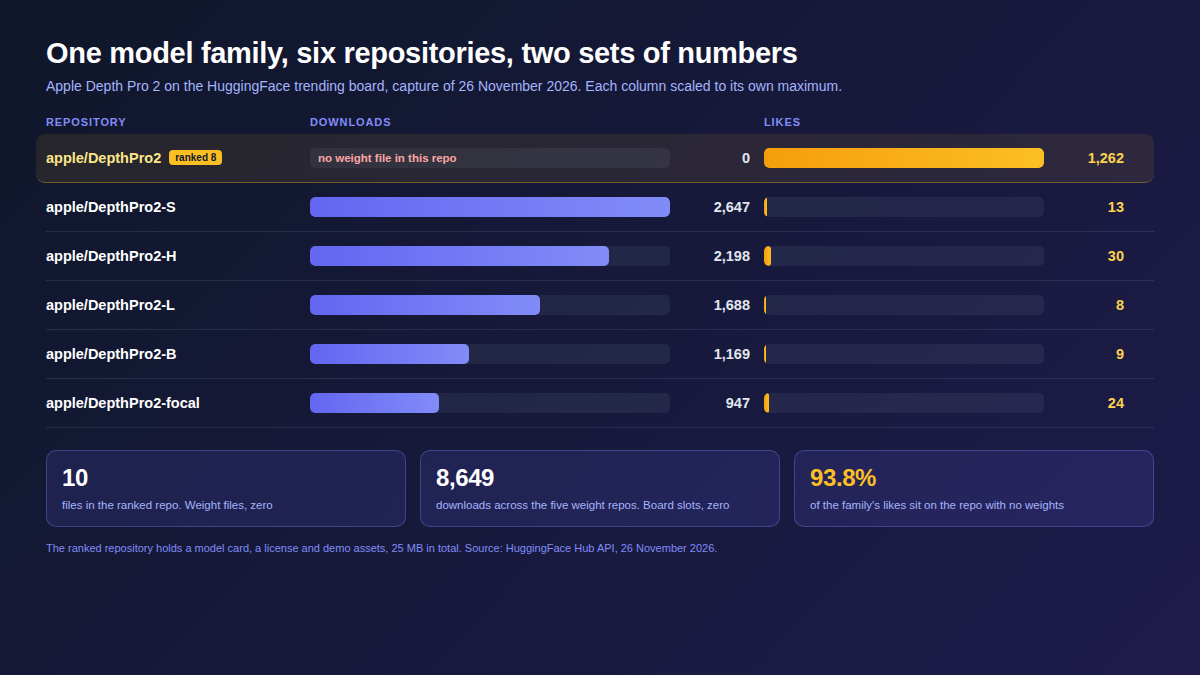
The H model is the clearest case. 872M parameters in a single 3.49 GB safetensors file, beside a 338 byte config. It has 2,198 downloads and 30 likes, and it has never appeared on the board in the 28 days this series has been capturing.
HuggingFace does not count downloads by watching a repository. It watches a few query files. The default list is config.json, config.yaml, hyperparams.yaml, params.json and meta.yaml. A request that hits one of those is a download. A request that hits anything else is not.
DepthPro2 contains no file from that list. Nothing exists for the counter to match on, so it reads zero however many people clone the repository or play the clip. The siblings that carry a config do register. The column is a statement about files, not about people.
That is how a repo holds a top ten slot for six straight captures on a flat zero. It entered at fourteen on 21 November, reached eight by the 23rd, dipped to twelve, and is back at eight. Likes climbed from 139 to 1,262 over the same six mornings. The counter never moved.
Apple’s other entry is FastFrames-L, a 14B autoregressive video model that reached rank three on 20 November. Nine captures later it sits at 25, with 633 likes and zero downloads on every single one.
That repo is not a brochure. It carries 173.5 GB of weight files, including a 28.6 GB diffusion transformer. It also has no query file, and it wants a CUDA 12.8 driver and eight GPUs to benchmark. 633 people liked something almost none of them will pull.
Both cases read the same and mean opposite things. One is a model you cannot download from the ranked repo. The other is a model you can download and probably should not. A zero does not tell you which one you are looking at.
Apple’s 2024 original makes the comparison easy. Depth Pro shipped its weights inside the repository and has 7,020 downloads against 569 likes. The sequel’s five weight repos total 8,649. Demand rose. What moved is the address, and the board keeps ranking the sign on the door.
The check takes a minute. Open the file tree and look for a safetensors or gguf file. Read the card for a table pointing at sibling repos and follow it. Then pull the repo you intend to pin and watch whether the counter moves, because a repo that reports zero while your cache fills is telling you the column is not measuring you.
The board stays a good release detector. It is a poor answer to the question operators are actually asking, which is which artifact goes in the image. Three questions worth carrying. Does the ranked repo hold weights. Does the card send you elsewhere to get them. And does a pull register at all.
Related reading. This series covered the same inversion in naming, when four of thirty slots went to one model family’s rebuilds, and the zero column as a pattern across four repos in one morning.
Get the next one before it is old news
Independent analysis of cloud-native infrastructure, Kubernetes and data center economics. No vendor spin.




[…] reading. This series used the same rank eight slot last week to show how a repo can rank with no weights in it, and traced what happens when a checkpoint reaches the board in six gigabytes of […]