


Executive Summary
AI token prices fell 77 percent between 1 May and 22 October on the index that tracks business spend with Anthropic, from $2.65 to $0.62 per million tokens. Darkbloom, a network that rents out spare Mac hardware for inference, told its roughly 800 participants on 30 October that payouts are unlikely to recover. Median earnings among the top 50 on its own leaderboard run $5.26 a day, about $159 a month.
The mechanism is supply. Output per NVIDIA cluster rose about 20 times this year, and margins wide enough to survive a 90 percent price cut do the rest. Volume now climbs four times faster than spend, so the unit price falls while usage grows. The distributed tier is the first casualty because it has the least room. A GPU lease signed in the spring was priced against a unit that reprices every four weeks.
The message landed in a Slack channel of about 800 people on 30 October. Earnings have been low, a researcher at Eigen Labs wrote, and for most participants they are not coming back. The network is Darkbloom, which turns spare Mac hardware into an inference supplier and sells the output through OpenRouter.
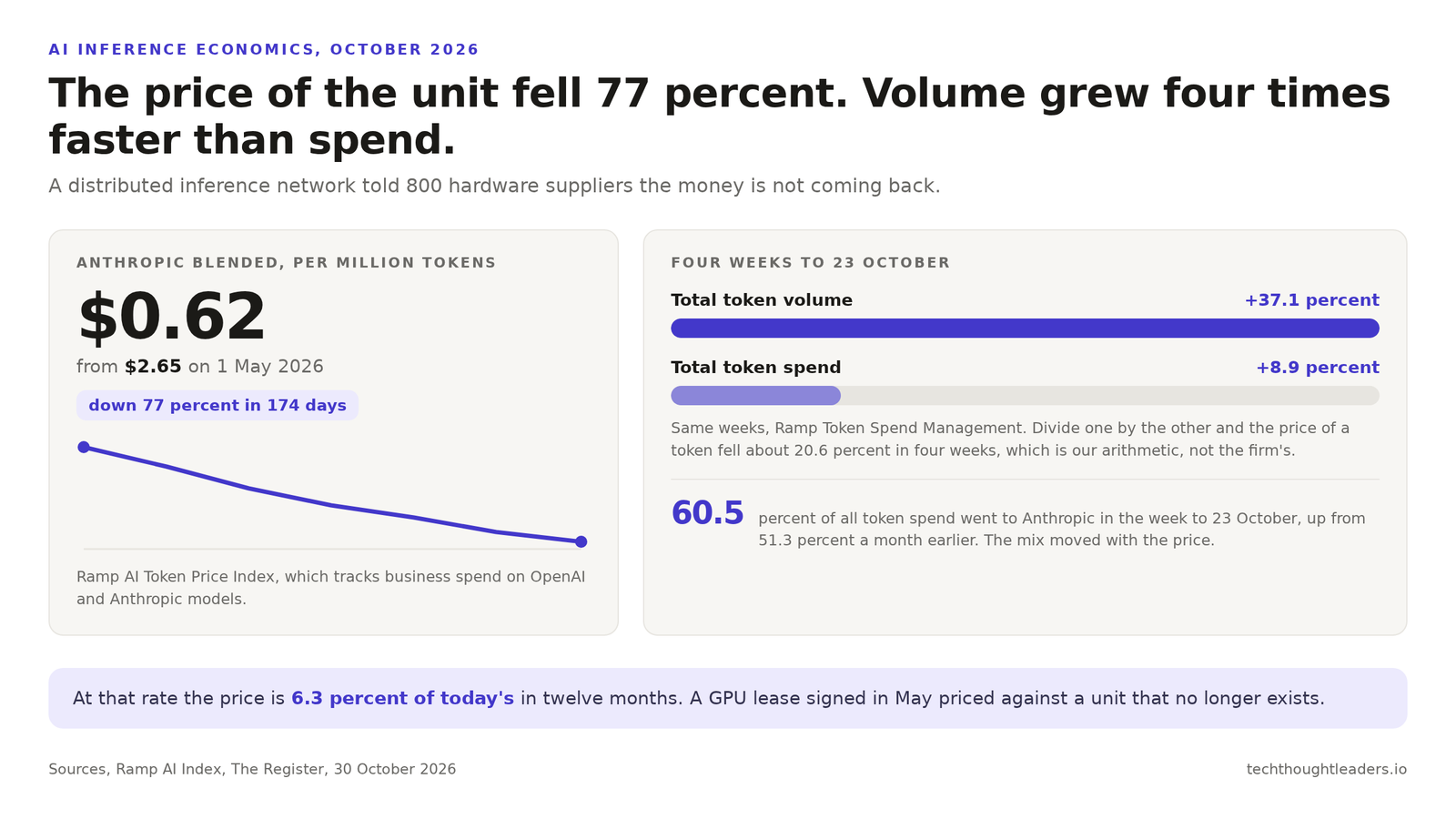
It is a small story with a large number inside it. The thing those 800 people sell, Anthropic tokens, went from $2.65 per million on 1 May to $0.62 on 22 October on Ramp’s AI Token Price Index, which is built from what businesses actually pay. Down 77 percent in under six months.
One cluster now produces about 20 times what it did last year
Kydo, the Eigen Labs researcher, gave the mechanism in the same message. Data centers got cheaper, output per NVIDIA cluster is up roughly 20 times this year, and the margins there are wide enough to cut prices 90 percent and still profit at 50 percent, he told the network. When the cost of production falls that far that fast, the price follows whether or not anyone wants it to.
Falling prices still get read as a fight between model vendors. Some of it is. The rest is throughput. More tokens out of the same GPU hour arrives through better kernels, tighter batching and cheaper cache handling, and each one lands in the price.
Darkbloom’s own estimate shows the ceiling. A Mac mini with an M5 Pro chip and 64GB of memory should earn up to $192 a month at full utilization on one popular open model selling at $0.065 per million input tokens. The median of the top 50 earners was $5.26 a day, about $159 a month. Almost nobody reaches full utilization, and the payout keeps sliding under the plan.
Volume grew four times faster than spend
The demand side makes the same point. Ramp’s data for the week ending 23 October puts volume up 37.1 percent on the same week a month earlier. Total token spend rose 8.9 percent. Divide spend by volume and the effective price fell about 20.6 percent in four weeks. The division is our arithmetic, not the firm’s.
That gap is what the Jevons argument looks like before it works. Cheap tokens are supposed to expand the market enough to keep revenue climbing. Revenue is climbing, at a quarter of the rate of usage. For a buyer that is a gift. For anyone whose business is owning the GPU, it is a reprice every four weeks.
A lease signed in May is priced against a unit that no longer exists
This is where the story leaves the Mac minis. Anyone who underwrote capacity on a revenue-per-token assumption made it in a market that has repriced four times since spring. If the four week rate held for a year, the price would land near 6 percent of today’s. Nobody should plan on that. It points one way, and the lease does not.
The distributed tier is just the first place the mismatch shows. Its participants see a payout daily and can leave, so the failure arrives as a Slack message instead of a renewal negotiation. Ten year contracts discover the arithmetic later, with less room to walk.
What Darkbloom does next is the useful part. It is steering participants toward clusters of high end Mac Studios carrying up to 512GB of memory and wired together with RDMA over Thunderbolt, and toward other work entirely, including distributed CI jobs. Its reasoning is that agents open pull requests faster than pipelines can finish them, which turns a token problem into a sandboxing problem. Compute demand moves to wherever margin lives, and that is no longer plain token generation.
Two things follow. A token price is now a leading indicator for capacity economics. And the cheapest tokens are the ones cached months ago, which is why OpenRouter has moved routing away from price and toward decode speed.
Three questions before your next capacity commitment. What price per token is in the model, and when was it last measured? If it fell another 20 percent next quarter, which line of the plan breaks first? And if generating tokens stopped paying for the hardware, what would you sell instead?
Related reading. llm-d hit 1.0 and the first feature was a fair queue and your 2029 capacity plan is about three times too big.
Get the next one before it is old news
Independent analysis of cloud-native infrastructure, Kubernetes and data center economics. No vendor spin.