


Executive Summary
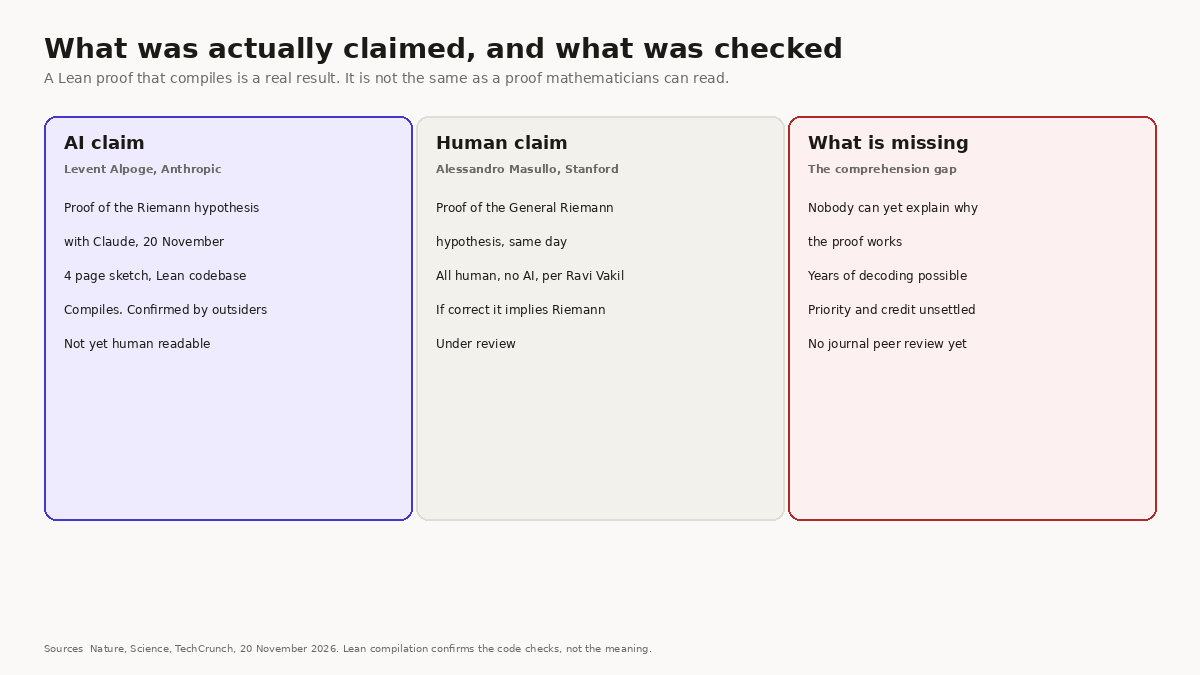
On 20 November Levent Alpöge, a mathematician employed by Anthropic, announced that he and the Claude model had found a proof of the Riemann hypothesis, the most famous open problem in mathematics. The evidence is a four page sketch and a Lean codebase that compiles. Several outside mathematicians, including Andrew Sutherland at MIT, say they have confirmed the compilation.
On the same day Alessandro Masullo, a postdoc at Stanford, posted a proof of the stronger General Riemann hypothesis, described by the president of the American Mathematics Association as all human with no AI. Neither claim has been through peer review. The proof that compiles is not yet a proof anyone can read, and the gap between those two things is now the real story in mathematics.
The Riemann hypothesis, posed in 1859, says something precise about where the zeros of the Riemann zeta function can sit. If it is true, the primes are distributed as evenly as they can be. It is one of the Clay Institute’s Millennium Problems, and a correct proof would carry a $1 million prize and a permanent place in the subject. It has survived every attempt since, which is why the timing of this one matters as much as the content.
What Alpöge claimed, and what Lean actually checks
Alpöge published a four page document on his own site describing the result and the route to it. He says the proof was developed with Claude and formalised in Lean, an open source language in which mathematics is written as code so a machine can check every step. That is a stronger claim than a PDF and a hopeful email, because compilation is mechanical. If the Lean code compiles against the right definitions, the logic is sound. It does not mean the definitions encode the theorem a human intended, and it does not mean anyone understands why the argument works.
That second limit is the one mathematicians keep raising. The formal proof is described as a codebase larger than some operating systems, a heap of machine checked steps with no narrative. Andrew Granville at Montreal said Alpöge should have taken time to write it up clearly before announcing. Maksym Radziwill at NYU put the deeper point, that the purpose of mathematics is understanding why something is true, rather than merely establishing that it is.
Two proofs, one afternoon, and a priority problem
The second claim landed the same day. Ravi Vakil, a Stanford professor and president of the American Mathematics Association, posted a proof of the General Riemann hypothesis by Alessandro Masullo, a Stanford postdoc, and noted that it is all human, with no AI. The General Riemann hypothesis is the stronger statement. If Masullo’s proof holds, the classical Riemann hypothesis follows as a special case.
That creates a credit problem the field has no procedure for. Two proofs of overlapping statements, one formal and machine generated, one conventional and human, released within hours. Priority in mathematics normally rests on publication and community acceptance, and neither has happened. The AI claim has the advantage of mechanical verification and the disadvantage of incomprehensibility. The human claim has the opposite profile. It is entirely possible that both are correct, and it is also possible that one contains a flaw nobody has found yet.
The timing drew its own comment. Anthropic had gone public days earlier at an initial valuation of $1.5 trillion, and the stock fell on 19 November. Alpöge has said he messaged the chief executive on the Sunday night because he felt he could not sit on the result. Granville’s complaint about the write-up is really a complaint about announcement practice, and it is fair. A result this large released as a sketch, days after the employer’s listing, asks the field to do its verification in public and at speed.
The bottleneck is comprehension, not proof search
The wider pattern is now clear. OpenAI’s October result ruled out zeros in a large region and proved the quasi-Riemann hypothesis, a weaker statement. Anthropic’s claim goes further, and both arrived within weeks. Whatever the outcome of peer review, the constraint has moved. Machines can now search proof space faster than people can read what they find, and a compiled proof is a new kind of mathematical object, correct in a sense that no journal currently reviews.
What happens next is unglamorous and slow. Mathematicians will try to extract a human argument from the Lean code, a process that could take years. Journals will have to decide what peer review means for a formal proof nobody can summarise. And the field will have to decide whether a result counts when the author cannot explain it, which is a philosophical question dressed as a procedural one.
The honest summary is that the Riemann hypothesis has two claimed proofs, zero published proofs, and one genuinely new problem. A machine checked proof that compiles is progress. It is not the same as understanding, and the difference is the part that will still be argued about long after the market has moved on from the infrastructure that made it possible.
Sources, Nature, the Clay Institute problem statement, TechCrunch and Alpöge’s announcement.
Get the next one before it is old news
Independent analysis of cloud-native infrastructure, Kubernetes and data center economics. No vendor spin.