
Executive Summary
The network that ties the accelerators inside one AI rack together has been Nvidia’s private territory since NVLink. Arista’s new rack-scale portfolio moves open Ethernet into that same layer, with a design that carries as many as 144 accelerators in a single hop and 1,024 across racks. It was built with AMD, Arm, Broadcom, d-Matrix, Meta, Microsoft and Qualcomm through the Ethernet for Scale-Up Networks initiative inside the Open Compute Project.
The bet behind it is that accelerator choice is breaking Nvidia’s grip. As buyers add Meta, Microsoft, Google and startup silicon, the argument for a proprietary in-rack fabric weakens, and Arista gives an operator a way to buy a rack without buying Nvidia’s interconnect. Ethernet does not match NVLink on every metric yet, and Nvidia sits inside the same coalition. But a credible open product now exists at the one layer that held lock-in in place, and that shifts the position of anyone negotiating for AI capacity.
Nvidia’s tightest hold on the AI rack was never just the chip. It was the short, fast fabric that ties the chips inside one rack to each other. Until this week, no major vendor sold an open replacement for that layer.
Arista moved on it on 7 October, and which layer it picked is the whole story.
Scale-up is the network inside the rack, and it was closed
An AI cluster runs two networks. Scale-out moves traffic between racks and across a data center, and it has run on Ethernet and InfiniBand for years. Scale-up moves traffic between the accelerators inside a single rack, where the coupling is tight and every microsecond lands in the training run. That inner network is where Nvidia’s NVLink sits. Buying an NVL72 rack meant taking Nvidia’s interconnect along with the GPUs.
That is the lock-in. A proprietary fabric ties the accelerator, the switch silicon, the optics and the rack layout to one supplier. Want to add a different accelerator to the rack. The fabric refuses.
Arista shipped a product, not another paper standard
The new platform is Etherlink SU-144. It carries up to 144 accelerators in a single-hop network and reaches 1,024 across racks. Arista offers three shapes, a liquid-cooled orthogonal chassis rated for 100 to 400 kilowatts, a cabled backplane, and a cross-rack system. The separate scale-out fabric runs on Arista’s Netdi diagnostic layer and stacks multiple liquid-cooled 7060EX7 switches at 102.4 terabits per second each. The release carries no price and no ship date, so the openness is a claim until the first racks ship.
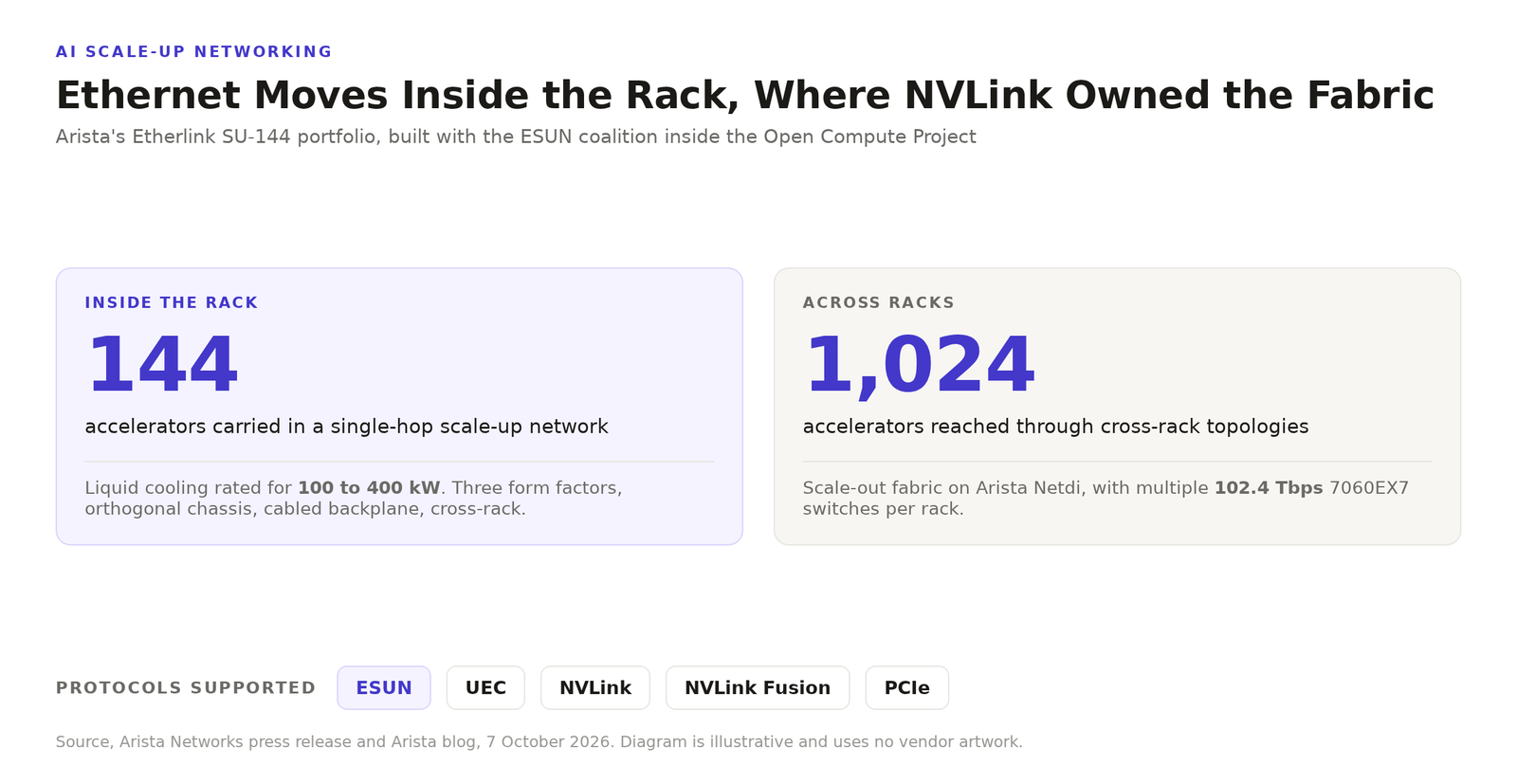
The standard underneath is Ethernet for Scale-Up Networks, or ESUN, a workstream inside the Open Compute Project. Broadcom contributed the transport specification that became SUE-T, and its Tomahawk switch families were built for the same job. Arista’s scale-up Ethernet fabric also follows Ultra Ethernet Consortium standards on the scale-out side. The launch roster reads like a coalition against one company’s defaults. AMD, Arm, Broadcom, d-Matrix, Meta, Microsoft and Qualcomm all signed on, and Arista frames the goal as an open path around proprietary compute islands.
The open fabric still has to win the training job
The honest read is that a standards win is not yet a performance win. Nvidia built NVLink for the hardest collective operations, and operators will not move a large training run onto Ethernet scale-up until it holds up. Nvidia is also a member of ESUN, and Arista’s scale-out layer carries NVLink and NVLink Fusion traffic alongside Ethernet. This is not a clean break with the current market. It is a second option that did not exist before.
Arista has been circling this for months. Chief executive Jayshree Ullal first raised the scale-up ambition on the company’s May earnings call. Vijay Vusirikala, who leads AI systems and networks at Arista, has said the company stayed out because Nvidia’s NVLink owned the segment. The accelerator market has now diversified enough, with Meta, Microsoft, Google and a wave of smaller chip vendors all shipping parts, for a non-proprietary fabric to find buyers.
The pace to watch is optics. Arista is developing open co-packaged optics for scale-up, with trials expected next year and a manufacturing ramp after that. That is the timeline on which Ethernet scale-up either becomes the default in dense racks or stays the cheaper option on the edge of them.
The shift worth naming is in the question buyers ask. For three years the first question at the top of an AI purchase was how to get Nvidia silicon. This week a second one appeared. Can you get the rack without the Nvidia fabric. That question now has a vendor on the other side of it.
Three questions worth putting to your own build. Does your rack design tie your accelerator choice to a single interconnect. If a faster or cheaper accelerator arrives, can it slot into the same fabric. And when your next capacity lands in 2027 or 2028, will the network inside the rack still be someone else’s property.
Related reading. AMD’s Helios racks already lean on Ethernet scale-up. The larger question is whether you buy a rack or a GPU. And the power behind those racks is still 32 gigawatts short.
Get the next one before it is old news
Independent analysis of cloud-native infrastructure, Kubernetes and data center economics. No vendor spin.