

Executive Summary
Cilium 1.20, the second major release of 2026 from the CNCF Graduated networking project, ships two changes that will outlast the feature list. The first is a plugin interface for the kernel datapath, contributed by Google, that lets cloud providers run independently versioned eBPF programs alongside Cilium’s own. The second is a jump from Gateway API v1.4 to v1.6, which adds ExternalAuth, CORS filters, ListenerSets, TCPRoute and UDPRoute, and beta IPv6 allocation through AWS ENI IPAM. More than 1,100 contributors landed the release.
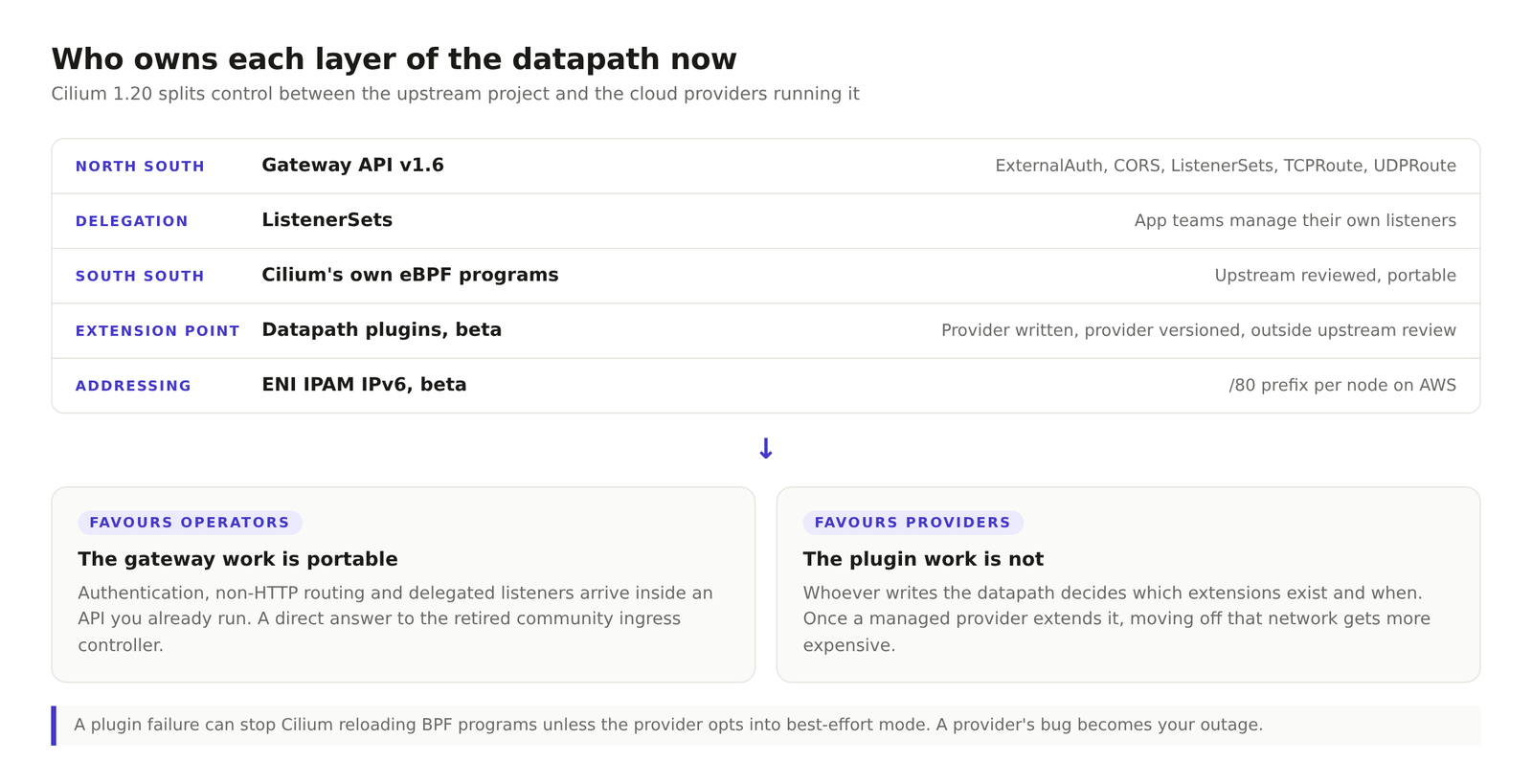
The gateway work favors operators. Platform teams get authentication, non-HTTP routing, and delegated listeners inside an API they already run, which is a direct answer to the retirement of the community ingress controller. The plugin work favors providers. Whoever writes the datapath decides which extensions exist and when they arrive. Cilium’s governance is unchanged. Its center of gravity is not.
Cilium 1.20 shipped with a feature list that reads like a checklist of platform team complaints. The release write-up walks through all of it. One item matters more than the rest. A beta interface now lets someone else edit the datapath.
That is not a feature. It is a transfer of control. It also arrives at the exact moment platform teams are deciding where north-south traffic should live.
The gateway is now a traffic manager, not a doorway
Cilium 1.20 moves from Gateway API v1.4 to v1.6. The upgrade brings ExternalAuth, CORS filters, ListenerSets, and full TCPRoute and UDPRoute support. Plain TCP and UDP services now fit the same routing model as HTTP and gRPC.
Before this, exposing a database, a DNS server, or a game server meant leaving the Gateway API behind. Teams fell back to raw LoadBalancer or NodePort Services. That was the seam where a clean platform story turned into a pile of exceptions.
ExternalAuth closes a different gap. An external service can authenticate and authorize an HTTPRoute request before it reaches the application. Security teams get that check without customizing Cilium’s built-in proxy.
ListenerSets change who is allowed to act. Application teams attach and manage their own listeners while the platform team keeps ownership of the shared Gateway. Delegating that work removes a standing bottleneck between the two groups.
Datapath plugins move the power toward the hyperscalers
Here is the part worth arguing about. Cilium 1.20 adds beta datapath plugins, built by Google. A plugin runs as a DaemonSet, one pod per node, and talks to the Cilium agent over gRPC on a Unix socket.
Cilium calls out to each plugin as it loads a BPF collection, so the plugin can hook in before or after the project’s own programs at a given attachment point. The plugin keeps its own version line. Providers extend the datapath without patching Cilium and without waiting for a release window.
Cilium is the default container network on many managed Kubernetes services. That turns a plugin API into an ownership question. Hyperscalers gain a supported way to differentiate the network beneath their managed offerings, and those networks stop looking identical to one another.
There is a real cost. A plugin failure can stop Cilium from reloading BPF programs unless the provider opts into a best-effort mode. A provider’s bug becomes your outage, and the extension code sits outside the project’s review.
AWS IPv6 parity is the quiet one that unblocks upgrades
One of the last gaps between the IPv4 and IPv6 stories is closed. ENI IPAM mode on AWS can now allocate IPv6 prefixes to pods, as a beta feature. The operator attaches an IPv6 /80 prefix to each node’s ENI through Prefix Delegation, and the agent assigns pod addresses from it.
That feature request sat open for four years. Clusters that already ran dual stack on other platforms had no matching option on the AWS side. Now they do.
ENI mode is what gives pods real VPC addresses, routable without an overlay. Teams that chose Cilium on AWS for that property finally get IPv6 with it.
The Ingress NGINX retirement gave teams a year of warning and then arrived in March 2026. Roughly half of cloud native environments depended on that controller. Cilium 1.20 offers clusters already running the CNI a landing spot for HTTP, TCP, and UDP traffic without adding another control plane.
The plugin work deserves more scrutiny than the gateway work, because it is harder to undo. Once a managed provider extends the datapath in ways upstream never reviews, moving off that provider’s network gets more expensive. Ask your provider what it ships and whether you can turn it off.
Both changes point the same direction. The Kubernetes control plane story is upstream and portable. The datapath story is becoming provider specific. Watch which one your traffic actually depends on.
Where this sits in the wider market
The datapath is one layer of a stack whose layers increasingly fail independently. The AI Infrastructure report walks the four layers under an AI platform and names the specific way each one breaks, from fabric and drivers through to scheduling.
Every announced commitment in this space is tracked with its source in our AI data centre power commitments record.
Related reading. Broadcom Wants VMware to Be Where Your AI Runs. Inside Your Own Walls.. Platform Lock-In Is a Team Decision, Not a Vendor One. Kubernetes 1.37 Is Rebuilding the Scheduler for Accelerators, Not Web Services. AI Infrastructure Runs on Four Layers. Most Break Below the Model..
Get the next one before it is old news
Independent analysis of cloud-native infrastructure, Kubernetes and data centre economics. No vendor spin.
[…] reading. Our look at what Kubernetes 1.37 changed in native histograms, what Cilium handed to cloud providers, and why root on one node is every identity on […]