


Executive Summary
Saskatchewan approved a large AI data centre expansion only after the proponent satisfied rules that most jurisdictions still treat as marketing language. Canadian ownership, a Canadian head office, and Canadian data residency are assessment criteria in the province’s Data Centre Framework, and the Bell project cleared every one of them. The same framework requires applicants to bring their own generation rather than draw more from the public grid.
That combination reshapes what a bid has to contain. A developer with cheap land and patient capital but no sovereignty story and no power of its own never reaches the table. Bell took the trade. It carries the cost and the construction risk of up to 900 MW of non-grid generation, which keeps existing ratepayers out of the financing. Sovereignty used to live in press releases. Here it lives in the conditions of approval, and conditions are far harder to walk back.
Bell Canada and the Government of Saskatchewan signed a non-binding memorandum of understanding on 14 September 2026. The agreement adds up to 900 MW of power to Bell’s AI data centre in the Rural Municipality of Sherwood, outside Regina. At full buildout the campus reaches 1.2 GW. Bell says total capital investment, including tenant compute and the generation behind it, could pass 50 billion Canadian dollars.
Two details in that announcement deserve more attention than the gigawatt number. The power is not coming from the provincial grid, and sovereignty is not decoration on the slides. Both were conditions the province set before it said yes.
Canadian ownership is a gate and not a preference
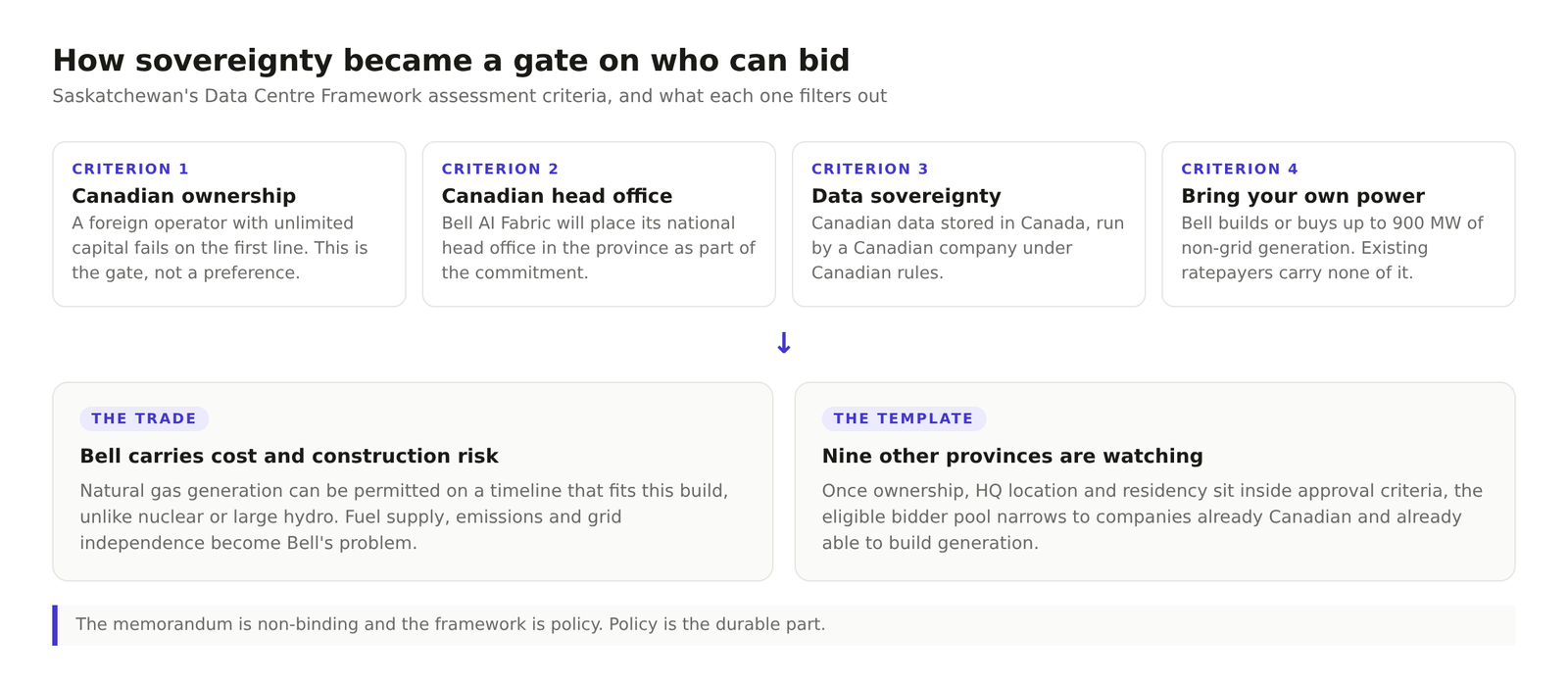
Saskatchewan published its Data Centre Framework on 27 August 2026. It lists six principles for assessing projects. Canadian ownership and a Canadian headquarters come first, followed by data sovereignty, local jobs and partnerships, operating experience, and centralized intake through one provincial office.
The order of that list is the story. The province built the framework while more than 30 data centre applications sat in the queue, so the test is not theoretical. Every one of them now gets measured against the same criteria. A foreign operator with unlimited capital fails on the first line.
The data requirement pushes the same direction. Canadian data will be stored in Canada, run by a Canadian company under Canadian rules. The province also collected an institutional commitment. Bell AI Fabric will place its national head office in Saskatchewan, and the attached backgrounder says up to 10 MW of wholesale capacity would be set aside for SaskTel for provincial data sovereignty work.
Bell owns the power problem and the gas plants that solve it
The 900 MW will not come from SaskPower. Under the province’s Bring Your Own Power principle, Bell has to build or buy the generation itself. The backgrounder ties the expansion to natural gas power production and states that Saskatchewan families and businesses will not pay for that power. Bell carries it.
That moves real cost and real risk onto the developer. Gas generation can be permitted and built on a timeline that fits this build, unlike nuclear or large hydro, and the province keeps its existing ratepayers clear of the bill. The trade is that fuel supply, emissions, and grid independence all become Bell’s problem to manage.
The headline commitment is softer than it reads. The memorandum is non-binding, and Bell’s release carries forward-looking language stating there is no assurance the expansion happens as described. The framework is policy, and policy is the durable part.
The template matters more than the megawatts
Read this as a procurement shift, not a telecom story. Once ownership, headquarters location, and data residency sit inside the assessment criteria, and once self-supplied power is mandatory, the pool of eligible bidders narrows to companies that are already Canadian and already able to build generation. Deep balance sheets stop being sufficient. Bell AI Fabric is selling sovereign capacity as a product line, which tells you where it thinks the demand sits.
Infrastructure buyers in Canada, Europe, and the Gulf should assume the same questions arrive on their next tender. Who owns you. Where is your head office. Where does the data rest. Who supplies the power, and can you prove it without a utility contract. The framework in Saskatchewan asks all four, and the province had enough applicants to be choosy.
The practical read is blunt. Sovereignty language in a vendor deck costs nothing, so ignore it. Sovereignty language inside approval criteria costs everything, because it decides who is allowed to bid at all. Bell cleared that bar by bringing its own electricity and by keeping the head office and the data inside the country. Everyone chasing the same compute demand should expect the same four questions and the same power obligation. Saskatchewan’s framework is worth reading as the first draft of a template other provinces will reach for, and as the clearest sign yet that national control has moved from the press release into the paperwork.
Where this sits in the wider market
Sovereignty and data centre power are the two constraints reshaping enterprise infrastructure at once, and neither is a vendor story. The 2026 State of Enterprise Infrastructure report pulls the public data together, including the sovereign cloud forecast and why grid access now gates where AI capacity can grow.
Every announced commitment in this space is tracked with its source in our AI data centre power commitments record.
Related reading. The VMware Exit Has a Shortlist. Nutanix Just Took a Front Seat.. Data Sovereignty Is Quietly Reshaping Where Cloud Workloads Run. Sovereign Cloud Is Not Data Residency, and the Gap Costs Money. The 2026 State of Enterprise Infrastructure.
Get the next one before it is old news
Independent analysis of cloud-native infrastructure, Kubernetes and data centre economics. No vendor spin.