


Executive Summary
Ant Group’s inclusionAI published Ling-3.2-air on Monday under an MIT license. It carries 124 billion total parameters with 5.5 billion active per token, native image and video input, and a 262,144 token context window. Against its predecessor the gains are real. AutomationBench-AA rises from 15.7 percent to 61, Terminal-Bench 4.0 from zero to 27, and AA-Briefcase picks up 353 Elo points. The model card also prints one number that nobody has promoted, and it is the number to carry into any evaluation.
On Harvey’s legal benchmark Ling-3.2-air passes 87.7 percent of criteria, clears 8.3 percent of tasks outright before the material hallucination check, and 0.8 percent after it. Nine in ten of its clean passes vanish at that step. The gap is the argument for scoring complete tasks rather than counting criteria, and for reading the check configuration before reading the score. The serving recipe is the second constraint. The air tier of the open weight ladder still starts at four 141GB accelerators or eight 80GB cards.
Ling-3.2-air went up on Hugging Face on Monday. The card leads with a 353 point Elo gain, a terminal benchmark that moved from zero to 27, and a legal score of 87.7 percent. Then it prints the number that undoes the third one.
This is Ant Group’s research arm, and the model is the small one in its line. It shares the native multimodal architecture of Ling-3.0-flash-VL, the predecessor the card measures against. Both are 124 billion parameters with 5.5 billion active per token, so 4.4 percent of the weights are awake on any given token. The backbone runs 42 layers, 35 of them KDA and 7 gated MLA at a 5 to 1 ratio, with 512 routed experts and eight switched on per token.
It ships under MIT, with a ModelScope mirror next to the Hugging Face repo. You can host it and keep the artifact.
The legal benchmark splits into three numbers and the last one is 0.8
Harvey’s LAB-AA benchmark scores legal tasks. Every task carries a set of criteria, and each one passes or it does not. The card reports 87.7 percent on that first measure.
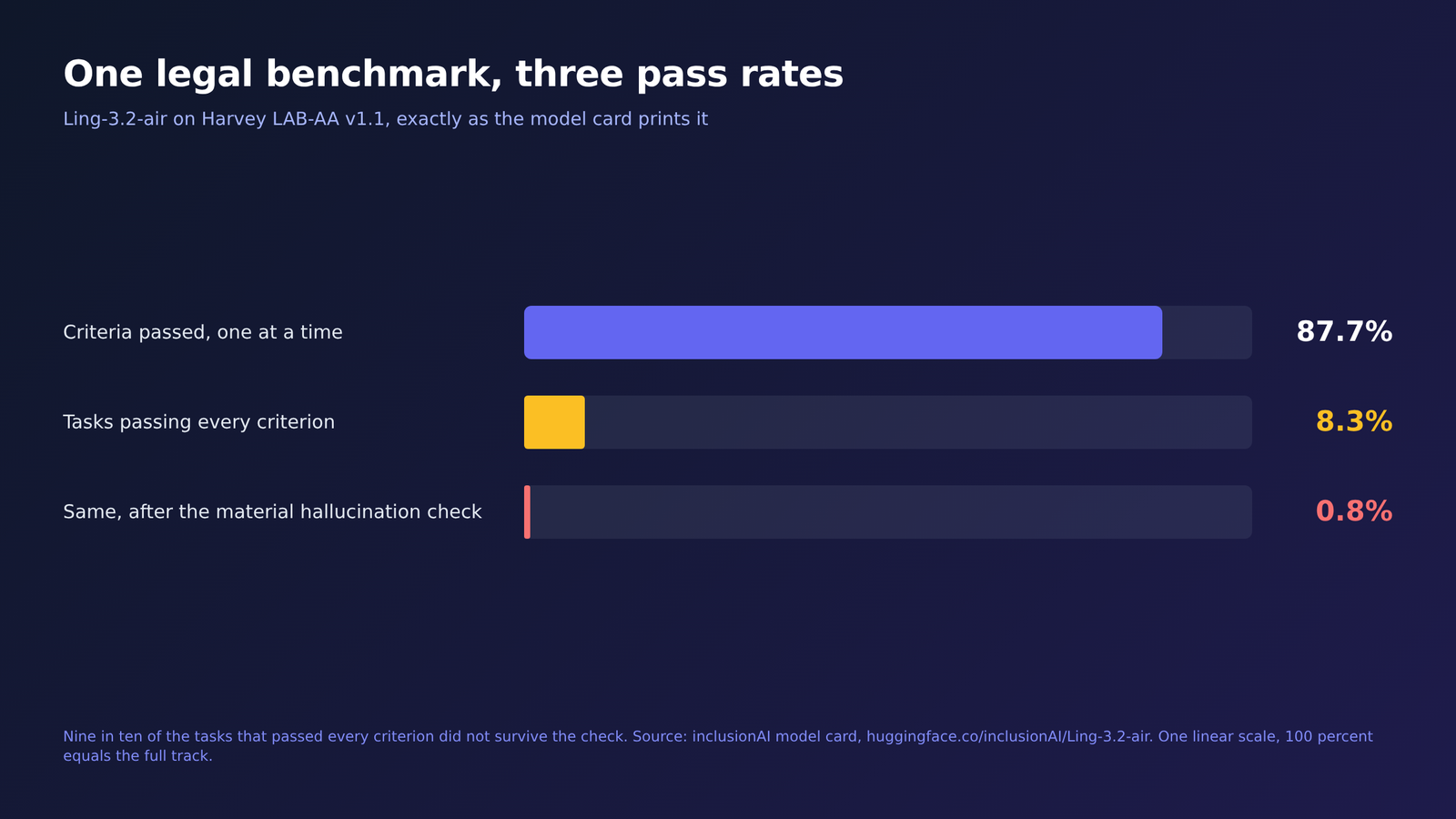
A task only counts as a pass when all of its criteria clear. On that measure the model scores 8.3 percent. The card then adds a third figure, the same all-pass rate after a material hallucination check. It falls to 0.8 percent.
Run the subtraction. Of the tasks that had cleared every criterion, 90.36 percent failed once the output was checked for a material falsehood. Eight tasks in a thousand come back clean.
That is the lab scoring against itself. Counting criteria and requiring a complete task are two measurements of the same run, and here they differ by a factor of 10.6. Add the hallucination check and the spread is 110 times. The eval configuration is a decision, and it moves the number more than the model does.
The air tier still starts at four accelerators
The serving recipe is just as specific. The SGLang day-0 image runs it at tensor parallel 4 across four 141GB-class cards, H20-3e or H200, or across four Blackwell B300 or GB300 nodes, at a 262,144 token context with MTP speculative decoding on. On 80GB H100 or H800 cards the recipe moves to tensor parallel 8.
vLLM works too, but only through a fork. The card points at inclusionAI’s vllm-ling-v3 rather than the mainline release. The MIT license covers the weights and says nothing about the serving stack you need, and the stack is what your team maintains after the model stops being news.
Four 141GB cards for the small model is the honest read on where the ladder starts. On 4 November we covered Kimi K3.1 Pro, whose open weights begin at eight Blackwell Ultra GPUs. Ling-3.2-air asks for half that floor and returns a fraction of the capability. Air means smaller than the flagship. It does not mean small.
The jump from zero is the note worth keeping
Most of the table is a normal generational gain. AutomationBench-AA goes from 15.7 percent to 61, nearly four times the predecessor. The GDP document benchmark lifts its all-pass rate from 8.4 percent to 16. AA-Briefcase climbs 353 Elo points. That is what a better recipe looks like on a smaller model.
Terminal-Bench 4.0 deserves a second read. The predecessor scored zero. This one scores 27. A model that could not complete a terminal task now completes about a quarter of them, and that is a capability appearing rather than a capability improving. It is still not a green light. Seventy-three percent of terminal tasks fail, and the card reports 23 on the Artificial Analysis Intelligence Index without ranking it against anything.
Three questions before you reserve the GPUs. Does your evaluation score criteria or complete tasks, and which of the two did the vendor market? Which check would kill the output if you ran it, and is anything running it today? And who owns the serving fork when the mainline kernel moves, because that cost lands on your team rather than the license?
Related reading. Our piece on why open weights now start at eight accelerators, and the Tencent Hy4 license that stops at fifty million dollars.
Get the next one before it is old news
Independent analysis of cloud-native infrastructure, Kubernetes and data center economics. No vendor spin.



[…] plainly that it must not be used as an independent basis for diagnosis, prescriptions or treatment. The last Ling model we covered looked strong on a legal benchmark until the hallucination check […]