


Executive Summary
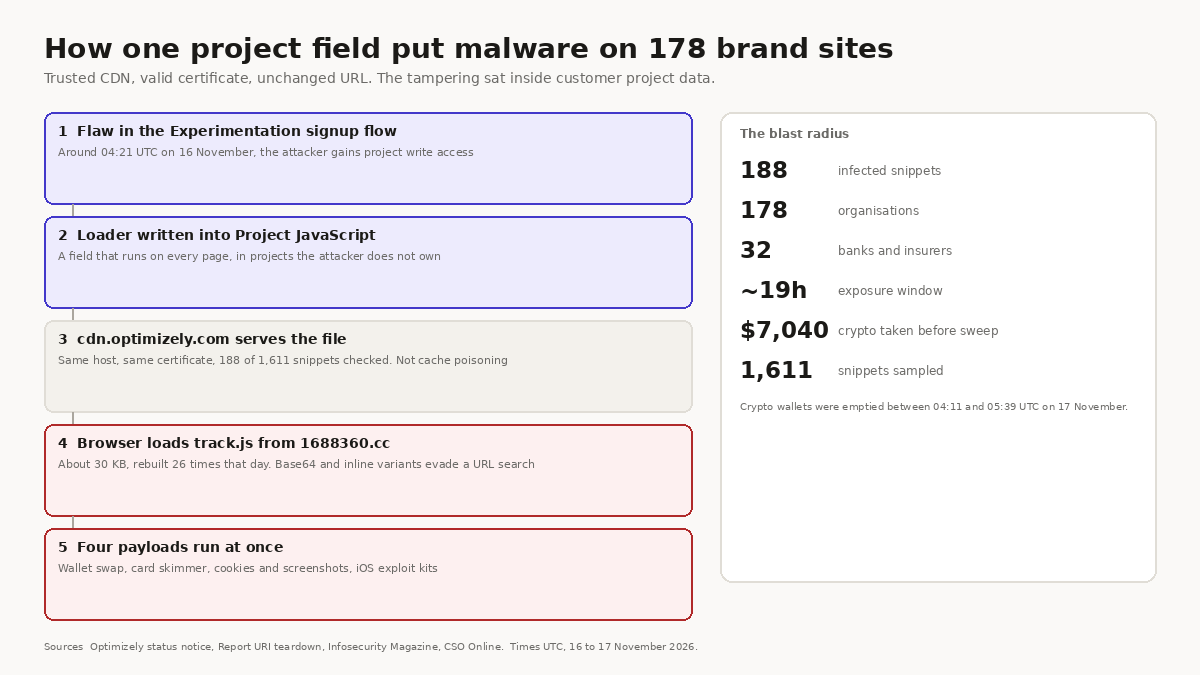
On 16 November a criminal group turned Optimizely’s experimentation platform into a malware delivery system. A flaw in the Experimentation account signup flow let an attacker write code into the Project JavaScript field of customer projects, and Optimizely’s own CDN served the result to visitors of 178 organisations, including the BBC, CNN, Zoom, Salesforce, HSBC and IKEA.
The payload was a general purpose crime kit. It swapped crypto wallet addresses in page text, forms and clipboards, skimmed card details from checkout forms, stole cookies and screenshots, and on older iPhones loaded two exploit kits. Every infected file was clean by 23.11 UTC, about nineteen hours after the first injection. The money taken was small, roughly $7,040. The lesson is not, because none of the victim sites were breached and nothing suspicious ever appeared in the URL bar.
This is the Optimizely supply chain attack, and the detail that matters is where the malicious code lived. Every customer running Optimizely Web loads a JavaScript snippet from cdn.optimizely.com. Inside that snippet sits an optional field called Project JavaScript, custom code a customer writes in the dashboard, which runs on every page before anything else. The attacker wrote a loader into that field across unrelated customer projects. The rest of each file was untouched.
A trusted file that changed after the fact
That is why the usual signals failed. The file still came from Optimizely’s domain, with Optimizely’s certificate, at the URL every site had already allowed. Report URI, which found the campaign, is explicit that this was not CDN cache poisoning. The CDN served exactly what the projects contained. Customers who self-host the snippet, such as Scheels and Vodafone Australia, were affected too, because the content still originates in the same project.
Report URI checked 1,611 snippets and found 188 infected, belonging to 178 organisations. The first injection was seen at 04.21 UTC on 16 November and mass clean-up ran from about 20.40 to 21.10. One snippet, TalkTalk’s, was still infected at 21.52, and everything was clean by 23.11. The payload was rebuilt 26 times during the day. One loader variant hides the payload domain in base64, so searching a snippet for the domain name is not enough. Another carries the whole payload inline and runs it through eval if the domain is blocked. Smartsheet’s snippet was cleaned and then re-infected, which suggests the attacker still had access at that point.
What the kit did, and who it hit
The payload was about 30 KB and ran four modules at once. The wallet swapper only replaced addresses that passed their chain’s checksum, so the replacement was valid and a wallet app would accept it. It rewrote addresses in text, form inputs, links, images, the clipboard, the share sheet and outgoing fetch and XHR requests, and it hooked copy events, so an address copied from an affected page could already be the attacker’s before it was pasted. The card skimmer looked for a card number that passed the Luhn check, a valid expiry and a CVV, and sent them to the payload server. Cards typed into a hosted payment iframe were out of reach, cards typed into the site’s own form were not.
On iPhones and iPads the script checked the iOS version and loaded an exploit chain in a hidden frame. Devices on iOS 13 to 17 got Coruna, iOS 18 got DarkSword, and iOS 26 was fingerprinted only. The kits’ own notes say 18.7.3 and 26.3 and later are patched, which is the advice Report URI gave visitors.
The victim list is a map of the consumer web. Banking and finance accounts for 32 organisations, technology and SaaS 23, retail 20, streaming 12, news and media 10, airlines and travel 9, telecoms 7, crypto and trading 6. The attacker’s wallets received about $7,040 by 19.25 UTC, then were emptied between 04.11 and 05.39 the next morning. One TRON address had been in use since March 2026, which puts this crew on the web long before this campaign. The same actor had run an earlier wave through Kissmetrics, StorifyMe and Minute Media scripts from 13 November, which is the more useful clue than any single domain.
Criminal supply chain, not an AI attack
Some coverage described Optimizely as an AI platform for marketers, and the company does sell AI features. That is not what was exploited. The flaw was in an account signup flow, and the payload is ordinary financial crime tooling. There is no evidence tying this campaign to Google’s report on autonomous AI exploitation, and no evidence tying it to Russia. The reporter who broke the story told CSO Online he believes the attackers were almost certainly Chinese, and Censys assesses with moderate confidence that the operator rented the loader from the seller behind webshell.lol. Attribution is still open, and anyone stating it as settled is guessing.
What is settled is the defensive gap. A third-party script on a bank’s homepage is a supply chain dependency with the same trust as a package in a build, and most organisations cannot say which scripts run on their pages, let alone what changed in them overnight. Optimizely says the vulnerability is fixed, sessions and tokens were revoked and customers were notified, but it has not explained how a signup flaw gave write access across unrelated projects. That answer matters more than the IOC list. The separate Google finding on autonomous exploitation is a different threat with a different actor, and the infrastructure layer that hosts these scripts deserves the same inventory discipline as the servers behind it.
Sources, the Optimizely incident notice, Report URI’s teardown, Infosecurity Magazine and CSO Online.
Get the next one before it is old news
Independent analysis of cloud-native infrastructure, Kubernetes and data center economics. No vendor spin.