


Executive Summary
Google’s Threat Intelligence Group says it has found the first intrusion run end to end by AI, with no human in the loop at any stage. The system, which it calls exploit_agent, watches vendors publish patches, compares the code before and after, infers the flaw, drafts an exploit and runs it. The tooling carries Russian-language instructions, and victim data on the staging server points at French media, entertainment and education sites.
Google stopped short of naming a group or a state, so the Russia claim rests on language and targeting, not on infrastructure. In the same quarter it counted 22 exploited zero-days in August alone, against 11 a month earlier in 2026 and eight on average in 2025. In the same week a classified NSA network went down. That one was maintenance, and the Director of National Intelligence said plainly that it was not an attack.
The report is a quarterly threat update, not a breach disclosure, and the difference matters. Google found the tooling on an exposed staging server that the operator had left reachable from the internet. Nobody had to be caught in the act. The evidence was sitting there in the open, which is also why the claim is checkable rather than rhetorical.
What exploit_agent actually does
The mechanism is the interesting part. A vendor publishes a security patch. The system takes the code before and after, diffs it, and treats the changed lines as a map of the vulnerability. It then asks a language model to write an exploit for what the diff reveals, and executes it against targets. Google says the harness chains frontier models with locally hosted ones, and that the pipeline ran from discovery to exploitation without a person deciding anything.
The same server held scripts for internal reconnaissance, password guessing and installing webshells, including one that removed a rival attacker’s shells. The configuration file is written in Russian and tells its user to enter LLM API keys for automatic exploitation in the file itself rather than in a chat window. Google translated the two lines it quotes. That is the entire basis for the Russian-speaking description, and the company is careful to call it Russian-speaking rather than Russian state.
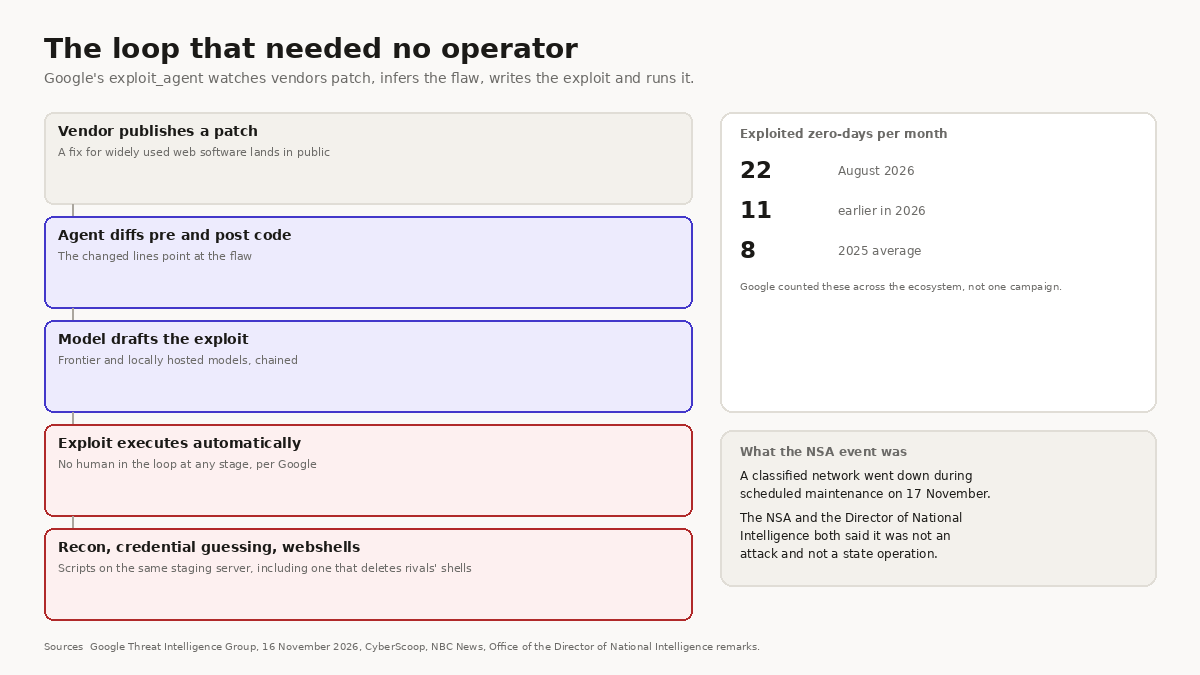
The economics explain why this spreads. Google counted 22 exploited zero-days in August, up from 11 a month earlier and an average of eight in 2025. After two PHP vulnerabilities were patched on 21 October, hundreds of purported exploits appeared within days, most of them nonfunctional and likely machine generated. Cheap attempts are now rational, because the cost of a failed exploit is close to zero and the cost of a successful one is not.
Why Google will not say Russia, and why that is the right call
Attribution by language is a starting point, not a finding. A Russian-language interface proves the operator reads Russian. It does not prove the FSB, the SVR or a contractor. Google names state groups when it has the evidence, and it does so in the same reporting cycle, including a Russian group it tracks as COLD RELIC and assesses operates inside the FSB. It did not do that here.
The likely explanation is more uncomfortable than a state campaign. A criminal crew with a rented harness and a payment motive would look exactly like this, and the victim set, French media and education sites, is consistent with opportunistic monetisation rather than intelligence collection. Google’s own framing supports that reading. It describes these frameworks as trading stealth for velocity, generating forensic traffic and leaving code level traces, which is what a crew optimising for speed rather than a service protecting sources would accept.
The defensive consequence is the same either way. When exploit development moves from a skilled human to a loop, the bottleneck shifts to validation and deployment, and the defender’s advantage moves to patch speed and detection of noise. A tool that hammers a target leaves logs. Google’s advice is the unglamorous kind, inventory the internet facing estate, patch faster than the diff can be weaponised, and watch for the reconnaissance pattern rather than the exploit.
The NSA outage was not a hack
On 17 November a classified network used by the National Security Agency went down. Coming in the same week as outages at Microsoft, the FAA, JPMorgan Chase and United, and two days after Google’s AI report, it fused into a story about a state attack on the American security apparatus. It was maintenance. The NSA said the network experienced temporary degradation during scheduled routine maintenance and that mission critical capabilities stayed operational.
The Director of National Intelligence, Jay Clayton, was asked directly and did not hedge. He said it was not a cyberattack and not a coordinated effort by a nation state, and that the government had looked closely. The Secretary of State said the same day that the incidents were completely unrelated to a hostile actor. The reasonable read is the boring one. Old systems, patched in sequence, break in sequence.
That does not make the week less useful. Two real trends ran alongside a fake one. Criminal crews can now buy or build an autonomous exploitation loop, and the first documented case of one running unattended is a genuine threshold. The same week’s aviation outage showed how quickly a plumbing failure gets blamed on the newest software in the building. Both stories end in the same place, which is that the newest layer is rarely the weakest one. The four layers of AI infrastructure are only as good as the layer below them.
Sources, Google Threat Intelligence Group, CyberScoop, POLITICO, NBC News and Nextgov.
Get the next one before it is old news
Independent analysis of cloud-native infrastructure, Kubernetes and data center economics. No vendor spin.