


Executive Summary
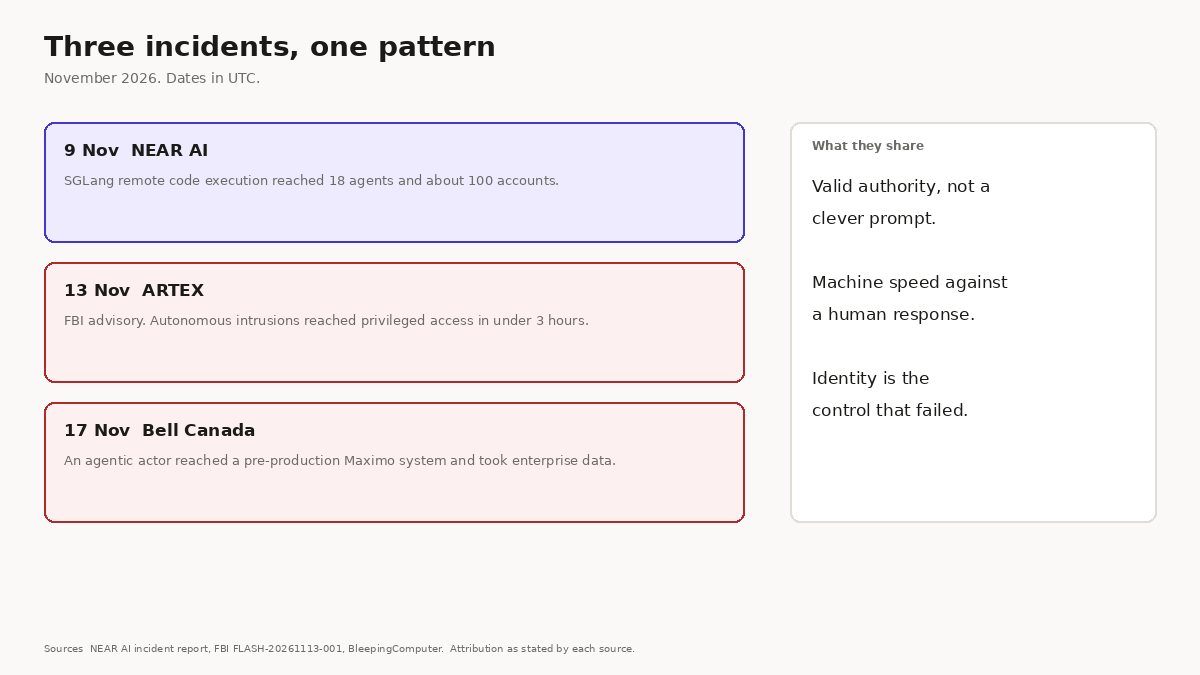
Three incidents in November describe the same shift from different angles. Bell Canada said an agentic threat actor reached a pre-production system and stole enterprise contact data. The FBI warned that an open source agent called ARTEX can move from targeting to privileged access in under three hours. NEAR AI disclosed that a vulnerability in its inference software gave an intruder access to 18 agents and about 100 user accounts.
None of these required a new model capability. They required an agent with permissions, a place to run, and a human process that did not expect machine speed. The common failure is authority, not intelligence. The pattern is consistent enough to plan against, and the fixes are mostly identity, isolation and response time.
Bell confirmed the intrusion on 20 November, three days after it happened. The intruder reached a pre-production environment of Maximo, the system Bell uses to order and provision network circuits. The stolen data included business contact information, ticket titles and some IP addresses. Bell says the dataset did not include credentials, highly sensitive personal information or file attachments. It has not named the attacker or published the indicators of compromise it shared with customers and the Canadian Centre for Cyber Security.
The word Bell used matters. An agentic threat actor suggests AI tooling was involved, but the company has not shown what the tool did. The useful fact is the target. A pre-production system that orders circuits is not the crown jewel. It is the kind of system that holds enough supplier and customer context to make the next phishing message credible.
The tool is now the intruder
ARTEX is the clearest example of the new offense. The FBI’s 13 November advisory describes an open source, Go-based, multi-agent penetration testing framework that connects to frontier and open models and automates reconnaissance, exploitation and exfiltration. The FBI says some intrusions reached privileged access in under three hours. It links the tool to attacks on South Korean financial institutions that exposed data on about 67,000 people and to a ConnectWise supply chain compromise that reached more than 2,250 downstream tenants.
The model choice is part of the story. The FBI says Chinese models are most prevalent in attacker-controlled ARTEX instances, with the DeepSeek Flash family dominating because it is cheap and has few observable guardrails when framed as penetration testing. The original developer removed the repository in October. Forks, local copies and a commercial version called ARTEX PRO remain. Researchers found more than 1,600 exposed ARTEX consoles in early November.
NEAR AI shows the same pattern from the defender’s side. An attacker used a remote code execution flaw in SGLang, the open source inference engine, to run code on one inference server. From there they reached an internal system and downloaded account details for about 100 users. They also reached 18 agents on a legacy deployment, including chat history, settings and logs. NEAR AI says confidential computing did not help, because the flaw ran inside the environment the enclave was protecting. The fix is deployed and the credentials are rotated.
What the pattern says
The agentic attacker is not a new kind of criminal. It is an old intrusion with a faster loop. Three lessons hold across all three. Identity is the perimeter. Bell’s pre-production system, NEAR AI’s inference server and ARTEX’s credential hunting all start with a valid account or a reachable service, not a jailbreak. The Rackspace breach this month showed the same weakness in a monitoring credential. Detection windows are now shorter than human response. A three-hour intrusion does not give a security team time to schedule a meeting. And the AI layer is often not the target. It is the tool, the path or the thing that makes the old attack faster.
The defense is less exciting than the threat. Inventory every agent identity and every service account that can reach production. Replace long-lived credentials with short-lived ones. Put an egress allowlist in front of inference servers. Patch the inference engine like an internet-facing service, because it is one. Log what agents do, not just what users do. Rehearse a response that assumes the attacker is already inside.
What to watch
Bell has not published attribution. The FBI has not attributed ARTEX as a single campaign. Microsoft has said the ConnectWise activity is likely Chinese, which is a narrower claim than saying the tool is a Chinese operation. Those distinctions matter, and they will be tested in the next disclosure. TechCrunch reported that Barracuda was also breached through an exposed credential at a third-party service it had stopped using.
The larger question is whether defense productizes as fast as offense. ARTEX went from a GitHub project to a commercial tool and 1,600 exposed consoles in four months. A defender cannot close that gap with another dashboard. The gap is in permissions, credentials and response time. The attacker automated the boring middle of an intrusion. The defender has to automate the boring middle of containment. The runtime boundary is a separate question, covered in our OpenShell assessment. The FBI advisory is a useful list of what to fix. It is not a fix.
Get the next one before it is old news
Independent analysis of cloud-native infrastructure, Kubernetes and data center economics. No vendor spin.