

Executive Summary
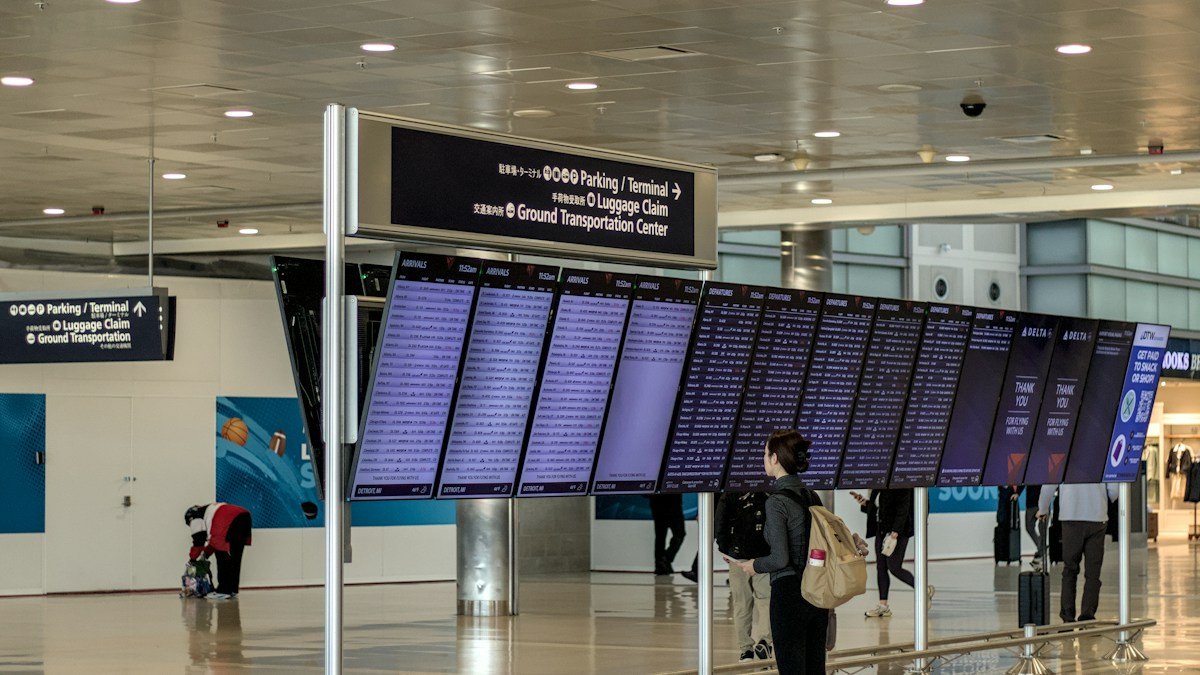
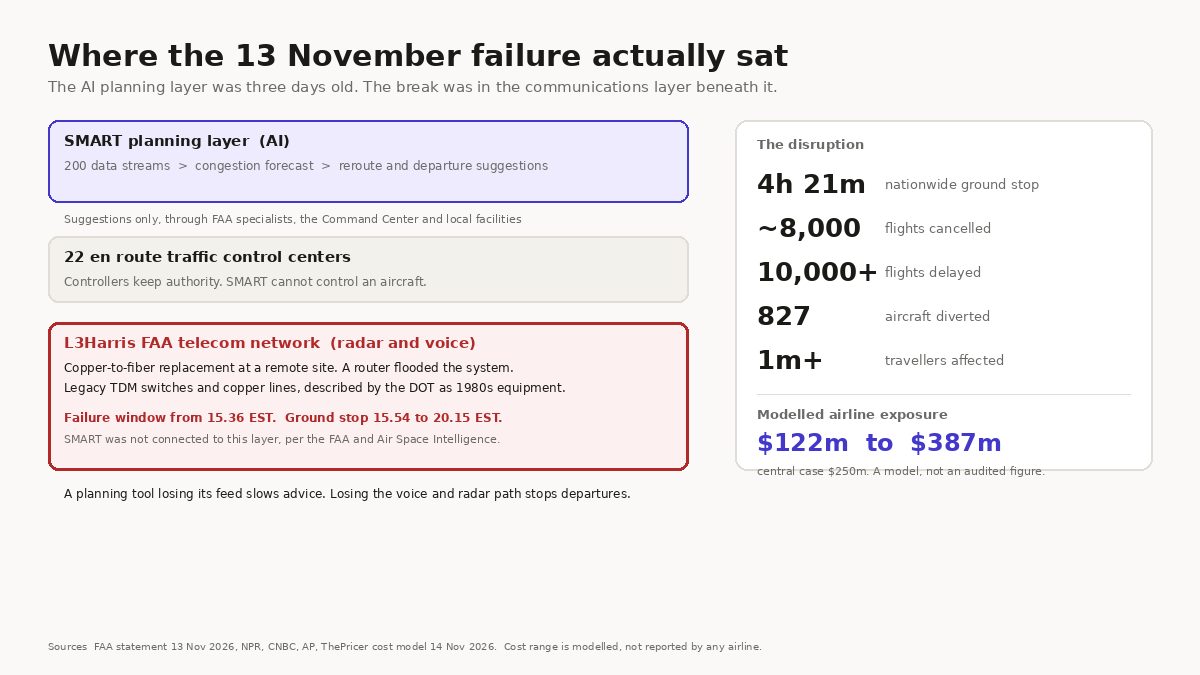
At 3.54 p.m. Eastern on Friday 13 November, the FAA stopped every departure in the United States. The halt lasted four hours and twenty-one minutes. About 8,000 flights were cancelled, more than 10,000 were delayed, 827 aircraft were diverted and potentially more than a million travellers were affected. It began three days after the agency switched on an AI planning system across all 22 air route traffic control centres.
The AI did not cause it. Officials trace the failure to a router in the L3Harris telecom network that carries radar and voice, flooded during a copper-to-fiber replacement at a remote site. The timing made the AI the story anyway, and that is the useful part. A planning layer cannot be more reliable than the plumbing beneath it, and that plumbing still runs on what the transport secretary calls 1980s copper.
The order went out at 20.54 UTC from Chicago, first to O’Hare and Midway and then to every airport in the country. Aircraft already in the air were allowed to continue to their destinations. Aircraft on the ground, at every gate and on every taxiway, were told to stay there. The last time that happened was January 2023, when the system that distributes notices to pilots failed. Before that it was September 2001.
Four hours that emptied the gates
By 9 p.m. Eastern, FlightAware counted more than 7,000 cancellations and 8,000 delays, figures that kept climbing into the weekend. Cirium tracked 827 diversions, of which 670 aircraft returned to the airport they had left and 157 landed somewhere else. The Department of Homeland Security said more than 3,000 flights were brought down safely and that no one was in danger. That is the part that worked.
The part that did not work was everything after the landing. Crews stuck on the ground burn duty hours, so a pilot who was scheduled to fly from New York to Miami on Friday night can be out of legal hours before the stop lifts. The aircraft then has to be crewed by someone else, and the flight that pilot was due to operate out of Miami on Saturday needs a replacement too. That is how a four hour stop becomes a two day recovery. About 2,000 flights were cancelled on Saturday, and the FAA’s administrator said the schedule should be normal by the end of Sunday, four days before the Thanksgiving rush.
International departures to the United States were suspended from 5 p.m. to midnight Eastern. Mexico’s civil aviation agency told US-bound aircraft to stay on the ground. Gates filled at every hub, some inbound flights were sent to smaller airports, and Amtrak reported abnormal traffic as stranded passengers looked for a train. Professional and college sports teams reorganised travel, some by bus. The visible experience was queues and departure boards turning red, and it fell on a Friday evening in the middle of pre-Thanksgiving travel.
What four hours on the ground costs
No audited total exists, and any single number should be read as a model. The most careful published attempt, from ThePricer on 14 November, puts airline exposure between $122 million and $387 million with a central case of $250 million. It borrows the only detailed US benchmark available, Delta’s 2024 disclosure after the CrowdStrike outage, when 7,000 cancellations over five days produced $380 million of lost revenue, $170 million of extra expense, $50 million of saved fuel and a net impact of at least $500 million. It then applies an industry operating cost of $98.41 per aircraft block minute. That rate covers flying and taxiing, not an aircraft sitting at a gate, so the model is an order of magnitude guide rather than a bill.
Passenger time is separate and larger in human terms than in cash terms. One published illustration applies $47 per passenger hour to 375,000 people losing two hours, which produces $35 million, or $106 million if 750,000 people lose three hours. Add hotels, meals, ground transport and missed connections and the unreimbursed total rises again, though much of it lands on airlines rather than travellers. In the United States a ground stop does not trigger automatic cash compensation. Airlines rebook, and sometimes pay for rooms, because their contracts and their reputations require it.
The knock-on cost is the one that does not appear in the model. Canadian carriers cancelled 720 flights, Air Canada alone put 23,000 customers on other plans, and an aviation lecturer at McGill put the recovery cost at millions with normal operations not expected before Tuesday. Cargo operators began contingency planning, because a missed air freight connection is a production line problem for someone. Airline shares fell on Friday. None of this includes the federal repair bill, which has not been published.
The AI was the alibi, not the cause
The system under suspicion is SMART, the Strategic Management of Airspace, Routes and Trajectories tool built by Air Space Intelligence under a 12 year, $875 million FAA contract. It reads about 200 data streams, forecasts congestion and recommends routes and departure times. It does not talk to aircraft. Its suggestions pass through FAA specialists in Washington, then the Command Center in Warrenton, then the 22 en route centres, where local leaders accept or decline them. The FAA says it cannot control an aircraft, and the company says the ground stop was not based on SMART or any of its products.
The timeline is what made the question fair. SMART ran in limited mode around Washington from 21 September, where the FAA says it rerouted 180 flights and saved about ten minutes and 80 gallons each, a result published without a methodology. On 10 November it went live across all 22 centres. Three days later, every departure in the country stopped. Members of Congress had already written to the FAA in October asking it to pause the rollout until safety and oversight were demonstrated, and the controllers’ union had complained about how little involvement it had.
What officials now describe is more mundane and more damning. L3Harris, which runs the FAA telecommunications network, was replacing copper with fiber at a remote site. A router flooded the rest of the system, producing intermittent radar and communications gaps from about 15.36 Eastern. The transport secretary described old switches, old routers and 1980s copper lines that went down everywhere at once. The homeland security secretary said new equipment was overwhelming the older system, then said there was no evidence of an attack. The investigation is open, and the honest position is that the AI is cleared by architecture rather than by audit. A planning tool losing its feed slows advice. Losing the voice and radar path stops aeroplanes.
That distinction matters more than the blame. The FAA has been given $5 billion for air traffic control under the 2021 infrastructure law and $12.5 billion in the 2025 budget bill, and the transport secretary used the outage to ask Congress for $50 billion more. The money is being spent in the same decade as the AI rollout, on the same estate. A model that recommends a better route is worth little if the link that carries the recommendation is a copper pair installed before the people running it were born.
The test after Thanksgiving is not whether SMART is safe. It is whether the modernization programme treats the network as the product and the AI as a feature on top of it, or the other way round. The four layers of enterprise AI infrastructure make the same point in a data centre, and the 2026 infrastructure report finds the same pattern of new workloads landing on old foundations. The FAA statement is three sentences long and does not mention AI at all. Three days of proximity did the rest.
Sources, NPR, CNBC, the incident record and the cost model.
Get the next one before it is old news
Independent analysis of cloud-native infrastructure, Kubernetes and data center economics. No vendor spin.